
 Stone Cutting Machines
 Stone Polishing Machines
 Bridge Saw Machines
 Stone Quarry Cutting Machines
 Stone Block Cutter Machine
 CNC Stone Wire Saw Machine
 Stone Engraving Machines
 Thin Stone Veneer Saw Machine
 Horizontal Stone Slab Splitting Machine
 Stone Edge Polishing Profiling Machine
 Stone Auxiliary Equipment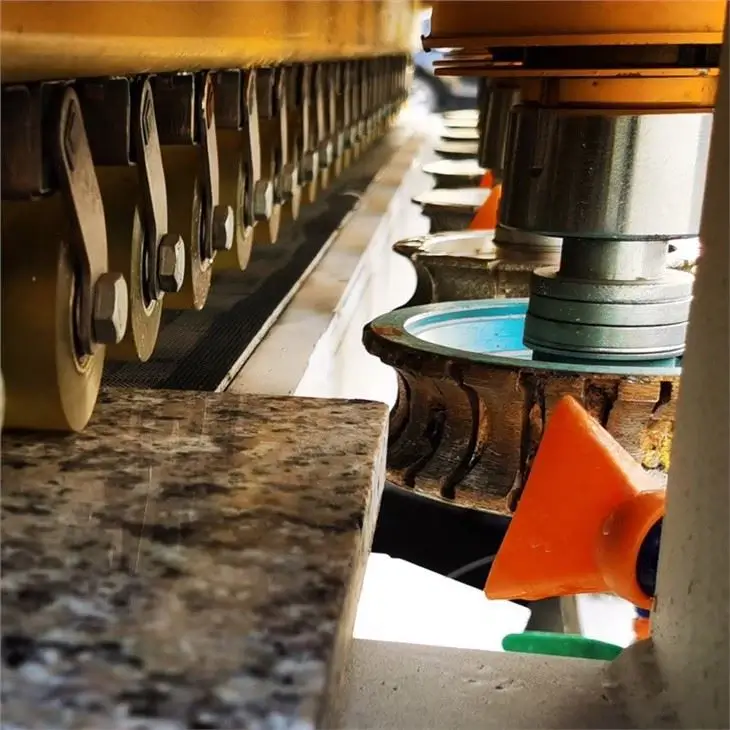
In the realm of advanced stone fabrication, achieving a flawless, mirror-like finish is not the result of chemical magic; it is a precise mathematical reduction of Surface Roughness (Ra). The Natural Stone Institute (MIA) defines high-quality stone edge gloss meter readings entirely by the surface’s ability to perfectly reflect light without distortion. This is accomplished through a relentless, microscopic relay race. The deep scratches left by a coarse grinding wheel must be systematically erased by the next, progressively finer grit. When machine operators become impatient and attempt to accelerate feed rates by “skipping grits” on their automatic edge polishers, the underlying structural trauma remains unhealed, exposing ugly “pigtail scratches” when the countertop is installed under bright ambient lighting.
A high-capacity residential countertop fabricator in Sydney, Australia, experienced this precise catastrophe. In an attempt to push their automatic multi-head line to a dangerous feed rate of 3 meters per minute, the floor manager bypassed the crucial 400# and 800# honing stages, attempting to force the 1500# resin pad to erase the severe gouges left by the 200# wheel. The result was a catastrophic failure: gloss levels flatlined at a dull 60 degrees, and the intense friction of over-working the fine 1500# pads caused them to melt and disintegrate within 72 hours—a set that should typically last two weeks. MosCut application engineers intervened, recalibrating the factory’s standard 1-to-14 spindle sequence and adjusting the pneumatic cylinder pressure matrix. By adhering strictly to the perfect grit sequence, the facility immediately restored 95-degree finishes while simultaneously doubling their abrasive tooling lifespan.
🚨 The Golden Rule of Abrasives
Polishing pads do not inherently “add shine” to the stone; they systematically remove the microscopic peaks that scatter light. Every single spindle on an automatic edge polishing line serves a singular purpose: to remove the scratch pattern left by the preceding wheel. The golden rule of high-end fabrication is absolute: Never skip a grit. Attempting to save a few dollars on a polishing pad will cost you hundreds of dollars in ruined wheels, rejected slabs, and unhappy commercial clients.
Stage 1: Aggressive Profiling & Calibrating
Establishing the architectural geometry and absolute linear thickness.Target Grits: 30#, 50#, 100#.
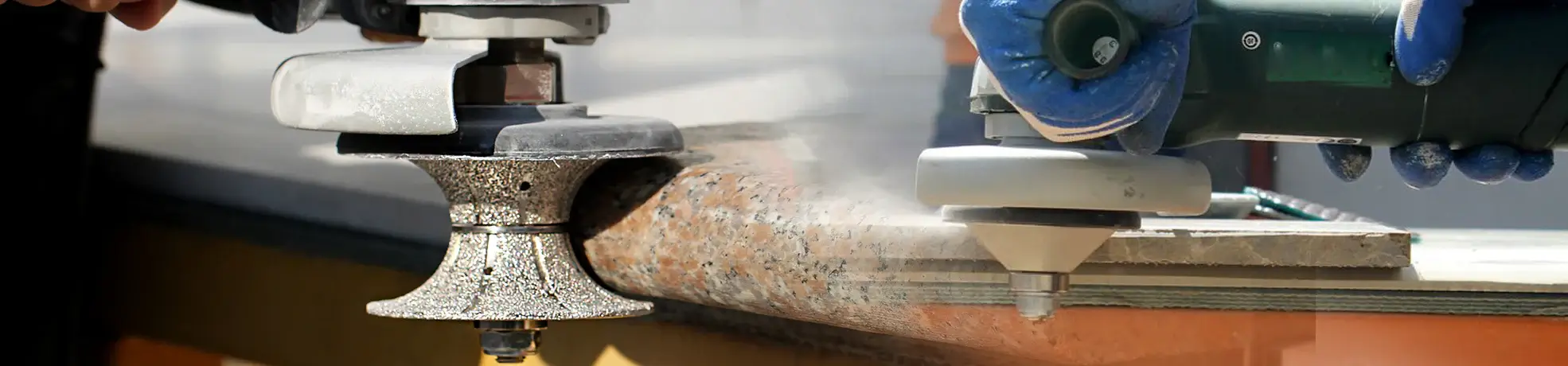
Tooling Matrix: These primary heads must utilize heavy-duty Metal-Bonded Diamond Edge Profiling Wheels. The metal matrix is rigid enough to endure the violent resistance of tearing through thick granite or engineered quartz without losing its shape.
Operational Parameters: This stage executes the heavy lifting—milling a blunt 90-degree edge into a sweeping Full Bullnose or an intricate Ogee profile. The PLC system should apply maximum pneumatic downforce (typically 2.5 to 3.0 Bar) and extreme hydro-cooling to flush out heavy stone chips.
Stage 2: The Honing Transition
Erasing the trauma of the profiling wheels and closing the stone’s pores.Target Grits: 200#, 400#.
Tooling Matrix: Transitioning to semi-metal or hard Resin-Bonded Polishing Pads.
Operational Parameters: By the time the stone reaches this sector, the architectural shape is completely formed. The exclusive job of the 200# and 400# pads is to act as a heavy eraser, scouring away the deep, horizontal saw marks left by the 100# metal wheel. The stone will emerge with a smooth, closed-pore, matte “Honed” finish. If this transitional stage is poorly executed or skipped, the underlying trauma remains, rendering any subsequent mirror polishing completely impossible.

Stage 3: The Mirror Polish & Ultimate Buff
Manipulating micro-pressure and high-grit resin to bend light flawlessly.🎨 Grit 800-1500: Color Activation
Using soft resin matrices, pneumatic pressure is scaled back to a delicate 1.5 Bar. At this stage, the mechanical abrasions are so microscopic that they cease to scatter light erratically. The deep, natural color (or quartz pigments) and inherent veining of the stone begin to aggressively emerge from the matte finish.
🪞 Grit 3000: Glass Reflection
The final true diamond abrasive step. With an ultra-fine 3000# resin pad, the edge transitions into a highly reflective glass-like state. You will immediately notice crisp, unbroken reflections of the factory overhead lights bouncing off the edge. Gloss meters will register at a highly respectable 80-85 degrees.
✨ The Buff Pad: Ultimate Gloss
The Buff pad (Black or White) contains little to no diamond cutting elements. For natural stone like granite, it utilizes micro-friction to generate localized chemical heat, slightly melting and sealing the mineral pores. This forces the final gloss meter reading to spike beyond 90-95 degrees, delivering the ultimate luxury shine.
Troubleshooting: The Cost of Skipping Grits & “Glazing”
Diagnosing the two most common operator errors on the polishing line.🌀 The “Pig-Tail” Scratch Phenomenon
If you mistakenly drop the 400# pad and jump straight from 200# to 800#, the microscopic diamond abrasive points on the 800# pad are physically too small to reach the bottom of the deep trenches dug by the 200# wheel. They only polish the “peaks” of the scratches. The edge might look shiny from a distance, but under direct LED kitchen lighting, it will reveal a chaotic web of swirl marks and “pigtail” scratches embedded deep in the surface.
🧊 Abrasive Glazing (Pad Slippage)
When polishing extreme-density materials like quartzites, or if the pneumatic pressure is set far too low, the resin pad fails to fracture. Instead of constantly exposing fresh, sharp diamond points, the surface of the pad melts slightly and hardens into a slick, blunt “glaze.” Once glazed, the pad stops cutting entirely and merely rubs the stone, generating massive heat and threatening to burn the slab. Operators must immediately run a dressing stone (firebrick) against the spinning wheel to break the glaze and expose fresh diamonds.
Deploy the Ultimate Polishing Matrix in Your Facility
Stop guessing your abrasive sequences, wasting expensive tooling, and delivering subpar edges. Maximize your factory’s output quality with MosCut’s precision automatic edge polishers, designed to execute the perfect grit sequence every single time.
Explore Our Full Edge Polisher Lineup