
 Stone Cutting Machines
 Stone Polishing Machines
 Bridge Saw Machines
 Stone Quarry Cutting Machines
 Stone Block Cutter Machine
 CNC Stone Wire Saw Machine
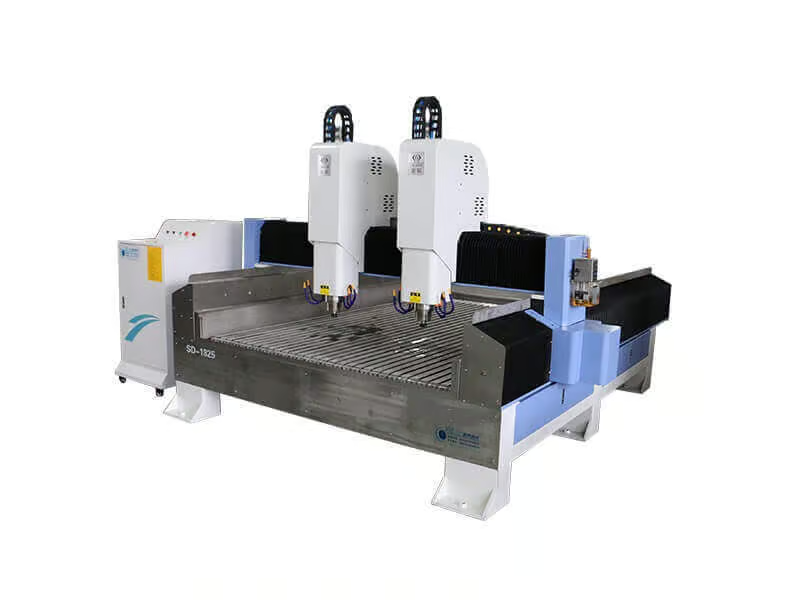 Stone Engraving Machines
 Thin Stone Veneer Saw Machine
 Horizontal Stone Slab Splitting Machine
 Stone Edge Polishing Profiling Machine
 Stone Auxiliary Equipment
Thin Stone Veneer Saw Machine
The global demand for natural thin stone veneer is skyrocketing, driven by architectural trends favoring lightweight, authentic masonry without the extreme dead-load of full-bed building stones. According to strict masonry cladding guidelines set by the The Masonry Society (TMS), adherence to precise geometric tolerances on the bonding surface is critical for shear strength. Relying on manual splitting or standard bridge saws to produce L-shaped corner stones yields inconsistent inner angles, resulting in massive grout joints, poor adhesion, and high failure rates on building facades. MosCut resolves this structural bottleneck with an automated, multi-axis cutting matrix. By simultaneously engaging vertical and horizontal diamond blades against the stone, we ensure a perfect 90° inner corner and an absolutely flat bonding surface, guaranteeing full compliance with high-end commercial and residential building codes.
A premier masonry veneer supplier in Texas, USA, recently revolutionized their operations. Previously, they employed a team of 15 skilled stonemasons using hand tools and basic saws to manually carve “L-corners” out of rugged limestone. This outdated method resulted in exorbitant labor overhead and a staggering 28% raw material scrap rate due to chipping. After deploying the MosCut Thin Stone Veneer Saw Machine, equipped with an automated V-way conveyor and synchronized orthogonal blades, their transformation was immediate. They slashed their processing team to just two operators while scaling production volume by 600%. More importantly, the internal corner angles were mechanically locked to within $pm0.2^circ$, delivering flawless dry-stack installations. This unmatched quality secured them an exclusive supply contract for a massive luxury housing development, paying off their entire machinery investment in under four months.
The Veneer Premium: Why Flats & Corners Secure 5x Margins
Convert heavy, low-value quarry rubble into the architectural industry’s most profitable masonry assets.Waste-to-Wealth Transformation
Stop discarding irregular quarry scrap. This machine devours unshaped, off-cut rubble and slices off the textured face, instantly creating premium flats. Your raw material acquisition cost effectively drops to near zero.
90° Corner Profit Monopoly
L-shaped corner stones command market prices 3 to 5 times higher than standard flats. By automating the notoriously difficult L-corner cut, you bypass labor bottlenecks and capture the most lucrative segment of the masonry market.
Absolute Uniform Thickness
The rigid steel conveyor bed guarantees that the back of every veneer piece is flawlessly flat. This mechanical precision allows downstream installers to save up to 50% on expensive polymer-modified mortar and adhesive.
Crushing Manual Labor Reliance
Eliminate the reliance on high-wage, hard-to-find master stonemasons. A single operator loading raw stones onto the automated conveyor can out-produce an entire crew of manual workers, standardizing output quality permanently.
Kinematic Cutting Axis: Simultaneous Multi-Blade Orthogonal Slicing
True L-corners cannot be achieved sequentially. Orthogonal multi-axis action is mandatory for dynamic stability.Producing an L-shaped corner stone using traditional single-blade machinery is a flawed process. It requires cutting the horizontal line, stopping the machine, manually flipping the heavy stone 90 degrees, and initiating a second cut. This sequential method introduces severe re-positioning errors, leading to mismatched joints and fragile, snapped corners.
The MosCut Solution: We engineered an orthogonal cutting matrix. The machine employs both Vertical and Horizontal diamond blades that engage the stone simultaneously as it travels down the conveyor. This dual-axis attack neutralizes opposing shear forces, locking the stone in a state of kinetic equilibrium. The internal stress on the thin wall of the L-corner is balanced by the mathematical resultant force equation:
$$Net Shear Stress (tau_{net}) = frac{F_{horizontal} sin(theta) – F_{vertical} cos(theta)}{Cross Sectional Area} to 0$$
By forcing the net lateral shear stress toward zero, our machine ensures that even the most fragile, naturally fissured stones are hollowed out into perfect 90° corners without crumbling.

Orthogonal Engagement: Simultaneous multi-axis cutting eliminates secondary positioning errors and prevents the delicate corner wall from fracturing under lateral pressure.
Detail Show of Masonry Veneer Saw Machine
A brutal structural cage engineered to absorb relentless shockwaves from multi-blade heavy slicing.🏗️ Heavy-Duty Reinforced Gantry Frame
Constructed from ultra-thick walled tubular steel, fully welded and heat-treated for stress relief. This massive gantry cage provides unyielding rigidity. It absorbs the extreme multi-directional impact forces generated when multiple diamond blades aggressively chew into solid rock simultaneously, guaranteeing the blade spindles never deflect.

🧠 Smart PLC Automation Control Cabinet
The operational brain. Equipped with a premium micro-computer PLC and advanced frequency inverters. Operators can digitally program feed speeds based on rock density. It features an automated self-diagnostic safety loop that instantly retracts the blades if spindle overload is detected, preventing catastrophic tool failure.

⚙️ Multi-Blade Independent Spindle Matrix
Each vertical and horizontal blade is driven by its own dedicated, high-torque industrial motor. The independent spindles are dynamically balanced and housed in heavy-duty, double-row self-aligning roller bearings. This ensures they can withstand continuous, punishing radial and axial loads during mass production without vibrating.

🛤️ High-Tension V-Way Conveyor Bed
Engineered specifically for irregular shapes. The reinforced conveyor belt features high-grip molded teeth and runs along a rigid V-shaped steel tracking guide. Accompanied by lateral pressure clamps, this system locks the unshaped quarry rubble in a vice-like grip, preventing any lateral slipping or twisting during the violent cutting phase.

📐 Modular Cutting Envelope Adaptability
Easily transition your product line. Both horizontal and vertical spindle heads are mounted on precision lead-screw tracks. With a simple mechanical adjustment, operators can rapidly dial in the exact dimensions to produce 4-inch, 6-inch, or 8-inch tall flats and corners, adapting instantly to custom architectural orders.

Thin Stone Veneer Saw Machine Applications
Fulfilling the elite material lists of premium architects and luxury home builders.🧱 Flat Veneer Panels (Wall Cladding)
Transform raw, bulky stone chunks into elegant flats. The machine cleanly saws off the back to create a perfectly smooth mounting surface while preserving the rugged, natural split-face or weathered texture on the front. These lightweight flats are the industry standard for commercial exterior facades, fireplace surrounds, and rustic interior accent walls.

📐 90° L-Shaped Corner Stones & Right Angle Stone Veneer
The crown jewel of masonry veneer. By perfectly hollowing out the interior of a rock, the machine creates a seamless 90-degree outer corner. When installed on the sharp edges of a building or a column, these L-corners brilliantly disguise the thin veneer, making the entire structure appear as though it were built from massive, solid, full-bed stone blocks.

⚡ Dynamic Slicing Efficiency & Throughput Kinetics
Purchasers must understand that output capacity on a multi-blade veneer saw is a dynamic function, not a fixed number. Throughput is governed by three interlocked variables:
- Rock Classification (Hardness): Slicing soft sedimentary limestone allows for aggressive feed rates, while dense, silica-rich quartzites require slower, calculated advancement to prevent blade glazing.
- Blade Matrix Configuration: Running a single vertical blade to slice flats draws far less motor torque than simultaneously engaging vertical and horizontal blades to hollow out a heavy L-corner.
- Conveyor Feed Tuning: Utilizing MosCut’s smart inverter, the conveyor speed dynamically adjusts based on instantaneous spindle load.
Under optimal tuning with MosCut CNC self-adaptive cruise control, the comprehensive production output typically stabilizes between 30 to 60 Linear Meters Per Hour, allowing your facility to effortlessly dominate local supply demands.
Industrial Tooling: Machine Consumables
The critical contact consumables engineered to withstand extreme continuous abrasion.🪚 Segmented Diamond Circular Blades
Purpose-built for deep hollowing and facing. Engineered with a high-strength manganese steel core to prevent warping under lateral stress. The rim features an aggressive, stepped arrangement of laser-welded diamond segments designed for rapid material removal and superior water-cooling slurry expulsion.

🔄 Optional Right-Angle Conveyor Table
Maximize your production throughput with this automated material handling upgrade. Engineered to seamlessly integrate with the main slicing matrix, the motorized right-angle conveyor table eliminates critical manual lifting bottlenecks. It continuously channels heavy, irregular raw stones directly into the cutting zone or effortlessly extracts finished flats and corners. This drastically reduces operator fatigue while aggressively scaling your continuous daily yield.

Technical Specifications
Heavy-duty parameter metrics engineered for uncompromising flat and corner masonry production.| Technical Parameter | 30HP-1 (22KW*1) | 60HP-1 (45KW*1) |
|---|---|---|
| Dimensions (L×W×H) | 2850mm × 1950mm × 1750mm | 3300mm × 2200mm × 2200mm |
| Machine Weight | 2200 kg | 3100 kg |
| Main Motor Power | 22 kw | 45 kw |
| Electricity | 3 Phase, 240V/460V | 3 Phase, 240V/460V |
| Amperage | 86/43 A | 172/86 A |
| Water Consumption | 3 m³/h | 3.5 m³/h |
| Blade Size | 800mm – 1000mm | 1000mm – 1200mm |
| Blade Speed Standard (Adjustable) | 900 rpm | 780 rpm |
| Max. Cutting Depth | 380 mm | 480 mm |
| Max. Stone Thickness | 20 – 220 mm | 20 – 270 mm |
| Conveyor Belt Speed (Adjustable) | 600 mm/min – 2450 mm/min | 600 mm/min – 2450 mm/min |
| Daily Production (Based on 8 Hours) | About 80 – 120 m² | About 80 – 120 m² |
Standard Operating Procedure: Flat & Corner Calibration
Execute this three-step protocol to guarantee perfect 90-degree alignment.🪨 1. Raw Material Orientation
Whether processing flats or corners, the operator must assess the irregular rock and place its most relatively flat, stable side face-down on the conveyor belt, pressing it firmly against the lateral alignment rail to ensure a straight trajectory into the blade zone.
📏 2. Intersection Indexing
Using the digital lead-screw controls, precisely calibrate the overlap (Intersection Point) of the vertical and horizontal blades. Over-cutting causes the corner to snap; under-cutting leaves a connective sliver that prevents the L-corner from dropping free.
🌊 3. Hydro-Cooling & Auto-Feed
Activate the high-volume internal and external water spray headers. Engage the PLC’s smart auto-cruise feed mode. The inverter will automatically accelerate through soft stone and decelerate upon hitting dense quartz nodes, ensuring non-stop, hands-free production.
Machine in Action: High-Definition Working Video
Watch the multi-axis matrix transform raw rubble into architectural masterpieces.Global Success Showcase: Industrial Field Records
Powering the supply chains of the world’s elite masonry veneer distributors.
USA (Texas): Quarry-Side Megaline
Deployed multiple VS-800 units directly at the quarry extraction site. Converted zero-value offcuts into high-margin architectural flats, securing regional dominance in the residential masonry market.
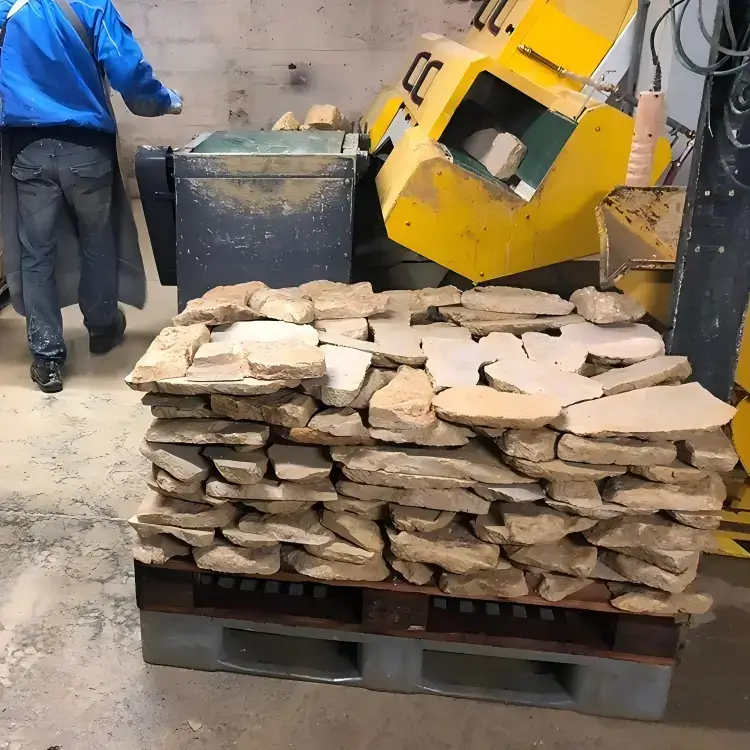
Canada (Whistler): Granite Ledgestone
Overcame the extreme abrasion of dense Canadian granite. The multi-blade orthogonal setup eliminated manual chiseling, producing flawless ledgestone corners for luxury ski resorts.
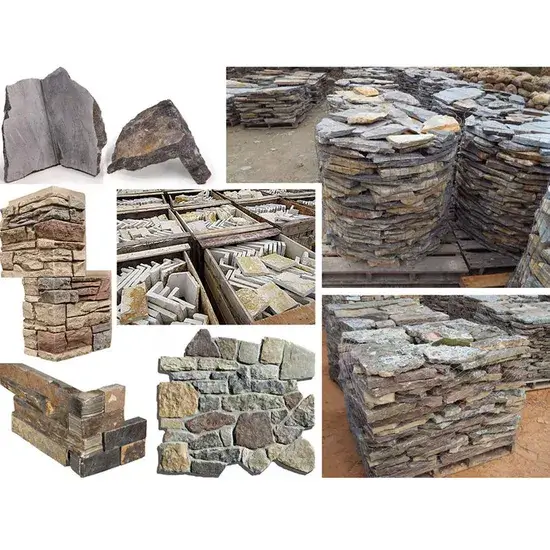
China (Hebei): Split-Face Cluster
Upgraded an entire industrial park’s capacity. By replacing outdated single-blade bridge saws, daily output of standardized flat wall cladding surged by over 400% with identical labor forces.

Australia (Melbourne): Sandstone Atelier
Perfected the art of sandstone processing. Solved the chronic issue of brittle sandstone corners snapping during fabrication by tuning the inverter feed velocity to match the soft sedimentary matrix.
Related Technical Insights & Slicing Guides
Master the mechanics of high-yield architectural masonry production.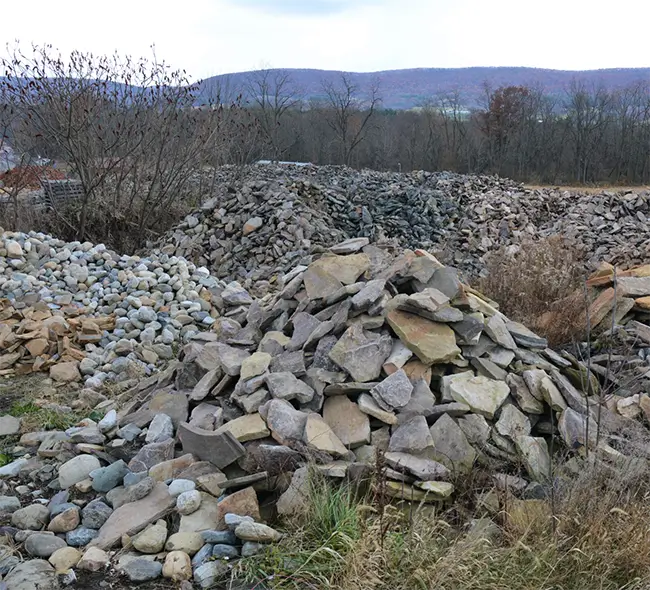
Maximize Yield from Quarry Waste
Strategic sorting protocols to identify the perfect irregular rock shapes for yielding the highest volume of premium 90-degree corner stones.
Read Insight
Calibration of Orthogonal Blades
The definitive engineering manual on indexing the vertical and horizontal spindle drop-points to prevent corner snapping.
Read Insight
Global Demand for Lightweight Veneer
An executive analysis of why North American and European building codes are aggressively pushing for natural thin stone masonry.
Read Insight
Preventing Micro-Chipping on L-Corners
Troubleshooting blade RPM, water coolant pressure, and conveyor traction to eliminate micro-fractures during the critical 90-degree cut.
Read InsightMonopolize the High-Margin Architectural Market
Stop leaving your most profitable masonry opportunities on the cutting room floor. Upgrade your facility with MosCut’s automated Thin Stone Veneer Saw Machines and transform low-value quarry rubble into premium, high-margin flats and corners.
Explore MosCut’s Full Range of Stone Cutting MachinesFrequently Asked Questions: Veneer Saw Machinery
1. How does the machine prevent visible saw marks at the inner 90-degree intersection?
We utilize an engineered micro-overlap calibration. By meticulously setting the vertical blade to pass just 1mm deeper than the horizontal blade’s apex, the corner block drops free cleanly without leaving a connective ridge or stepped saw marks.
2. My L-corners are coming out slightly obtuse (wider than 90 degrees). How do I fix this?
This indicates that the spindle chassis has suffered a severe lateral impact or is out of alignment. You must use a machinist’s square on the vertical and horizontal flanges to recalibrate the spindle mountings back to absolute true zero.
3. Can I run the machine with only the vertical blade to just produce flats?
Yes. The electrical control cabinet allows you to independently isolate and power down the horizontal spindle motor. You can run purely on the vertical axis for high-volume flat wall cladding production.
4. What is the optimal feed speed for cutting hard granite compared to soft limestone?
Soft limestone can often be fed at speeds approaching 1.0 to 1.5 meters per minute. Hard, silica-rich granite requires significantly more torque and must be dialed back to 0.3 to 0.6 meters per minute to prevent the diamond segments from glazing over.
5. Why does the rock sometimes jam and stall the conveyor belt mid-cut?
Jamming occurs if the rock’s base is highly irregular and rocks side-to-side, or if the lateral pressure guides are not tightened correctly. Ensure the rock has at least one relatively stable face down on the high-friction belt, and lock the side guides firmly.
6. How often do the rubber teeth on the V-way conveyor need replacing?
The vulcanized rubber cleats are highly durable, but depending on the abrasiveness of the stone and the cleanliness of the water slurry, they generally require replacement every 8 to 12 months in a heavy-production facility to maintain optimal grip.
7. Can this machine cut architectural arches or curved stones?
No. The Veneer Saw Machine relies on fixed, straight linear interpolation along the conveyor bed. It is designed exclusively for producing perfectly straight planar flats and orthogonal 90-degree L-corners.
8. Do I need specialized water filtration for the cooling system?
Yes. Because the machine generates a massive amount of fine rock dust rapidly, recycling raw, heavily silted water will quickly destroy the spindle seals and clog the cooling jets. A proper cyclonic settling tank or filter press is highly recommended.
9. What is the minimum thickness a flat veneer can be cut to on this machine?
Depending on the structural integrity of the raw stone, the machine can comfortably slice flats down to 15mm to 20mm (approx. 0.6 to 0.8 inches) thickness. Going thinner on irregular rubble increases the risk of the natural split-face crumbling.
10. Is the machine delivered fully assembled or in modules?
Due to its massive weight and precise factory calibration, the main gantry and spindle matrix are shipped fully assembled. The conveyor extensions and water catch basins are modularly attached on-site during the commissioning phase.