
 Stone Cutting Machines
 Stone Polishing Machines
 Bridge Saw Machines
 Stone Quarry Cutting Machines
 Stone Block Cutter Machine
 CNC Stone Wire Saw Machine
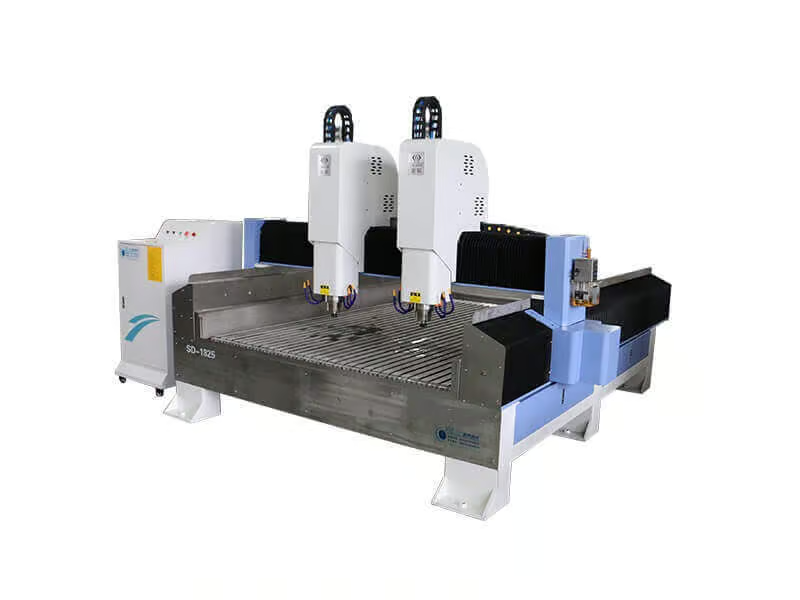 Stone Engraving Machines
 Thin Stone Veneer Saw Machine
 Horizontal Stone Slab Splitting Machine
 Stone Edge Polishing Profiling Machine
 Stone Auxiliary Equipment
A profound macro-economic transition is redefining the global architectural envelope. For decades, traditional heavy dry-hung stone facades—relying on massive 5cm solid slabs—were the standard for prestigious developments. Today, stringent building energy codes mandated by the American Institute of Architects (AIA) and ASHRAE Standard 90.1 are aggressively regulating the continuous insulation (CI) barriers of commercial structures. Heavy anchor systems inevitably pierce these insulation layers, inducing catastrophic “Thermal Bridging” that drives severe energy leakage. Consequently, the international market has pivoted aggressively toward natural thin stone veneer integrated with lightweight exterior insulation finishing systems. This has triggered an explosive, inelastic global demand for precision-cut flats and structurally stable right-angle corner cladding.
A premier architectural masonry distributor based in Toronto, Canada, recently experienced the high-stakes reality of this market evolution. While supplying a ultra-luxury multi-family residential enclave, their initial supplier—relying on manual guillotine splitters—delivered highly inaccurate, obtuse corner stones. The installation team encountered massive, irregular grout lines on the prominent exterior columns, resulting in an immediate aesthetic rejection by the lead architect and racking up thousands of Dollars in daily project delay penalties. Desperate to salvage the contract, the distributor routed the emergency order to a fully automated facility running MosCut multi-axis veneer saws. Delivering perfectly hollowed, seamless right-angle stone cladding allowed the field masonry crew to execute a flawless dry-stack installation 40% faster than scheduled. This precision secured the distributor’s reputation, completely monopolizing the region’s premium commercial masonry pipeline.
The Structural Evolution: Why Full-Bed Stone is Obsolete
Modern structural engineering is an unyielding war against dead load weight and thermodynamic leaking.🌡️ Insulation Compliance
Modern building codes demand an uninterrupted thermal blanket around the structure. Thin stone veneers (under 1.5 inches thick) bond directly to anti-fracture lamination mortars over insulation, completely avoiding heavy metallic anchors that compromise the building’s thermal envelope.
🏗️ Foundation Dead-Load ROI
Replacing 5cm full-bed dimensional stone with 3cm thin veneer slashes the dead weight of the exterior facade by up to 70%. This drastic weight reduction allows structural engineers to down-spec the size of the foundational concrete piles and structural steel beams, saving millions in upfront capital.
⏱️ High-Rise Cranage Velocity
Time is asset burn. A single construction crane hoist can transport four times the surface area of lightweight thin veneer flats compared to heavy masonry blocks. This significantly compresses the building enclosure timeline, allowing developers to begin leasing months ahead of schedule.
The Corner Imperative: Why “Right-Angle” Accuracy Wins Contracts
Architects abhor messy, visible miters. The column edge must perfectly mimic solid, foundational masonry.When a prominent commercial building features natural stone siding, the corners are the absolute focal point of design critique. Traditional installers often attempt to bypass dedicated corner machinery by taking two standard flat veneer panels and gluing them together via a 45-degree mitered joint on-site.
Under continuous thermal cycling and building settlement, these mitered seams invariably separate, accumulate black dirt, and crack—instantly exposing the structure as a cheap, thin imitation.
The MosCut Power Advantage: Our Thin Stone Veneer Saw Machine cuts an authentic, single-piece Right-Angle corner. Because it is carved out of a single piece of solid rock, it behaves as a monolithic structure. It gracefully resists intense localized wind shear forces at building corners while maintaining an uncompromised, solid 90-degree visual profile. Providing this level of geometric perfection allows fabricators to command premium pricing from elite commercial developers.

Market Segmentation: Hunting High-Margin Premium Orders
Align your automated machine output with the economic clusters driving premium real estate.To maximize the utilization of an automated multi-blade veneer saw line, processing facilities must target three high-value architectural sectors:
1. Commercial Luxury Retail Fronts: High-street flagship stores and elite automotive showrooms demand striking, rugged split-face stone aesthetics but operate under tight, nocturnal mall renovation schedules. Precision flats and pre-cut right angle corners install instantly without messy, loud field chiseling.
2. Net-Zero Luxury Residential Estates: High-net-worth buyers demanding timeless, historical stone siding while enforcing extreme insulation criteria. Ultra-thin veneer satisfies both goals perfectly.
3. Hospitality Weight-Constrained Interiors: High-altitude luxury hotel lobbies and hanging penthouse fireplaces where structural floor load-bearing limits prohibit the use of full-bed stone masonry.

📊 The Developer’s Spreadsheet: Installation Cost Economics
The raw purchase price of the stone material is a marketing decoy. Experienced commercial developers evaluate bids strictly based on the Total Cost of Ownership (TCO) of the finished wall facade.
The macro economic calculation follows a strict structural cost formula:
Cheap, manually split stone veneer with inaccurate angles is an economic trap. It forces masonry contractors to waste hundreds of billable hours manually trimming, chipping, and shimming each stone on-site, blowing up the $Installation Hours$ variable.
By supplying absolute uniform flats and mathematically true right-angle corners from a MosCut production line, you allow contractors to complete the facade up to 50% faster with zero field modifications. The overall $Total Facade Cost$ drops significantly, allowing you to charge a higher per-meter premium for your stone while saving the developer massive capital on their bottom line.
Capture the Elite Global Architectural Market
The massive global pivot toward lightweight, high-precision natural masonry is an irreversible architectural reality. Position your manufacturing facility at the absolute top of the supply chain. Equip your floor with MosCut’s automated thin stone veneer saw lines and start securing elite, high-margin global contracts.
Explore MosCut Thin Stone Veneer Solutions