
 Stone Cutting Machines
 Stone Polishing Machines
 Bridge Saw Machines
 Stone Quarry Cutting Machines
 Stone Block Cutter Machine
 CNC Stone Wire Saw Machine
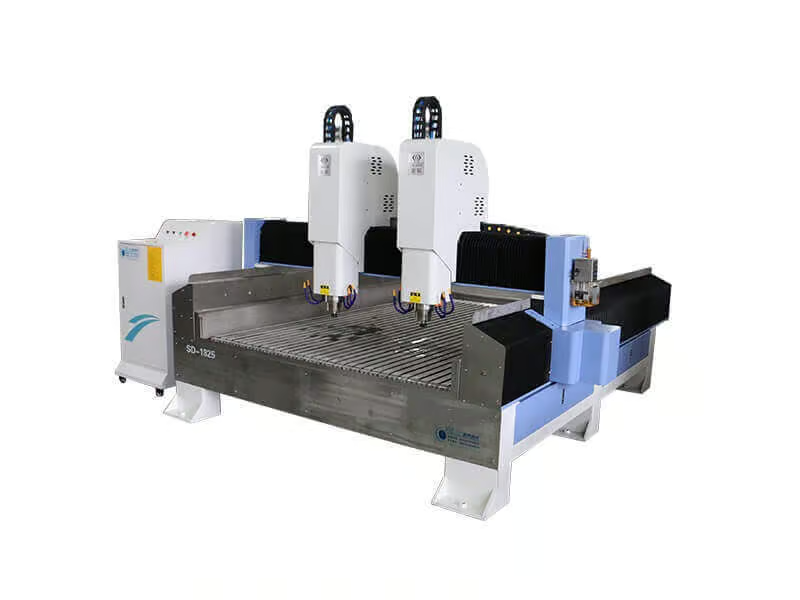 Stone Engraving Machines
 Thin Stone Veneer Saw Machine
 Horizontal Stone Slab Splitting Machine
 Stone Edge Polishing Profiling Machine
 Stone Auxiliary Equipment
In the high-stakes world of stone fabrication, there is a common misconception that the most advanced technology always yields the highest profit. However, according to a 2026 MOSCUT financial health analysis of 300 stone processing facilities worldwide, the truth is quite different: among the top 20% of most profitable factories, over 82% of all foundational cutting (straight edges and blanking) is performed by standard laser bridge saws, not complex 5-axis CNCs.
Last year, a major countertop manufacturer in Cape Town, South Africa, faced a severe cash flow crisis. They had taken out significant loans to purchase two high-end imported 5-axis CNCs, primarily using them for basic L-shaped quartz countertops. Between the massive monthly loan repayments, the high salary of a dedicated programmer, and frequent downtime due to fragile electronic sensor failures, they were losing money on every order. On our recommendation, they sold one CNC and replaced it with three rugged MOSCUT Standard Laser Bridge Saws. The result? Their daily output doubled, maintenance costs dropped to near zero, and they achieved a full ROI on the new machines in just 5 months. In stone fabrication, simplicity is often the ultimate strategic advantage.
The “Cannon vs. Mosquito” Trap
Over-engineering your shop floor is a silent profit killer. For 90% of stone work, a standard bridge saw outshines complex CNC technology in raw commercial value.

The Hidden Burden of Over-Complication
5-axis machines are engineering marvels, but they are also packed with delicate servo motors, precision gearboxes, and digital slip rings that are highly vulnerable to the wet, abrasive environment of a stone shop. When you use these machines for basic straight cuts, you are paying a massive “functionality premium” for features you don’t need, while inheriting a significantly higher risk of mechanical failure.

Uptime is the Ultimate Metric
Your clients do not care how many axes your machine has; they only care that their order is delivered on time. Standard bridge saws rely on heavy-duty mechanical structures and simple contactor systems. Even in the most demanding, mud-splattered environments, they maintain an uptime rate of over 99%. In a business where missing a deadline means losing a client, reliability is more valuable than versatility.
The Labor Advantage: Operators vs. Programmers
The real cost of a machine isn’t just the purchase price—it’s the cost of the person standing in front of it.

Zero CAD/CAM Bottlenecks
Running a CNC requires importing CAD drawings into CAM software and generating tool paths. This creates a dangerous bottleneck: if your only programmer is sick or resigns, your expensive machine becomes a paperweight. A standard laser bridge saw requires no programming. The operator aligns the laser with the chalk line and starts cutting immediately.

Half-Day Training for New Hires
The standard laser bridge saw is designed for “idiot-proof” operation. A new hire can be trained to make perfect, professional-grade straight cuts in just a few hours. This allows you to scale your workforce quickly during peak seasons without the massive expense of recruiting specialized CNC technicians.
The Strategic “Blanking” Layout
Top-tier factories use standard laser bridge saws to rapidly size slabs and perform basic cuts. Once the “blank” pieces are ready, they are sent to the CNC only for complex undermount sink cutouts, engravings, or intricate edge profiles. This hybrid workflow maximizes the throughput of the entire factory and ensures your high-tech machines are only used for high-value tasks.
Cost vs. Output: The Engineering Math
When you look at the raw data for straight-line fabrication, the financial case for the standard bridge saw is undeniable.
| Commercial Metric | Standard Laser Bridge Saw | 5-Axis CNC Bridge Saw |
|---|---|---|
| Initial Investment | Highly Affordable (Low Debt) | Extreme (Requires Long Financing) |
| Setup Time per Slab | < 1 Minute (Laser Alignment) | 5 – 15 Minutes (CAD & CAM) |
| Required Operator Skill | Entry-Level Worker | Specialized CNC Technician |
| Yearly Maintenance | Minimal (Standard Greasing) | High (Calibration & Electronics) |
| ROI for Straight Cuts | 3 – 6 Months | 1.5 – 3 Years |
Maximize Your Workshop’s Profit Margin
In a competitive market, success belongs to those who manage their overhead and maximize their uptime. Stop following the trend of over-complication and start investing in the machinery that actually drives your bottom line.
Ready to deploy a machine that prints money?
Explore the heavy-duty specifications and proven reliability of our Standard Laser Bridge Saw. Build your factory on a foundation of unstoppable output.
Explore the Standard Laser Bridge SawTop 10 FAQ: Standard Bridge Saw ROI
1. What is the typical depreciation period for a standard bridge saw?
Due to their heavy cast-iron construction and simple mechanics, most MOSCUT standard saws remain operational for 15-20 years. However, for tax purposes, most shops depreciate them over 5-7 years, often achieving full ROI long before then.
2. If I only do small custom batches, do I still need a standard saw?
Yes. Even in custom shops, the “prep work” takes up the most time. A standard saw allows you to prep your pieces 10x faster than doing everything on a CNC, keeping your custom production line moving smoothly.
3. Which ROI is higher: Monoblock or Gantry designs?
Monoblock designs usually have a higher initial ROI because they require no foundation work and can be installed in a single day, meaning they start earning money for you immediately.
4. Does the electricity cost of a standard saw significantly impact ROI?
Standard saws are remarkably energy-efficient because they aren’t powering multiple high-speed servo drives 24/7. Our 15KW motors are optimized to provide high torque with low power consumption.
5. Can a standard saw handle the latest sintered stone materials?
Yes. While you need the correct blade and a steady hand, the heavy cast-iron beam of our standard saw provides the necessary vibration absorption to cut sintered stone without the “chatter” that causes chips.
6. Is it easy to resell a standard bridge saw if I want to upgrade?
Standard bridge saws have the highest resale value in the used equipment market because every stone shop, regardless of size, has a use for one.
7. How does the laser alignment feature improve profitability?
It eliminates the “measure twice, cut once” delay. Operators can layout their cuts visually on the slab in seconds, reducing errors and increasing the number of slabs processed per shift.
8. Do standard saws require a concrete foundation for maximum precision?
While Gantry models on concrete offer the ultimate rigidity, our heavy-duty steel Monoblock chassis is designed to provide 100% precision for standard countertops without the cost of foundation work.
9. What is the most common reason for downtime on standard saws?
Lack of lubrication. If you keep the mechanical nodes greased, downtime is virtually non-existent. There are no software patches or motherboard failures to worry about.
10. Can I customize the motor power to improve cutting speed and ROI?
Yes, we offer motor upgrades (e.g., from 15KW to 18.5KW) through our OEM services for shops processing exceptionally dense materials like Absolute Black granite or Quartzite.