
 Stone Cutting Machines
 Stone Polishing Machines
 Bridge Saw Machines
 Stone Quarry Cutting Machines
 Stone Block Cutter Machine
 CNC Stone Wire Saw Machine
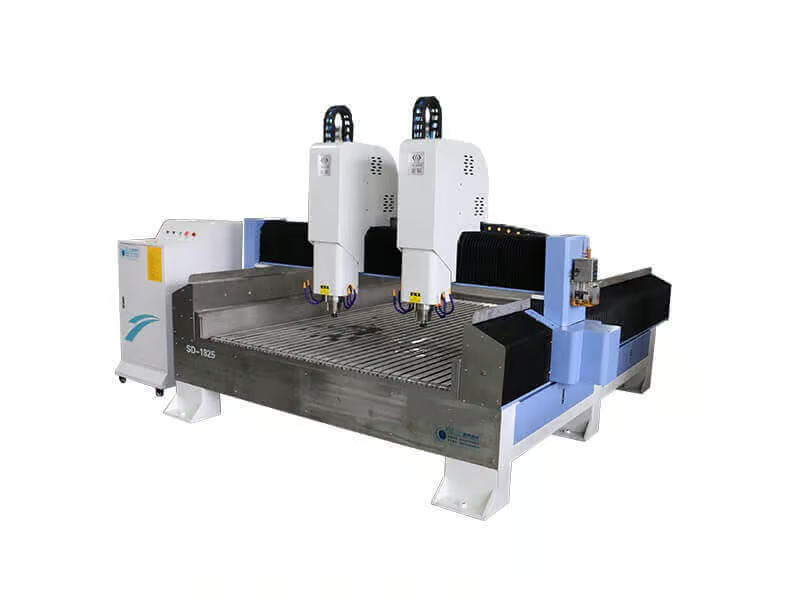 Stone Engraving Machines
 Thin Stone Veneer Saw Machine
 Horizontal Stone Slab Splitting Machine
 Stone Edge Polishing Profiling Machine
 Stone Auxiliary Equipment
When purchasing a standard bridge saw, the most critical decision happens before you even look at the motor specs: how will the machine be anchored to your factory floor? According to Q2 2026 MOSCUT global installation data, 68% of medium-sized fabrication shops now choose foundation-free Monoblock designs, while 85% of heavy-duty commercial factories still firmly rely on traditional Gantry (split-frame) structures.
Last year, a growing stone fabrication shop in Santiago, Chile, leased a new warehouse and needed to begin production within two weeks to fulfill a massive shopping mall contract. If they had chosen a traditional Gantry saw, digging foundations, pouring concrete walls, and waiting for it to cure would have taken at least 14 days. Instead, our engineers recommended a heavy-duty MOSCUT Monoblock saw. It was unloaded with a forklift, connected to power and water, and was cutting slabs the very next morning, saving the contract.
Conversely, a monument manufacturer in Germany, specializing in 150mm thick Absolute Black granite, unhesitatingly poured heavy concrete walls for a Gantry installation to absorb the extreme vibrations of thick plunging cuts. There is no absolute “best” structure—there is only the structure that perfectly matches your facility and your workflow.
The Core Difference: How the Machine is Anchored
To make an informed decision, you must understand the physical engineering behind how these machines manage weight and vibration.

The Gantry Design (Split Frame)
The Gantry (or split) structure consists of two independent parallel rails that the main cutting bridge travels upon. These rails must be bolted to heavy supports—typically concrete walls poured specifically for the machine, or heavy-duty steel legs bolted deep into the factory floor. The worktable sits separately between these walls. This is a permanent, immovable installation designed for ultimate vibration absorption.

The Monoblock Design (Integrated Chassis)
A Monoblock machine is built on a massive, unified steel frame. The side rails, the main bridge, and the rotating worktable are all engineered onto a single, heavy-duty chassis—much like a shipping container. It requires zero foundation work. As long as your factory floor is flat, you simply place the machine down, and it is ready to operate.
Head-to-Head Comparison: Installation, Rigidity, and Relocation
Let’s look at how these two structural designs compete in a real-world factory environment.
| Performance Metric | Gantry Design (Split Frame) | Monoblock Design (Integrated) |
|---|---|---|
| Foundation Requirement | Requires poured concrete walls or deep bolting | None (Requires flat concrete floor) |
| Installation Time | 7 – 14 Days (including concrete curing) | 1 – 2 Days (Plug and play) |
| Vibration Absorption | Maximum (Concrete transfers vibration to earth) | Excellent (Absorbed by heavy steel frame) |
| Relocation / Resale | Difficult (Walls cannot be moved; high tear-down cost) | Extremely Easy (Lifted by forklift as one unit) |
| Best Material Thickness | Any thickness (Ideal for 100mm+ blocks & monuments) | Standard slabs (Ideal for 0-80mm countertops) |
When to Choose a Gantry Structure
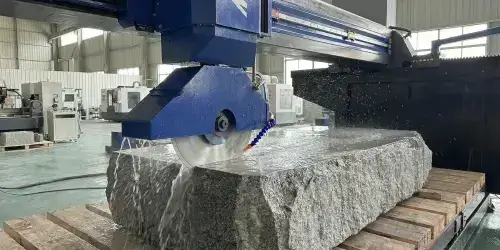
Heavy Duty Thick Slabs & Monuments
If your primary business is cutting thick architectural granite or cemetery monuments, the lateral resistance against the blade is massive. A Gantry machine bolted to concrete walls will channel all that violent vibration directly into the earth. This protects your machine’s linear guides from premature wear and ensures perfectly smooth cuts on incredibly dense materials.
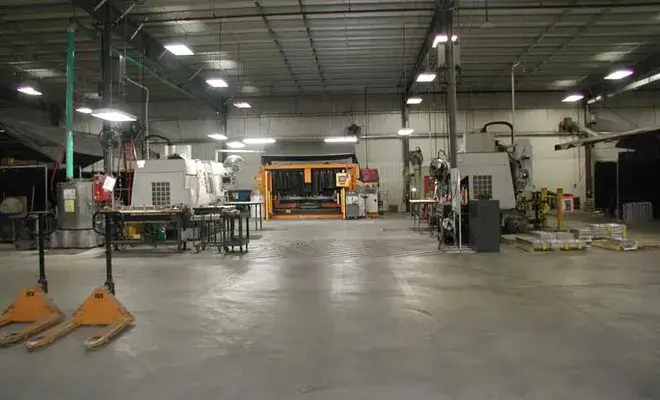
Permanent Factory Ownership
If you own the land and the factory building, and you intend to operate there for the next 20 years, building a concrete foundation is the highest-ROI decision you can make. The unparalleled stability of a permanent installation will extend the life of your bridge saw well beyond industry averages.
When to Choose a Monoblock Structure

Leased Warehouses and Fast Deployment
Many commercial landlords strictly forbid tenants from digging trenches or pouring heavy concrete structures inside leased warehouses. A Monoblock machine solves this completely. Furthermore, when your lease expires and you need to move to a larger facility, you can easily load the entire machine onto a flatbed truck without abandoning thousands of dollars in concrete work.

Space-Constrained Shops
Because the worktable and the rails are integrated into a single tight footprint, Monoblock machines are generally more compact than their Gantry counterparts. For medium-sized fabricators located in urban areas where square footage is expensive, the Monoblock design helps maximize aisle space and factory flow.
Make the Right Structural Choice for Your Future
Do not let the wrong foundation dictate your factory’s potential. Whether you need the absolute permanence of concrete or the rapid agility of a steel chassis, we build machines that fit your exact reality.
Ready to build a stone line that fits your floor perfectly?
Explore the customizable OEM options—including both Gantry and Monoblock structures—on our heavy-duty standard saw platform.
Configure Your Standard Laser Bridge SawTop 10 FAQ: Monoblock and Gantry Bridge Saws
1. Does a Monoblock machine vibrate during cutting?
While not as immovable as a concrete wall, a high-quality Monoblock machine is built with tons of heavy-gauge steel. For standard 20mm to 40mm countertops, vibration is virtually non-existent and will not affect cut quality.
2. How level does my floor need to be for a Monoblock saw?
Your concrete floor should be industrial-grade flat. However, our Monoblock machines come with adjustable heavy-duty leveling feet that allow technicians to perfectly square the machine even if the floor has slight imperfections.
3. If I choose a Gantry saw, will MOSCUT provide the foundation blueprints?
Absolutely. Before the machine ships, we provide your civil engineering team with detailed, millimeter-accurate blueprints for the concrete walls, including the exact placement for the anchor bolts.
4. Are Monoblock machines more expensive than Gantry machines?
The machine itself is slightly more expensive because it requires massive amounts of structural steel to build the chassis. However, when you factor in the cost of pouring concrete walls and the downtime for installation, the Monoblock is usually cheaper overall.
5. Can a Gantry machine be installed on steel legs instead of concrete walls?
Yes. We offer heavy-duty steel leg structures as an alternative to concrete walls for Gantry machines. It provides excellent stability while being faster to install than pouring cement.
6. How do I move a Monoblock machine inside my shop?
It can be lifted in one piece using a high-capacity forklift or a heavy-duty overhead factory crane. There is no need to dismantle the bridge from the rails.
7. Do both structures support 0-90° rotating tables?
Yes. Whether you choose Monoblock or Gantry, the hydraulic tilting and rotating worktable functionalities remain exactly the same.
8. Is the cutting speed different between the two designs?
No. Assuming they use the same spindle motor and blade, the cutting speed is identical. The difference lies only in maximum vibration absorption on ultra-thick materials.
9. Do they take up the same amount of space in a shipping container?
Monoblock machines take up more space because the chassis cannot be fully dismantled. They typically require a dedicated 20ft or 40ft open-top container, whereas some Gantry components can be packed more tightly.
10. Can I convert a Gantry machine into a Monoblock later?
No. The entire geometric engineering and structural balancing of the two machines are fundamentally different. This is why choosing the right structure on day one is critical.