
 Stone Cutting Machines
 Stone Polishing Machines
 Bridge Saw Machines
 Stone Quarry Cutting Machines
 Stone Block Cutter Machine
 CNC Stone Wire Saw Machine
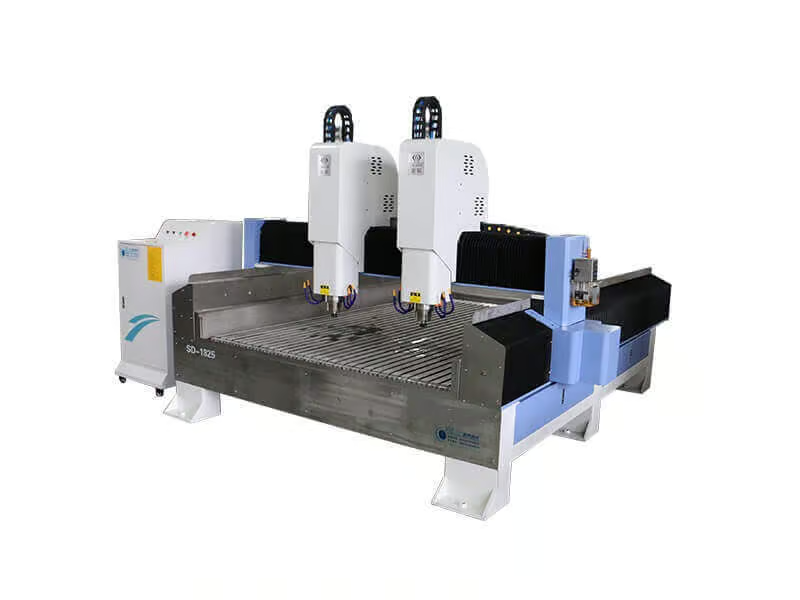 Stone Engraving Machines
 Thin Stone Veneer Saw Machine
 Horizontal Stone Slab Splitting Machine
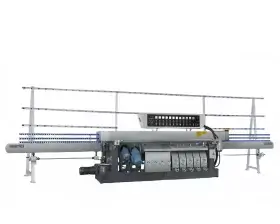 Stone Edge Polishing Profiling Machine
 Stone Auxiliary Equipment
In dimensional stone mining, true efficiency is not found in a single machine, but in the systematic coordination of specialized equipment. According to whitepapers on zero-waste extraction published by IMM Carrara (Internazionale Marmi e Macchine), the world’s most profitable marble quarries never rely on isolated tools. Instead, they deploy a hybrid extraction matrix commonly referred to as the ‘Italian Method’. This strategy pairs the surgical precision of an arm-style chain saw with the relentless volumetric speed of a diamond wire saw, entirely eliminating the operational bottlenecks associated with pneumatic drilling.
A top-tier Crema Marfil marble quarry in Alicante, Spain, revolutionized their yield using this exact approach. Historically relying exclusively on DTH drills and wire saws, their operation was plagued by incomplete bottom cuts. When excavators pushed the massive blocks over, ‘Bottom Breakout’ (tearing at the base) caused up to 15% of their premium stone to be scrapped as rubble. By implementing a MosCut systems approach—pairing 1 Chain Saw with 3 Wire Saws—they eradicated drilling failures. The chain saw handled all blind corners and undercuts, while the wire saws sliced the massive faces. Block integrity skyrocketed to 99%, increasing their high-grade export yield by 400 cubic meters per month.
The Flaw of Working in Isolation
Relying entirely on a single type of extraction machine leaves your quarry vulnerable to geometric and operational bottlenecks.Every extraction machine has a distinct superpower and a fatal limitation. If a quarry relies only on diamond wire saws, they are entirely at the mercy of their drilling equipment. If a drill bit hits a mud seam and the hole collapses, the wire saw cannot be threaded, bringing the entire bench to a standstill. Furthermore, wire saws are incapable of cutting perfectly into tight, 90-degree internal blind corners.
Conversely, if a quarry relies only on chain saws, they face depth limitations (maximum arm reach of 7.5 meters) and generally slower square-meter-per-hour cutting speeds across massive vertical faces. The solution is not choosing one over the other; the solution is utilizing both to cancel out their respective weaknesses.

The “Italian Method” Explained
Pioneered in the mountains of Carrara, this hybrid strategy uses each machine strictly for what it does best: the chain saw as the surgeon, the wire saw as the workhorse.The ‘Italian Method’ treats the quarry bench as a highly synchronized manufacturing floor. In this system, the MosCut chain saw acts as the Surgeon. It is deployed to handle the most difficult, geometrically complex cuts—specifically the horizontal base undercuts and the inaccessible internal corner cuts where drilling is impossible.
Once the chain saw has ‘opened’ the rock, the MosCut wire saw takes over as the Workhorse. Freed from the burden of complex threading, the wire saw can focus entirely on slicing through massive, 20-meter high vertical walls at maximum velocity. This synergy guarantees zero broken blocks and uninterrupted daily production.

Step 1: The Chain Saw Prepares the Base
A flawless block extraction always begins at the bottom. The chain saw secures the foundation of the cut.The extraction cycle begins with the MosCut chain saw. The machine drives up to the solid bench face without requiring any preliminary drilling. The operator positions the arm horizontally and executes a Plunge Cut directly into the floor level of the bench, traveling laterally to create a perfect, flat 100% horizontal base undercut.
Next, the operator rotates the chain saw’s turret 90 degrees. They maneuver the machine to the tightest inside corner of the bench and execute a vertical plunge cut straight down. This severs the block from the back wall and completes the surgical phase of the extraction.

Step 2: Flawless Wire Threading
Eliminate the frustration of jammed drill bits and collapsed holes. The chain saw kerf becomes the ultimate threading channel.This is where the magic of the synergy happens. The MosCut chain saw leaves behind a perfectly straight, clean 40mm wide cut slot (kerf) in the rock. Because this slot connects the horizontal base and the vertical rear, intersecting drilling is completely bypassed.
Quarry workers simply drop the 11mm diamond wire directly into the 40mm chain saw slot from the top. Using a simple hook tool, they pull the wire out from the bottom slot. What used to take hours of frustrating, imprecise drilling and fishing for wires is now accomplished in less than 5 minutes with absolute certainty.

Step 3: High-Speed Wire Saw Slicing
With the wire perfectly looped through the pre-cut slots, the wire saw takes over to deliver unmatched vertical cutting speeds.With the wire successfully looped through the massive block, the MosCut wire saw is engaged. Because the bottom and rear corners have already been cleanly separated by the chain saw, the diamond wire only needs to focus on slicing through the primary vertical face.
The wire saw cuts at incredible speeds. Once the vertical slice is complete, the massive block is fully separated. Operators slide hydro-bags (water bags) into the vertical cut and inflate them. The colossal marble block tips over gently and slides perfectly onto the quarry floor. Because the base was 100% flat and pre-cut by the chain saw, the bottom of the block is pristine, resulting in a ‘factory-ready’ rectangular block that commands the highest market premium.

Build Your Ultimate Extraction System
Stop settling for 85% yield. Pair MosCut Chain Saws with our advanced Wire Saws to achieve 100% factory-ready blocks and zero bottom breakage.
Explore MosCut Quarry Systems