
 Stone Cutting Machines
 Stone Polishing Machines
 Bridge Saw Machines
 Stone Quarry Cutting Machines
 Stone Block Cutter Machine
 CNC Stone Wire Saw Machine
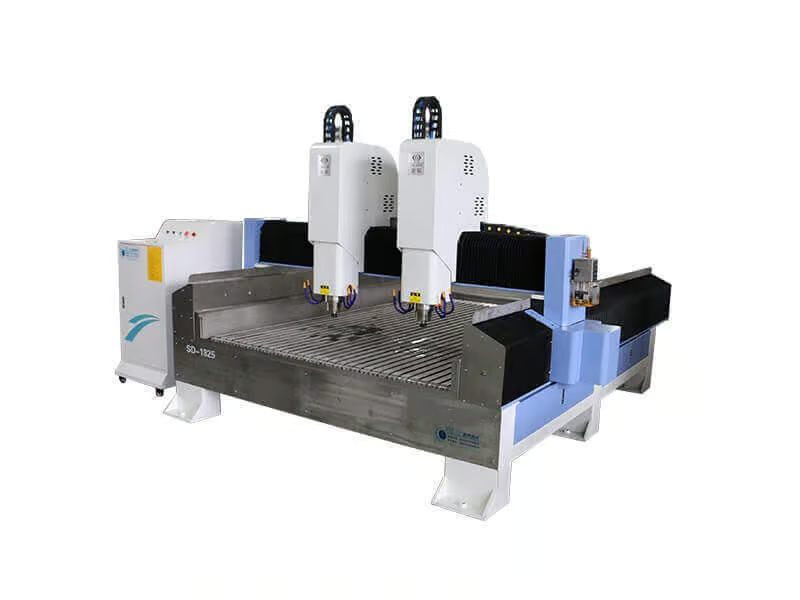 Stone Engraving Machines
 Thin Stone Veneer Saw Machine
 Horizontal Stone Slab Splitting Machine
 Stone Edge Polishing Profiling Machine
 Stone Auxiliary Equipment
Open-pit mining remains one of the most hazardous industrial environments globally, where traditional methods often expose workers to unpredictable geological shifts. According to the Occupational Safety and Health (OSH) framework established by the International Labour Organization (ILO), the elimination of explosives and the mitigation of airborne particulate matter are the two most critical factors in reducing quarry-site fatalities and chronic respiratory conditions like silicosis.
A historic marble quarry in Carrara, Italy, recently underwent a full safety transformation following a localized rockfall incident. By completely phasing out manual wedging and micro-blasting in favor of MosCut remote-controlled chain saws and diamond wire machines, they achieved a significant milestone: zero Lost Time Injuries (LTI) over a consecutive 36-month period. This transition not only protected their workforce but also significantly lowered their annual insurance premiums by proving a lower operational risk profile.
Protocol 1: Eliminate Explosives & Adopt Mechanical Cutting
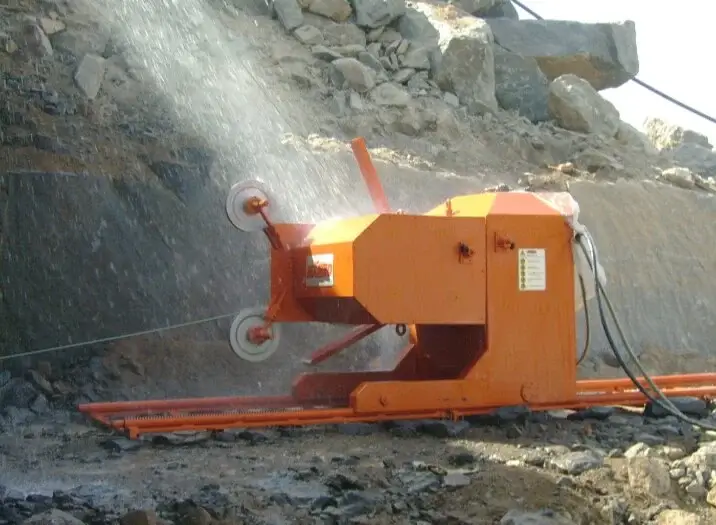
The most effective method of hazard management is complete hazard elimination. In modern dimensional stone extraction, explosives are an outdated and unnecessary risk.Traditional blasting creates “flyrock”—uncontrolled stone fragments that can travel hundreds of meters, posing a lethal threat to personnel and equipment. Furthermore, the seismic shockwaves from explosives induce micro-fractures in the surrounding mountain, leading to unstable cliff faces and increased landslide risks. By switching to pure mechanical cutting with Diamond Wire Saws or Double Blade Cutters, the quarry maintains the structural integrity of the rock, creating a “clean” and predictable environment that is inherently safer for every worker on-site.
Protocol 2: Enforce Safe Operational Distances via Remote Control
Proximity to falling rock is the second highest cause of quarry fatalities. Operators must be physically separated from the cutting face during active extraction.Modern extraction machinery should never require the operator to stand directly next to the cutting slot. MosCut machines feature advanced Wireless Remote Control Systems that allow the operator to stand up to 50 meters away from the machine. From this safe vantage point, the operator can monitor real-time VFD (Variable Frequency Drive) data, wire tension, and motor load. This physical separation ensures that in the event of an unexpected rock shift or wire snap, the human element remains completely protected behind safety barriers or at a safe distance.

Protocol 3: Mandatory Daily Inspections of High-Tension Equipment
Mechanical failures in heavy-duty machinery store massive kinetic energy. A strict daily maintenance checklist is the baseline for preventing catastrophic snap events.A diamond wire saw under tension is like a giant, high-speed loaded spring. If the wire snaps due to poor maintenance, the resulting “whip” effect can be devastating. A mandatory safety inspection must be performed before the first cut of every shift:
- Wire Joint Integrity: Inspect the crimped copper or steel joints for signs of slipping or fraying.
- Flywheel Rubber Liners: Check for deep grooves or hardening that could cause the wire to jump the track.
- Track Stability: For double blade cutters, ensure the railway is perfectly leveled and clear of debris to prevent machine tipping.
- Emergency Stops: Test both the local and remote E-stop buttons to ensure immediate power cutoff.
Protocol 4: Implement Water Suppression for Silica Dust Control
Long-term respiratory health is just as critical as immediate physical safety. Invisible silica dust from granite cutting is a silent quarry killer.Cutting granite and other silica-rich stones produces fine, crystalline dust that stays airborne for hours. Inhaling this dust leads to irreversible lung scarring (Silicosis). Safety protocols must mandate High-Pressure Water Suppression at the point of contact. All MosCut cutting equipment is designed with integrated water manifolds that flood the cutting channel, capturing 99% of airborne dust and turning it into a manageable slurry. This protects not only the machine operator but every worker in the vicinity from long-term health complications.
Protocol 5: Secure Block Tipping with Pneumatic Air Pushing Bags
The final stage of separation—tipping the massive cut block away from the mountain—is notoriously dangerous when using traditional excavators or levers.Once a 200-ton block is cut, it must be gently tipped onto a bed of soft debris for secondary processing. Attempting to “push” this block with an excavator bucket is unstable and often leads to the machine tipping or the block shattering unpredictably. The gold standard for safety is the Pneumatic Air Pushing Bag. These ultra-thin, high-strength bags are inserted into the narrow saw cut. When inflated, they apply thousands of tons of even, gentle pressure, tipping the block away from the face with total control and zero risk of sudden rock movement.
Ready to Upgrade Your Quarry Safety & Efficiency?
Eliminate blasting risks and protect your workforce with MosCut’s remote-controlled, eco-friendly stone quarrying machines. From wireless wire saws to high-precision double blade cutters, we provide the technology for a safer mine.
Explore Our Safety-First Quarrying Solutions