
 Stone Cutting Machines
 Stone Polishing Machines
 Bridge Saw Machines
 Stone Quarry Cutting Machines
 Stone Block Cutter Machine
 CNC Stone Wire Saw Machine
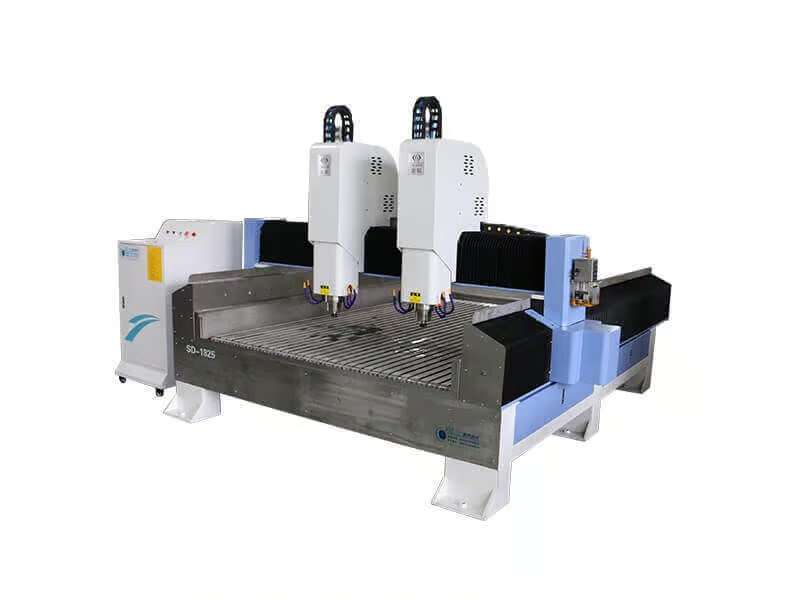 Stone Engraving Machines
 Thin Stone Veneer Saw Machine
 Horizontal Stone Slab Splitting Machine
 Stone Edge Polishing Profiling Machine
 Stone Auxiliary Equipment
In the global extraction of high-value natural stone, material efficiency is no longer just a financial goal but a regulatory necessity. According to the resource efficiency and sustainable lifecycle guidelines established by the International Organization for Standardization (ISO), minimizing industrial waste during the primary extraction of non-renewable geological resources is a cornerstone of responsible mining. For marble and travertine producers, this translates directly into protecting every cubic inch of export-grade material from fracture or over-cutting.
A prestigious white marble quarry on the island of Thasos, Greece, faced a critical challenge with their ultra-premium Thassos White stone. Traditional drilling and blasting methods caused extensive micro-cracking and jagged edges, leading to a usable block yield of only 45%. By integrating MosCut Chain Saw Machines for precision ‘Blind Cutting’ and vertical separation, they successfully increased their premium block yield to 85%. Furthermore, the dry-cutting capability of the chain saw prevented the slurry-water staining often seen in traditional wet-cutting processes.
The Geometry of the ‘Blind Cut’ Advantage
Understanding the kinematics of a plunge cut is the first and most critical step to reducing geometric waste in your quarry.Traditional diamond wire saws require intersecting pilot holes, which can be time-consuming and often result in ‘overcutting’ at the corners where the wire curves. The Chain Saw Machine, however, excels in making a ‘Blind Cut’. The machine can plunge its cutting arm directly into the top of the stone bed and travel vertically to a precise depth. This allows for the creation of perfectly squared, 90-degree internal corners without damaging the adjacent stone. By eliminating overcuts, you preserve the geometric integrity of the surrounding formation, allowing for much tighter spacing between blocks.

Strategic Kerf Management: Preserving Wealth
The thickness of your cutting tool directly translates to lost material. Managing your kerf is literal wealth preservation in a high-value quarry.In stone extraction, the ‘kerf’ is the width of the cut made by the tool. While blasting creates a massive zone of shattered material, and wide-set drills create significant debris, the MosCut Chain Saw utilizes a narrow, torque-optimized chain. Typically, the kerf is kept between 38mm and 42mm. In a 100-meter quarry line, this narrow precision allows an operator to extract an additional full standard-sized block for every 20-30 cuts made compared to less precise methods. When dealing with luxury marble, the market value of that ‘saved’ block can often cover the monthly operating costs of the machine.
Dry Cutting: Yield Benefits in Porous Stones
Water dependency can halt operations and cause thermal shock or staining in certain stones. Dry cutting preserves original material integrity.For stones with high porosity like Travertine or Limestone, the introduction of cooling water is a risk. Water carries stone dust and metallic particles from the machine into the pores of the rock, causing permanent staining or ‘rust spots’ that lower the stone’s grade. MosCut chain saws are engineered with tungsten-carbide or specialized diamond-tipped teeth designed for high-heat dissipation. This allows for ‘Dry Cutting’ operations. By removing the need for water, you ensure that the blocks remain in their pristine, natural state, commanding a higher price at the slab factory.

Preventing ‘Bottom Break-Out’ During Separation
The most common point of catastrophic block failure occurs during the final separation phase at the base of the cut.Even a perfectly cut block can be ruined if the bottom separation isn’t handled with precision. If an operator attempts to tip a block before the horizontal separation is clean, the stone will experience ‘Bottom Break-Out’—a jagged tear that can ruin the bottom 20% of the block. The chain saw machine’s ability to create a deep, uniform vertical slot allows for the seamless insertion of Pneumatic Air Pushing Bags. These bags apply a gentle, even pressure that releases the block from its base along the horizontal wire cut line, ensuring the block remains a perfect cube from top to bottom.
Ready to Maximize Your High-Value Stone Yield?
Stop losing profit to material waste and staining. Upgrade to MosCut’s precision chain saw machines for the straightest cuts and highest block yields in the industry.
Explore Our Precision Chain Saw Solutions