
 Stone Cutting Machines
 Stone Polishing Machines
 Bridge Saw Machines
 Stone Quarry Cutting Machines
 Stone Block Cutter Machine
 CNC Stone Wire Saw Machine
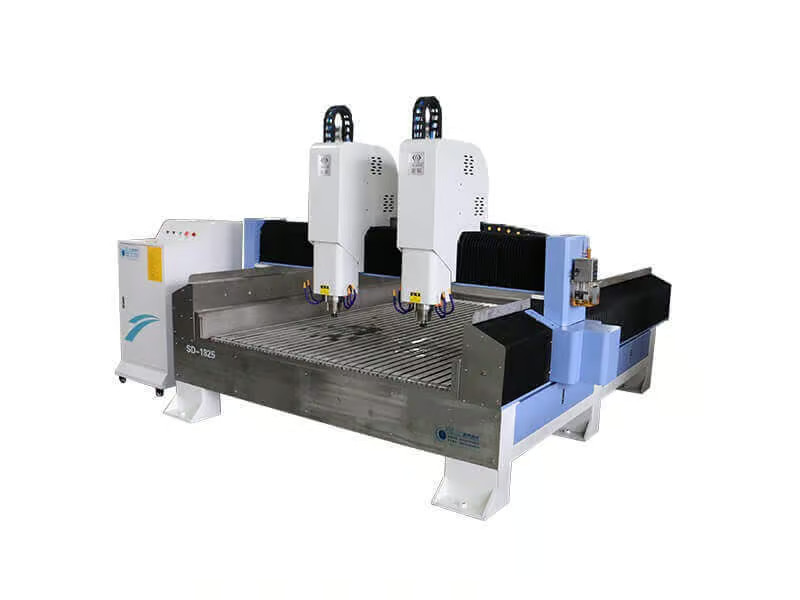 Stone Engraving Machines
 Thin Stone Veneer Saw Machine
 Horizontal Stone Slab Splitting Machine
 Stone Edge Polishing Profiling Machine
 Stone Auxiliary Equipment
Extracting granite, which typically registers between 6 and 7 on the Mohs hardness scale, presents significant challenges in energy consumption and material waste. According to technical reports from the International Society for Rock Mechanics and Rock Engineering (ISRM), modern mechanized cutting methods can reduce block rejection rates by up to 40% compared to traditional drilling and blasting, primarily by eliminating explosive-induced micro-fractures that compromise stone structural integrity.
A major granite quarry operator in Tamil Nadu, India, initially relied exclusively on wire saws for all extraction phases. However, they found that the time required for pilot hole drilling and wire threading on flat quarry beds accounted for nearly 40% of their operational hours. After introducing a fleet of MosCut Double Blade Cutters for their primary benching, they realized a 60% increase in total daily output while simultaneously standardizing their block dimensions for direct factory processing.
The Core Mechanics: How They Extract Granite
Before comparing their profitability, it is crucial to understand that while both machines eliminate blasting, their physical approach to slicing a mountain differs fundamentally.The Diamond Wire Saw Approach
The Diamond Wire Saw functions through high-speed friction. A continuous loop of steel wire, embedded with diamond beads, is wrapped around the rock mass. Driven by a massive VFD-controlled flywheel, the wire pulls through the granite, essentially “shaving” its way through the stone. This method allows for massive primary cuts, separating thousands of cubic meters of stone from the mountain in a single, silent operation.
The Double Blade Milling Approach
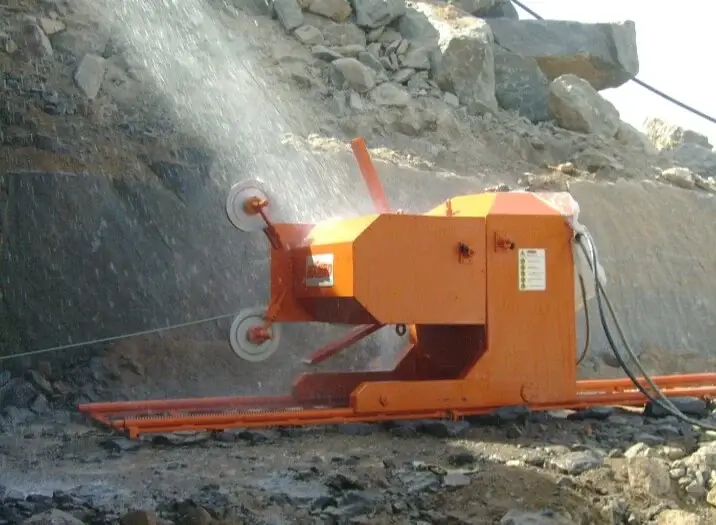
In contrast, the Double Blade Cutter acts as a heavy-duty mobile milling station. Two giant diamond-segmented circular blades rotate at high torque while the entire machine traverses along a precision-leveled rail system. It carves two deep, parallel channels directly into the quarry bed. This “trenching” method produces perfectly squared blocks directly from the bedrock, bypassing the need for secondary squaring entirely.
Terrain Adaptability and Quarry Setup
The geological layout of your granite deposit is the absolute dictator of your equipment choice. A machine fighting against its ideal terrain will drain your profit margins.
Mastering Steep and Irregular Mountainsides
The wire saw is the ultimate “mountain climber.” Because the machine can be positioned hundreds of feet away from the cut, it is indispensable for opening new quarries, tackling steep vertical faces, or making complex horizontal undercuts. If your quarry is characterized by jagged outcrops and irregular terrain, the wire saw is your primary tool.

Dominating Expansive, Flat Quarry Beds
The double blade cutter thrives on order. It requires a relatively flat quarry floor to lay its heavy-duty tracks. However, once the tracks are down, the machine operates with relentless efficiency. For massive horizontal deposits where blocks can be extracted in a grid pattern, the double blade cutter outpaces the wire saw because it eliminates the time-consuming process of drilling intersecting pilot holes.
Resource Consumption: Water and Power Requirements
Cutting solid granite generates immense thermal friction. Effectively managing your off-grid power supply and cooling water is vital for continuous operation.A standard 55kW or 75kW Wire Saw requires a constant, precise flow of water to lubricate the wire and prevent the diamond beads from overheating and detaching. Because the cutting area is often deep within the rock, water management can be challenging in remote quarries.
The Double Blade Cutter, often equipped with twin 55kW or 75kW main motors plus a propulsion motor, demands a robust 3-phase power supply (often requiring 200kVA+ generators). Its cooling requirements are equally intense; the massive blade discs must be continuously showered to flush away the thick granite slurry generated by the high-speed milling action. For large-scale operations, a water recycling and settling pond system is mandatory to ensure the cutters don’t stall.
Cutting Speed, Block Yield, and Standardization
Extraction volume is meaningless if the blocks require excessive secondary trimming. Let’s evaluate how these machines perform in output quality.The Wire Saw Advantage: Its primary strength is the ability to make “massive separation cuts.” It can slice through a 1000m² surface area in a single setup. While the resulting block surface may have slight “wire-bowing” curves, the sheer volume of stone moved per day is unmatched for large-scale mountain opening.
The Double Blade Advantage: This machine is the king of “Net-Zero Trimming.” Because it cuts along a rigid rail, the blocks emerge with 100% straight, vertical edges. These “Lego-like” blocks maximize truck loading capacity and can be sent directly to the factory’s gang saws. This standardization significantly reduces the labor cost associated with manual block squaring in the quarry.
Cost Analysis and Return on Investment
A successful quarry manager looks beyond the initial machine purchase price and calculates the cost per square meter of granite extracted.The **Diamond Wire** is a variable cost. It has a finite lifespan (measured in m² per meter of wire) and carries the risk of snapping if tension isn’t managed correctly by the PLC. For smaller or irregular cuts, the cost per square meter can be higher.
The **Double Blade** uses metal-bonded diamond segments. While the initial investment in a set of giant blades is high, the segments can be re-welded multiple times. On a large, flat granite quarry, the consumable cost of diamond segments per square meter is typically **20% to 30% lower** than diamond wire, leading to a faster ROI in high-volume production environments.
Final Verdict: The Decision Matrix
To simplify your procurement process, use this direct comparison to match the equipment to your specific granite extraction goals.| Feature | Quarry Wire Saw Machine | Double Blade Cutter |
|---|---|---|
| Best Terrain | Mountains, Cliffs, Steep Slopes | Flat Quarry Beds & Benches |
| Setup Complexity | High (Requires drilling & threading) | Moderate (Requires rail leveling) |
| Block Quality | Natural surfaces, may need squaring | Standardized, factory-ready blocks |
| Consumable Cost | Higher (Fixed wire wear) | Lower (Segment re-welding) |
| Operational Safety | Excellent (Remote operation) | Excellent (Stable rail platform) |
The MosCut Pro-Tip: The world’s most profitable granite quarries do not choose one over the other. They use the Wire Saw to open the mountain and make the primary bottom cuts, and the Double Blade Cutter to efficiently “dice” the flat quarry floor into standardized export blocks. This hybrid approach maximizes yield and minimizes waste.
Ready to Upgrade Your Quarry Extraction?
Whether you need the terrain flexibility of a Diamond Wire Saw or the massive standardized output of a Double Blade Cutter, MosCut has the exact machinery to maximize your yield and lower your extraction costs.
Explore All Stone Quarry Cutting Machines