
 Stone Cutting Machines
 Stone Polishing Machines
 Bridge Saw Machines
 Stone Quarry Cutting Machines
 Stone Block Cutter Machine
 CNC Stone Wire Saw Machine
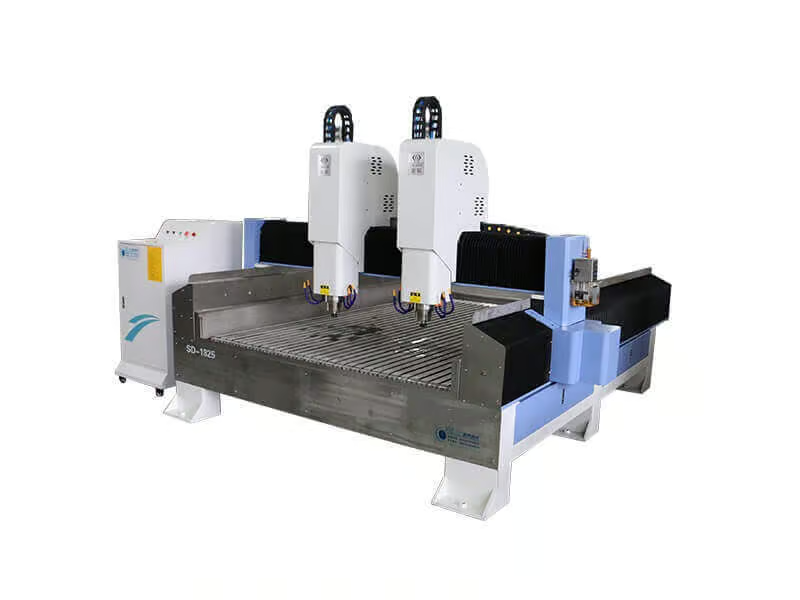 Stone Engraving Machines
 Thin Stone Veneer Saw Machine
 Horizontal Stone Slab Splitting Machine
 Stone Edge Polishing Profiling Machine
 Stone Auxiliary Equipment
In the heavy industrial sector, optimizing how power is transmitted from the motor to the cutting tool is critical for lowering daily operational costs. According to the International Energy Agency (IEA), replacing traditional belt-driven induction motors with Direct-Drive Permanent Magnet Synchronous Motors (PMSM) is a core strategy for reducing industrial energy consumption and slashing corporate electricity overheads. In stone quarrying, this upgrade is not just about ‘going green’—it is about sheer mechanical survival.
A high-volume granite quarry in a rain-heavy region of Portugal struggled constantly with power transmission. Their older belt-driven double blade cutters would suffer severe belt slippage as soon as cooling water and stone slurry coated the pulleys. This resulted in a 30% loss of cutting power and required monthly shutdowns to replace burnt belts. After upgrading to MosCut Direct-Drive Permanent Magnet Cutters, belt slippage was reduced to zero. Even in the worst weather conditions, the direct-coupled blades maintained maximum cutting speed, and their monthly electricity bills dropped by a staggering 22%.
The Mechanics of Belt-Drive: The Slipping Point
Traditional belt-driven systems were the industry standard for decades, but in the muddy, abrasive environment of a stone quarry, they are a massive vulnerability.To transfer rotational force from an electric motor to the main cutting spindle, traditional machines rely on a series of V-belts. In a clean, dry factory, belts work fine. However, a quarry is a battlefield of high-pressure cooling water, abrasive granite dust, and slippery limestone slurry.
When this muddy slurry coats the pulleys, the belts lose their friction. The moment the giant 3-meter diamond blades hit a hard quartz vein, the resistance spikes. Because the belts lack grip, they begin to slip. The motor keeps spinning, but the blades slow down. This slippage causes the belts to squeal, overheat, and eventually burn out, leading to sudden blade jamming and catastrophic segment loss.

The Direct-Drive Advantage: 100% Power Transfer
By eliminating the intermediary belts and pulleys, direct-drive systems deliver unadulterated rotational force directly to the diamond blades.MosCut engineers solved the slippage problem by removing the belts entirely. In our Direct-Drive architecture, the rotor of the motor and the main cutting spindle are integrated into a single, cohesive, co-axial unit.
This physical hard-connection means that 100% of the motor’s torque is transferred instantly to the diamond blades. There are no pulleys to slip and no belts to stretch. When the machine encounters extreme rock densities, it relies on raw, uncompromising torque to grind through the obstacle without missing a single revolution. The result is a rock-solid, incredibly consistent cutting speed that maximizes daily block yield.

Permanent Magnet (PM) Technology Explained
Not all direct-drive systems are created equal. The integration of Permanent Magnet (PM) synchronous motors takes quarry cutting to an unprecedented level of efficiency.Traditional asynchronous induction motors generate their own magnetic field, which consumes extra electricity and results in very weak torque at low speeds (which is why they needed belts and pulleys to ‘gear up’ the force).
Permanent Magnet (PM) Motors, however, feature rotors embedded with rare-earth magnets. Because the magnetic field is permanently present, the motor can deliver massive peak torque at incredibly low RPMs. This is crucial for double blade cutters, as it takes immense starting torque to spin up two 3-ton steel blades. The PM motor achieves this effortlessly, providing a smooth, stepless acceleration that prevents mechanical shock to the machine chassis.

Energy Economics: Slashing the Electricity Bill
In a high-volume quarry, electricity is one of the largest continuous overheads. Direct-drive PM motors directly attack this massive cost center.Every time a V-belt bends around a pulley, it generates heat. That heat represents wasted electricity. Standard belt-driven systems lose roughly 10% to 15% of their energy just overcoming mechanical friction.
MosCut Direct-Drive PM motors eliminate this friction entirely. Furthermore, the inherent electrical efficiency of the permanent magnet design adds another 5% to 8% efficiency gain over standard induction motors. The result? A combined energy savings of up to 20%. For a heavy-duty machine drawing over 100kW and running 10 hours a day, this 20% reduction translates to thousands of dollars saved annually, accelerating your return on investment to unparalleled speeds.

Eliminating Maintenance Downtime
Replacing snapped or stretched belts halts production. Direct-drive technology removes the most common failure point from your machine.Belts are consumables. They stretch, they crack, and they snap. In a traditional setup, operators must constantly stop the machine to adjust the belt tension or spend hours dismantling safety guards to replace broken belts.
With MosCut’s direct-drive architecture, the power transmission is completely maintenance-free. The motor is encased in a heavy-duty, IP65-rated sealed housing, completely protected from water, dust, and operator interference. By removing belts and pulleys from the equation, you eliminate the most frequent cause of unplanned machine downtime, allowing your crew to focus 100% of their time on harvesting premium stone blocks.

Stop Losing Power to Belt Friction
Upgrade to the ultimate efficiency of MosCut Direct-Drive Permanent Magnet Cutters. Reduce your electricity bills and eliminate slippage today.
View Direct-Drive Quarry Cutter