
 Stone Cutting Machines
 Stone Polishing Machines
 Bridge Saw Machines
 Stone Quarry Cutting Machines
 Stone Block Cutter Machine
 CNC Stone Wire Saw Machine
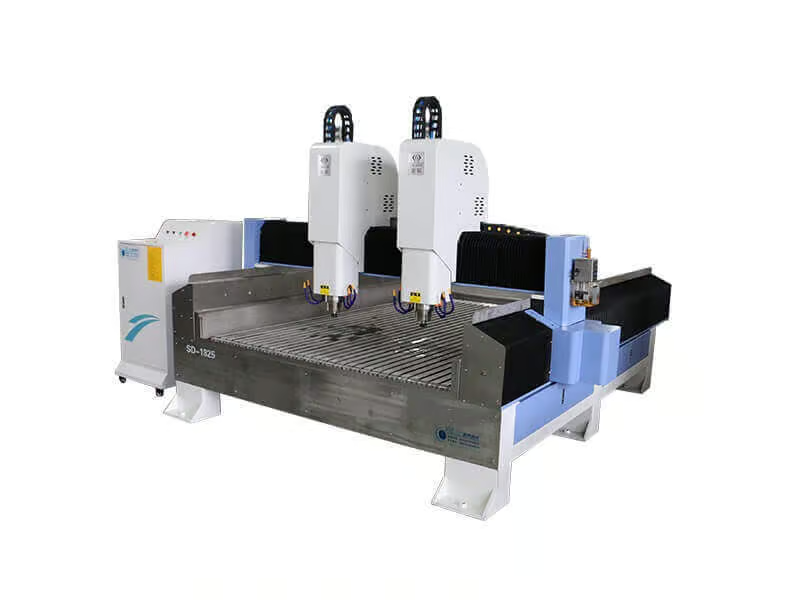 Stone Engraving Machines
 Thin Stone Veneer Saw Machine
 Horizontal Stone Slab Splitting Machine
 Stone Edge Polishing Profiling Machine
 Stone Auxiliary Equipment
In the dimensional stone industry, the volume of rock you extract matters far less than the volume of rock you can actually sell. According to global quarrying efficiency reports published by the United States Geological Survey (USGS), traditional blasting and wedging methods frequently result in a staggering 50% loss of usable stone, relegating high-value material to the crushed gravel pile. Precision mechanical cutting is no longer an optional upgrade; it is the fundamental requirement for maximizing resource profitability.
A top-tier granite and marble extraction facility in Brazil experienced this paradigm shift directly. Relying on a mix of low-yield explosives and older single-blade cutters, their net block yield hovered at a dismal 45%. After a complete operational overhaul utilizing MosCut Double Blade Quarry Cutting Machines, the facility achieved 100% parallel cutting geometry. This transformation instantly eliminated blast-induced micro-fractures and reduced secondary squaring waste to zero, rocketing their net block yield to 92% and effectively doubling their monthly net profit.
The True Cost of Extraction Waste
Waste in a quarry is a double financial penalty. You lose the potential revenue of the stone, and you pay for the diesel to haul the rubble away.Every piece of irregular, non-standard rock that falls to the quarry floor carries a hidden price tag. It is a common misconception that waste stone is simply a ‘free’ byproduct of mining. In reality, producing a pile of rubble means you have actively spent expensive electricity, water, and labor to extract something you cannot sell.
Furthermore, this waste must be cleared. You are paying excavator operators and burning hundreds of liters of diesel fuel just to move this useless rubble out of the way of your active bench. When your block yield is low, every liter of fuel you burn is only half as effective as it should be. Maximizing yield means ensuring that every ounce of energy expended results in a salable product.

Blasting vs. Precision Cutting: A Paradigm Shift
Explosives separate stone through violent shockwaves, compromising the structural integrity of the blocks before they even reach the factory.Explosive extraction is inherently uncontrollable. While it may free a large mass of stone quickly, it destroys the perimeter material and, more critically, introduces micro-fractures deep inside the seemingly intact blocks.
These micro-fractures are a ticking time bomb. A blasted block may look solid in the quarry, but once it is transported to the processing factory and placed under the massive tension of a multi-blade gang saw, the block will shatter along these invisible fault lines. Mechanical extraction using circular diamond blades relies on smooth, physical friction with zero shockwaves, guaranteeing that the internal crystal structure of the stone remains 100% pristine and factory-ready.

The Single-Blade Flaw: The ‘Trapezoid’ Problem
Traditional single-blade cutting relies on repeated repositioning, which inevitably introduces human error and mechanical drift.Many quarries have moved away from blasting, only to rely on outdated single-blade cutters. The inherent flaw of a single blade is the procedure itself: cut one line, manually measure 1.5 meters, lift the rails, reposition the machine, and cut the second line.
This repositioning almost always introduces a margin of error. Worse still, a single massive 3-meter blade cutting through hard granite will naturally experience deflection (bending inward or outward) as it seeks the path of least resistance through the rock’s varying densities. The result is a block that is wider at the bottom than at the top—a ‘trapezoid’. This irregular shape makes the block impossible to process efficiently on standard factory machinery.

Dual-Blade Economics: 100% Parallel Extraction
By locking two diamond blades onto a single rigid spindle, MosCut guarantees absolute geometric precision in every pass.The MosCut double blade machine solves the trapezoid problem through uncompromising physical engineering. Two massive diamond circular blades are firmly mounted onto a single, heavy-duty rigid spindle.
This hard-mounted connection means that no matter how hard the rock gets, the distance between the two blades cannot change. There is no manual measuring between cuts, and there is absolutely no room for independent blade deflection. The machine forces a perfectly parallel path through the stone, creating blocks that are as squared and uniform as manufactured bricks. This pushes your dimensional block yield to the absolute mechanical limit.

Factory-Ready: Premium Pricing for Standard Blocks
Processing factories pay a premium for perfectly squared blocks because they maximize gang-saw efficiency and minimize blade wear.When you deliver a trapezoidal block to a processing factory, they must perform Secondary Squaring—using a wire saw to slice off the uneven ‘belly’ of the stone before it can be placed into a multi-blade gang saw. Factories will heavily penalize you on price to cover this extra labor, time, and lost stone volume.
Conversely, MosCut dual-blade extraction yields ‘Factory-Ready’ standard blocks. Because these blocks feature perfect 90-degree corners and flat faces, processing plants can load them immediately into their saws with zero preparation. This allows you, the quarry owner, to command top-tier export pricing, easily offsetting the investment cost of the dual-blade machine within a few short months.

Stop Leaving Profit in the Rubble Pile
Upgrade your operation from unpredictable blasting to the absolute parallel precision of the MosCut Double Blade Quarry Cutting Machine.
View the Double Blade Cutter