
 Stone Cutting Machines
 Stone Polishing Machines
 Bridge Saw Machines
 Stone Quarry Cutting Machines
 Stone Block Cutter Machine
 CNC Stone Wire Saw Machine
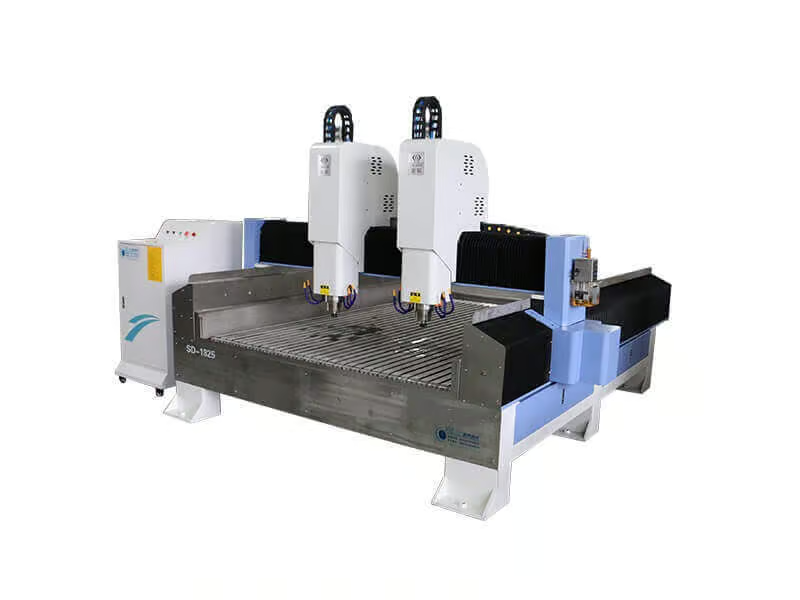 Stone Engraving Machines
 Thin Stone Veneer Saw Machine
 Horizontal Stone Slab Splitting Machine
 Stone Edge Polishing Profiling Machine
 Stone Auxiliary Equipment
In large-scale stone extraction, the machine provides the relentless horsepower, but the diamond segments execute the cut. According to the rock mechanics and tool wear standards established by the International Society for Rock Mechanics (ISRM), the quartz content and abrasiveness of igneous rocks dictate the localized wear rates of diamond tools. There is no such thing as a ‘universal segment’; maximum productivity requires matching the chemical matrix of the tool to the specific geological density of your deposit.
A prominent open-pit operation in Zimbabwe extracting premium ‘Zimbabwe Black’ (an extremely dense, high-quartz gabbro-diabase) suffered terribly from low cutting speeds. Their team was purchasing cheap, generic rectangular segments that would ‘glaze over’ and stop cutting entirely within hours. After collaborating with MosCut engineers to analyze their rock core samples, they transitioned to a custom-engineered, soft-cobalt matrix formula with advanced M-profiles. The result was a immediate 40% extension in overall blade life and a 15% increase in daily horizontal advance speed on their double blade cutters.
The Quartz Problem: Why Granite Destroys Normal Blades
Granite is not a uniform material; it is a complex mineral composite. The true enemy of your circular blade is quartz.Unlike marble, which is composed of relatively soft calcium carbonate (Mohs hardness 3), granite is packed with crystalline quartz, which boasts a brutal Mohs hardness of 7. As the circular saw spins, these hard quartz grains act like heavy industrial sandpaper, relentlessly attacking the metal binder holding the diamonds in place.
If you attempt to use a standard segment designed for soft stones on a granite rock face, the metal matrix will erode instantly. Without support, the valuable diamond crystals will shed prematurely before they have done any actual cutting work, stripping the blade bare in a matter of minutes. Granite extraction requires a highly specialized metallurgical bond capable of resisting this extreme abrasion.

The Counter-Intuitive Rule: Soft Bond for Hard Rock
The most common mistake quarry owners make is requesting a ‘harder’ segment to cut harder stone. Physics dictates the exact opposite.To understand segment selection, you must understand the principle of Self-Sharpening. A diamond segment consists of industrial diamond grits suspended inside a metal matrix (usually a sintered blend of cobalt, copper, iron, and tungsten powder).
When cutting extreme high-hardness granite, the exposed diamonds dull rapidly. For the blade to keep cutting, the metal matrix must be soft enough to wear away at a controlled rate, allowing the blunt diamonds to fall out and exposing a fresh layer of sharp, underlying diamonds. If the metal matrix is too hard, it will not erode. The blunt diamonds will remain trapped, rubbing uselessly against the rock. The segment surface will ‘glaze over’ like smooth glass, causing the main motor current to spike wildly and lock up the machine.

Diamond Concentration and Particle Size Dynamics
Finding the perfect balance between cutting speed and segment lifespan requires fine-tuning the diamond grit inside the metal matrix.The performance of a segment is heavily governed by two internal metrics: diamond grit size (mesh) and diamond concentration.
Coarse Grit + Lower Concentration: This combination creates an incredibly sharp, fast-cutting segment because fewer diamonds are sharing the motor’s power, allowing each crystal to plunge deeper into the rock. However, the segments will wear down faster.
Fine Grit + Higher Concentration: This setup distributes the workload across thousands of tiny, dense diamond points. It delivers an ultra-smooth cutting action and an exceptionally long lifespan, but demands massive electrical power. MosCut customizes this concentration based precisely on your machine’s main motor rating (e.g., matching a high concentration to our heavy-duty 65kW models) to prevent motor overload while optimizing segment longevity.

Segment Shapes: The Advantage of ‘M’ and ‘W’ Profiles
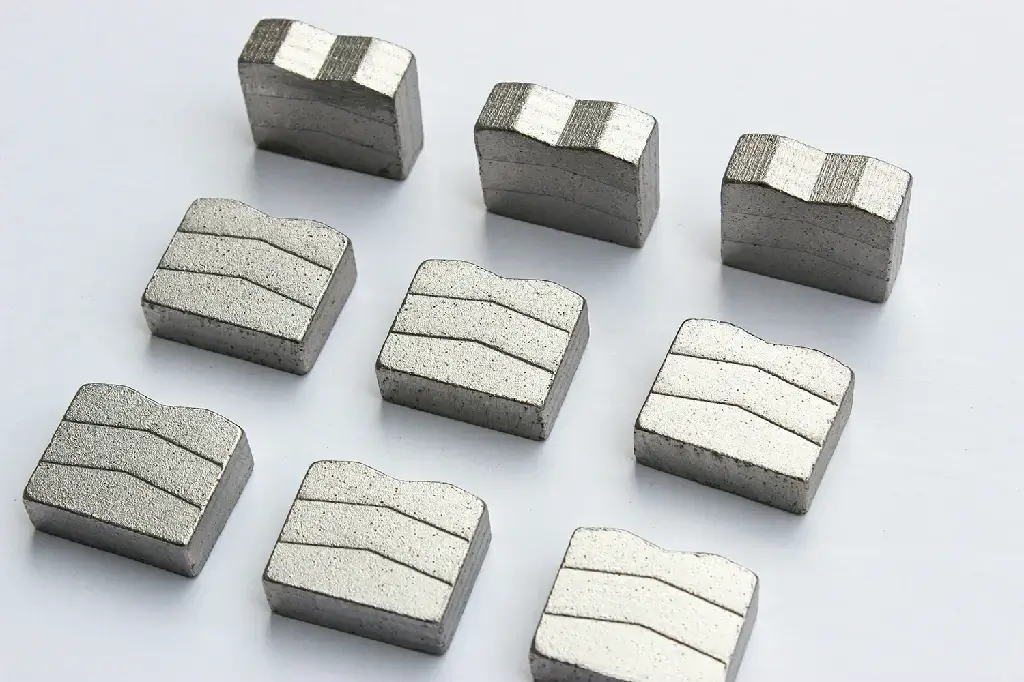
A flat rectangular segment takes hours to expose its diamonds. Engineered profiles drastically reduce the break-in period.Modern quarrying has evolved beyond traditional flat rectangular blocks. Advanced circular blades now feature specialized geometric profiles, such as **’M-Shape’**, **’W-Shape’**, or corrugated side-grooves.
These shapes provide two massive tactical advantages in the pit. First, they drastically reduce the ‘break-in’ or opening period of a new blade. Because the ridges of an M-shape have a much smaller initial surface contact area with the rock, the localized pressure is immense, forcing the blade to sharpen itself and start cutting at full speed on the very first pass. Second, the built-in grooves act as miniature highways, allowing coolant water to penetrate deeper into the 1.5-meter vertical cut slot.
Cooling Dynamics: Preventing Segment Loss
Even the perfect segment formula will fail if the extraction zone lacks adequate water management. Heat is the ultimate destroyer of segments.When twin circular blades are grinding into dense granite at depths exceeding 1,500mm, the friction generates intense thermal energy. If the water cooling volume drops, the temperature at the brazed joint can skyrocket within seconds.
This heat causes the silver solder connecting the segment to the steel core to melt or weaken, resulting in immediate **Segment Loss (dropping teeth)**. Losing segments inside a deep cut is a nightmare—the loose segments will bind against the remaining teeth, tearing them off and potentially warping a multi-thousand-dollar steel blank. Always maintain a steady 5m³/h water flow and ensure the nozzles direct the stream precisely into the cut channel.

Pair Premium Power with Custom Matrix Tools
Stop burning through generic circular blades. Let MosCut formulate the perfect diamond segments tailored to your quarry’s geology and unlock maximum output.
Explore MosCut Machinery Solutions