
 Stone Cutting Machines
 Stone Polishing Machines
 Bridge Saw Machines
 Stone Quarry Cutting Machines
 Stone Block Cutter Machine
 CNC Stone Wire Saw Machine
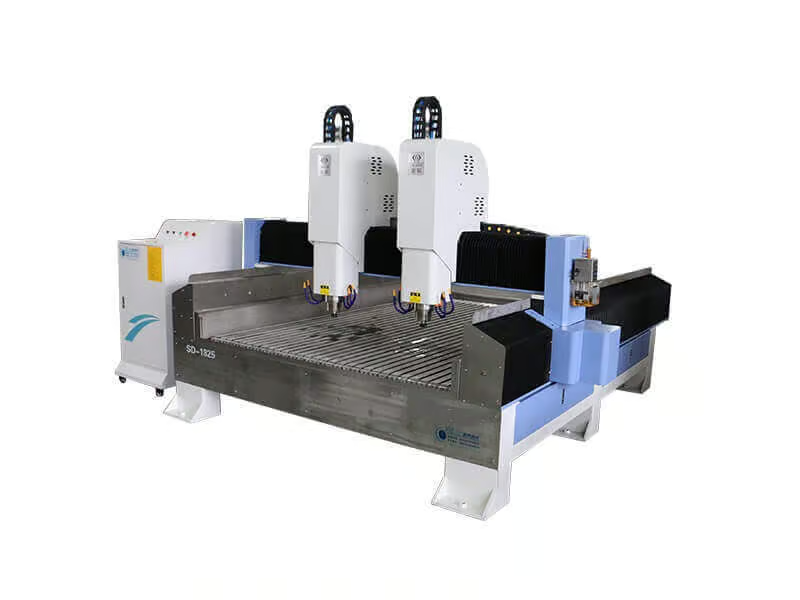 Stone Engraving Machines
 Thin Stone Veneer Saw Machine
 Horizontal Stone Slab Splitting Machine
 Stone Edge Polishing Profiling Machine
 Stone Auxiliary Equipment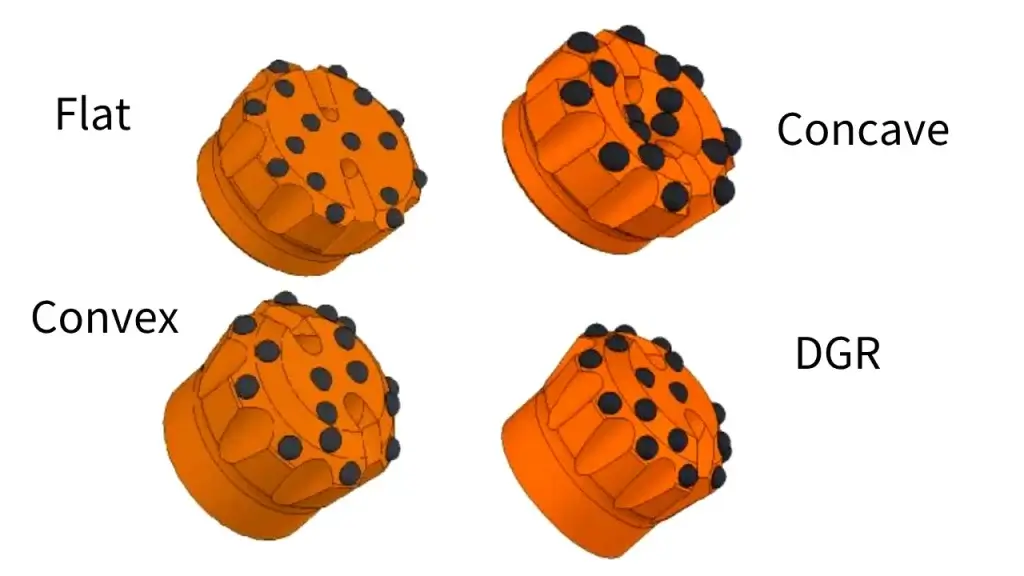
In high-performance quarry drilling, there is no such thing as a “universal” drill bit. According to geotechnical literature published by the American Rock Mechanics Association (ARMA), the Uniaxial Compressive Strength (UCS) and fracture state of the rock formation demand specific tool geometry for efficient energy transfer. The “face” of the drill bit—whether it is concave, convex, or flat—dictates the trajectory of the percussive shockwave and the airflow path for rock cuttings. Utilizing the wrong face design in a complex geological formation can lead to a 40% loss in penetration rate and severe deviation of the borehole trajectory.
A marble extraction company in Turkey operating in heavily fractured and faulted geological zones consistently struggled with vertical pilot holes drifting off-target. This deviation made wire saw intersections nearly impossible. Upon inspection, MosCut field engineers discovered operators were using standard Flat Face bits, which tend to “skate” when hitting angled natural fissures. By transitioning their inventory strictly to Concave Face bits, the quarry leveraged the “self-centering” physical properties of the indented face. The bit tracked perfectly straight through the fractured zones, improving their hole straightness by 100% and drastically reducing wire saw setup times.
The Physics of Penetration: Why Face Shape Matters
You are fighting two enemies simultaneously: solid rock resistance and accumulated rock dust. The bit face determines which enemy you conquer first.Every time the DTH hammer strikes, the tungsten carbide buttons shatter the rock. However, the subsequent challenge is immediate: how do you get those rock chips out of the way before the next strike? If the cuttings are not evacuated instantly, the bit begins to grind its own dust, a phenomenon known as ‘secondary crushing’, which rapidly destroys the carbide buttons and stalls penetration.
The geometric face of the drill bit is specifically engineered to direct high-pressure exhaust air. Certain face designs prioritize massive, wide air channels to blow out soft, sticky rock dust rapidly. Other face designs prioritize maximum steel mass and structural integrity to withstand the brutal, unrelenting impact of extreme high-quartz granite. Matching the face profile to the specific rock condition ensures optimal energy transfer and fluid dynamics at the bottom of the hole.

The Core Four: Face Designs Explained
Understand the distinct mechanical advantages of the four primary DTH bit geometries to optimize your quarrying operations.📏 Flat Face: The Hard Rock Hammer
Design: The front of the bit is completely flat. All inner buttons are on the exact same horizontal plane.
Characteristics: This is the most robust and durable design. Because the face is flat, it contains the maximum amount of solid steel mass to absorb severe percussive shockwaves.
Ideal Application: Extremely hard, highly abrasive, and solid (non-fractured) formations like high-quartz granite or basalt. When brute force is required over finesse, the Flat Face delivers.
⛰️ Convex Face: The Fast Penetrator
Design: The center of the bit protrudes outward (like a dome), placing the center buttons slightly ahead of the gauge buttons.
Characteristics: The domed shape creates exceptionally wide and deep flushing channels. This allows for massive volumes of air to rapidly evacuate heavy or sticky rock cuttings.
Ideal Application: Soft to medium-hard rock (like standard limestone and soft marble). It provides the highest penetration rate possible but is prone to drifting if it hits angled hard-rock faults.
🎯 Concave Face: The Straight Shooter
Design: The center of the bit is smoothly indented inward (bowl-shaped), creating a conical depression.
Characteristics: As it drills, the indented center leaves a small cone of rock in the middle of the hole. The bit continuously rides over this cone, creating a powerful “self-centering” physical effect.
Ideal Application: Medium-hard to hard rock that is heavily fractured, faulted, or jointed. When maintaining an absolutely straight hole is critical for wire saw intersections, the Concave face prevents deviation.
🕳️ Drop Center Face: The Aggressive Hybrid
Design: Features a wide, flat outer gauge ring with a sudden, deeply recessed center section.
Characteristics: Combines the massive outer steel strength of a Flat face with the extreme self-centering tracking of a Concave face. It generates the largest rock chips and blows them out instantly.
Ideal Application: Soft-to-medium but highly abrasive rock where both maximum penetration speed and strict hole straightness are required simultaneously. A favorite for deep-hole limestone drilling.
Button Profiles: Spherical vs. Ballistic
The face shape dictates the airflow, but the button shape dictates how the rock fractures.Once you select the correct face geometry, you must choose the shape of the Tungsten Carbide (TC) inserts. The two primary profiles used in stone quarrying are Spherical and Ballistic.
Spherical Buttons (Domed): These are semi-circles. They possess the highest structural strength and are incredibly resistant to chipping and breaking. They are mandatory for extremely hard, abrasive granite where impact forces are immense. While they drill slightly slower, their lifespan is vastly superior in brutal conditions.
Ballistic Buttons (Parabolic): Shaped like a bullet, these buttons penetrate deeper into the rock on every strike. They generate significantly faster drilling speeds in medium-hard rocks like marble and limestone. However, if used in extreme hard rock or fractured zones, the prominent tip is highly vulnerable to sideways shear forces and will easily snap off.

The Ultimate Selection Matrix
Use this chart to instantly match the geological reality of your quarry with the optimal MosCut bit configuration.| Rock Hardness | Rock Condition | Recommended Face Design | Recommended Button Shape |
|---|---|---|---|
| Hard (Granite / Basalt) | Solid / Uniform | Flat Face | Spherical |
| Hard (Granite / Quartzite) | Fractured / Faulted | Concave Face | Spherical |
| Medium (Marble / Hard Limestone) | Solid / Uniform | Flat or Convex Face | Semi-Ballistic or Spherical |
| Medium (Marble / Hard Limestone) | Fractured / Jointed | Concave Face | Spherical |
| Soft (Travertine / Soft Limestone) | Solid / Porous | Convex Face | Ballistic |
Equip Your Rig with the Perfect Tool
Stop guessing and start optimizing. Maximize your penetration rate and eliminate borehole deviation with MosCut’s precisely engineered DTH drilling equipment.
Explore MosCut DTH Machines & Consumables