
 Stone Cutting Machines
 Stone Polishing Machines
 Bridge Saw Machines
 Stone Quarry Cutting Machines
 Stone Block Cutter Machine
 CNC Stone Wire Saw Machine
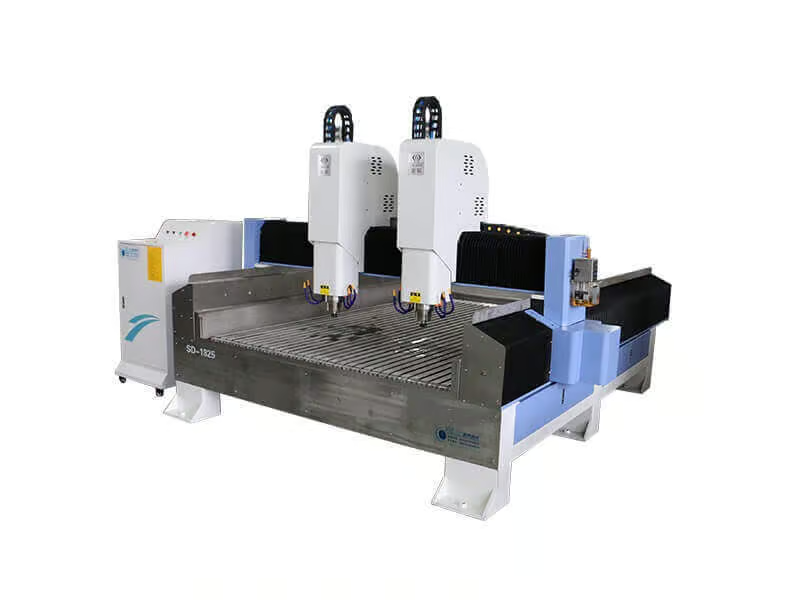 Stone Engraving Machines
 Thin Stone Veneer Saw Machine
 Horizontal Stone Slab Splitting Machine
 Stone Edge Polishing Profiling Machine
 Stone Auxiliary Equipment
A seismic shift is actively rewriting the global architectural supply chain. For centuries, incorporating natural stone into a building meant adding crushing dead weight. Today, strict seismic regulations mandated by the Council on Tall Buildings and Urban Habitat (CTBUH) and aggressive carbon-reduction targets set by the LEED Green Building Rating System are rapidly phasing out the use of thick 3cm to 5cm solid stone slabs on high-rise exteriors. The market has violently pivoted toward Lightweight Stone Composite Panels—a marriage of a 5mm ultra-thin natural stone veneer laminated to high-strength aluminum honeycomb. This revolutionary material offers 100% of the natural aesthetic while eliminating 80% of the weight, and possesses impact strength five times greater than solid rock.
A leading traditional stone supplier in Dubai, UAE, recently transformed their entire business model through this realization. While bidding on a multi-million-dollar contract for a “7-Star” luxury hotel, their original proposal using 2cm solid marble for elevator lobbies and high-altitude cladding was rejected outright. The structural engineers calculated that the immense weight of the solid stone would exceed the elevator cab load limits and require an exponentially more expensive steel superstructure for the facade. Facing a lost contract, the supplier urgently integrated three MosCut Heavy-Duty Horizontal Splitting Machines into their floor. By horizontally slicing their premium marble blocks into extreme 5mm veneers and laminating them to aluminum honeycomb, they slashed the delivered weight by over 75%. Not only did they win the lucrative contract, but by turning one 2cm slab into three sellable 5mm veneers, their net profit margin soared by 200%.
⚖️ The Physics of Profit: The Dead Load Reduction Formula
In the modern construction economy, every kilogram of “dead weight” eliminated from the facade translates directly into thousands of dollars saved in structural steel reinforcement and international ocean freight.
Consider the math: A standard 2cm (20mm) thick solid marble slab weighs approximately $55text{kg/m}^2$. A lightweight composite panel (featuring a 5mm marble veneer sliced by a MosCut machine, bonded to a 15mm aluminum honeycomb backing) weighs just $16text{kg/m}^2$.
The Freight ROI: Due to heavy weight limits on shipping containers, a standard 20-foot container maxes out at roughly 400 square meters of 2cm solid stone. By switching to lightweight composites, that same container can hold up to 1,200 square meters of material before hitting the weight limit. You immediately slash your global logistics costs by two-thirds.
Market Driver 1: High-Rise Seismic Cladding
Defying gravity and extreme wind shear with aerospace-grade composite matrixes.Traditional thick stone cladding is rigid and brittle. During an earthquake or under the extreme wind shear forces found at the top of a skyscraper, thick stone cannot flex. Instead, it fractures at the anchor points, creating a catastrophic hazard of falling 50kg stone blocks. Aluminum honeycomb stone composites are fundamentally different. Due to the tough, flexible epoxy resin bond and the ductile aluminum structure, the panel can undergo microscopic elastic deformation alongside the building’s sway. This shatter-proof, lightweight nature has made it the mandatory specification for curtain walls in seismic zones across North America and the Middle East.

Market Driver 2: Superyachts & Aerospace Interiors
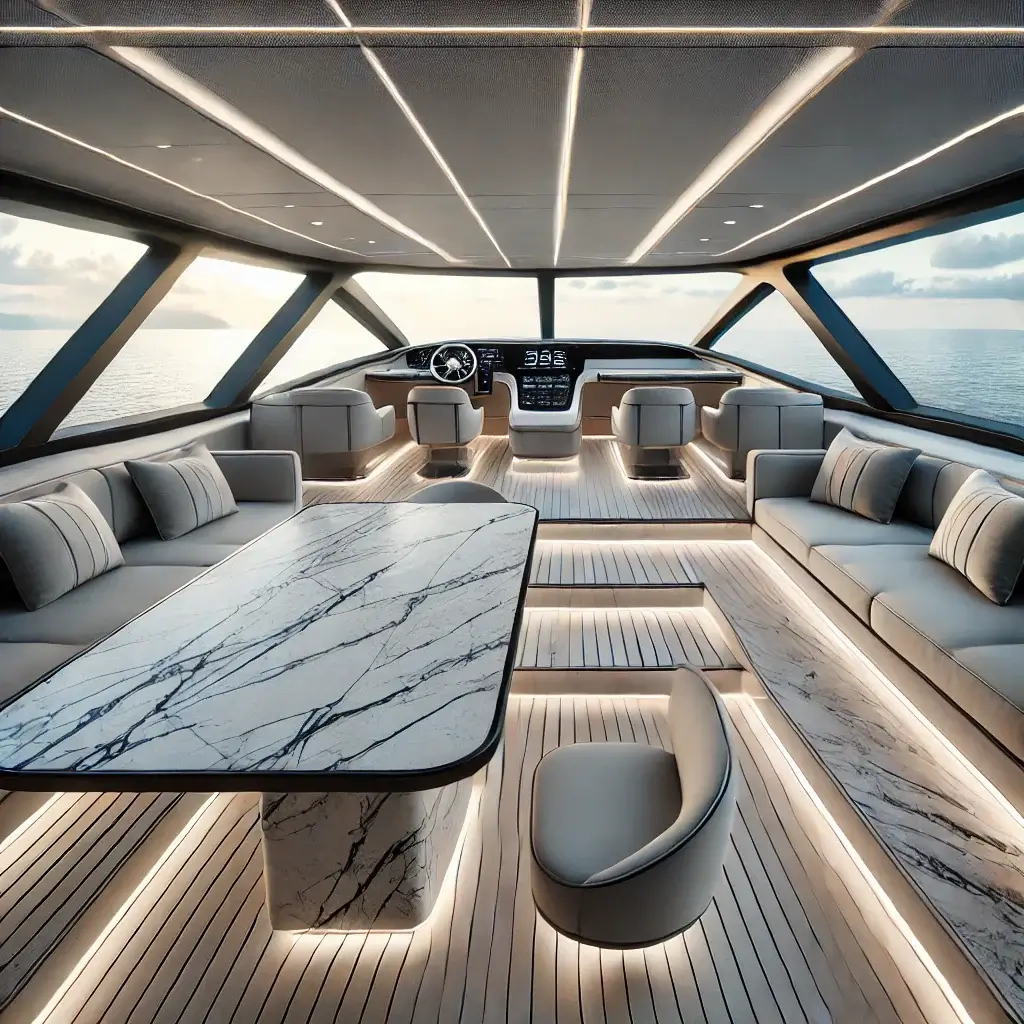
Bringing the Earth’s heaviest luxury materials into the ocean and the sky.Weight is the ultimate enemy of speed and fuel efficiency. For decades, the designers of multi-million-dollar Superyachts and private jets were forced to compromise, using cheap-looking faux-stone laminates to save weight. Today, precision horizontal slicing has shattered that limitation. By slicing exotic marbles and quartzites down to an astonishing 3mm and backing them with ultra-light carbon fiber or fire-retardant honeycomb boards, fabricators deliver 100% genuine stone aesthetics without adding a single gram of unnecessary ballast. This niche market commands the highest square-meter premium in the entire stone industry.
Market Driver 3: Backlit Translucent Luxury Design
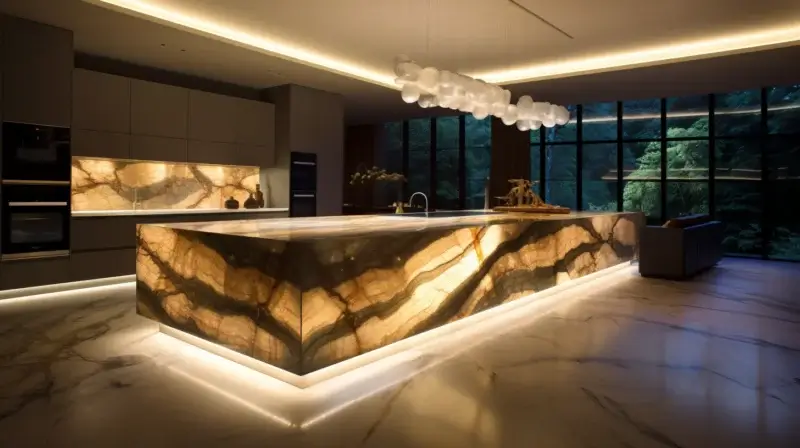
Reinventing interior design by transforming solid rock into radiant, glowing art.Beyond structural benefits, ultra-thin slicing unlocks hidden optical properties. Semi-precious stones like Onyx, Agate, and certain high-end quartzites become incredibly translucent when sliced below 6mm. By horizontally slicing these rare blocks and laminating the thin veneers to ultra-clear tempered glass, interior designers create breathtaking, continuous backlit feature walls. Furthermore, the extreme lightness of the panels allows natural stone to be safely mounted on floating kitchen cabinetry doors and ceiling accents—applications where traditional heavy stone was previously impossible.
How to Enter the Market: The MosCut Precision Advantage
The barrier to entry isn’t capital; it’s the capability to slice flawlessly at a mass-production scale.🏗️ Unyielding Rigid Architecture
You cannot cut a 5mm veneer on a shaking machine. MosCut’s ultra-heavy gantry cast-iron chassis guarantees zero harmonic vibration, even when pushing 2250mm wide jumbo slabs, ensuring your ultra-thin panels never shatter mid-cut.
🛡️ Zero-Fracture Conveyance
Premium exotic stones are naturally riddled with fissures. Our horizontal flat-bed conveyance, supported by shock-absorbing rubber and pneumatic pressure rollers, prevents gravity and water from breaking delicate slabs during the splitting process.
⚙️ Turnkey Scalability
MosCut doesn’t just sell saws. As your lightweight panel business explodes, our horizontal splitting machines seamlessly integrate into our fully automated calibration, drying, and epoxy lamination production lines.
Capitalize on the Lightweight Stone Revolution
The era of heavy, inefficient stone processing is over. Position your factory at the forefront of the high-margin architectural revolution. Equip your floor with MosCut’s horizontal splitting technology and start commanding premium market prices today.
View MosCut Horizontal Splitting Machines