
 Stone Cutting Machines
 Stone Polishing Machines
 Bridge Saw Machines
 Stone Quarry Cutting Machines
 Stone Block Cutter Machine
 CNC Stone Wire Saw Machine
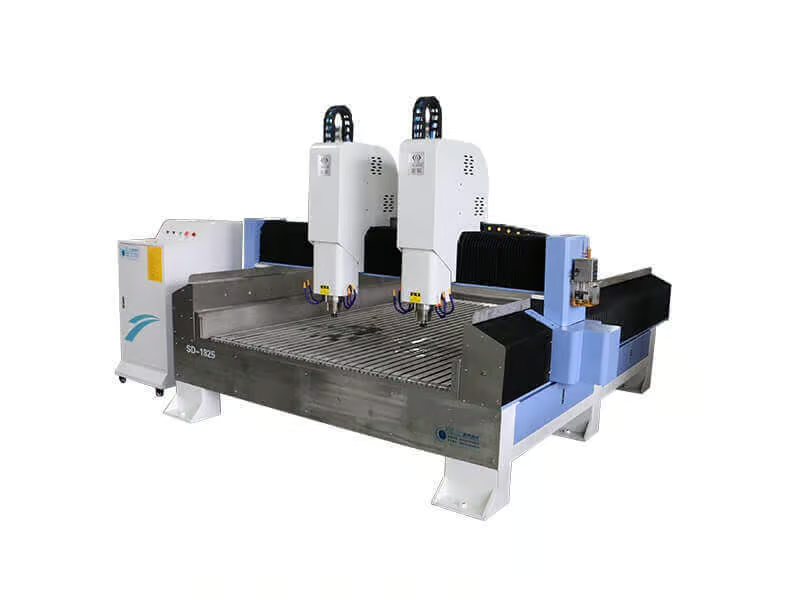 Stone Engraving Machines
 Thin Stone Veneer Saw Machine
 Horizontal Stone Slab Splitting Machine
 Stone Edge Polishing Profiling Machine
 Stone Auxiliary Equipment
In the heavy machining environment of a stone quarry, visual precision is the ultimate indicator of mechanical health. When a massive circular saw blade (2.0 to 4.2 meters in diameter) begins to twist and flutter inside a cut, operators describe it as “Wobbling.” In metallurgical engineering, this is diagnosed as “Dynamic Lateral Runout.” According to rigid body geometric tolerancing standards defined by the American National Standards Institute (ANSI), a minor angular deviation at the central mounting hub is drastically amplified over distance. On a 3000mm diameter steel disc, a microscopic 0.1mm irregularity at the machine flange will multiply into a violent 5mm to 10mm lateral slapping motion at the cutting edge. This violent alternating stress creates deep wavy patterns in the extracted stone, strips diamond segments off the core, and can ultimately tear apart the main spindle bearings of a multi-million-dollar extraction machine.
A major commercial quarry in Brazil recently faced a production halt when a newly installed 3.3-meter blade began violently vibrating, cutting erratic, snake-like trenches into the bedrock. Frustrated, the quarry owner assumed the blade was defective and prepared to authorize a $15,000 replacement of the machine’s primary transmission spindle. A MosCut field engineer intervened and initiated a strict diagnostic protocol. Upon removing the blade, the engineer discovered a nearly invisible, 0.5mm-thick crust of compacted rock dust hardened onto the inner surface of the machine’s mounting flange. This tiny layer of dirt was acting as a wedge, tilting the massive blade off-axis. After thoroughly scrubbing the flange with wire brushes and solvents, the blade was remounted. The wobbling vanished instantly, the cuts returned to perfect laser-straight lines, and the quarry saved both a ruined blade and an expensive, unnecessary mechanical repair.
The Diagnostic Test: The “Air Spin”
Before you blame the blade or the rock, you must isolate the variable. Start with the dry spin.When you detect wavy cuts or hear the blade screaming, your first action must be to perform a diagnostic Dry Air Spin Test. Elevate your machine so the blade is completely suspended in the air, far away from the rock face. Turn the motor on and slowly ramp it up to full operating RPM without any water. Stand at a safe distance and look precisely at the outer edge (the diamond segments) relative to a fixed point.
The Diagnostic Logic:
- Scenario A: If the blade wobbles violently left and right while spinning in the air, the issue is 100% mechanical. You either have a dirty flange, a bent machine spindle, or the blade’s steel core was severely bent during shipping/storage.
- Scenario B: If the blade spins perfectly true and flat in the air, but begins to twist and scream the moment it enters the stone, the problem lies in operational physics. You are facing an RPM mismatch, poor water cooling, or worn-out segments causing friction.

⚠️ Culprit 1: The Dirty Flange (The Multiplier Effect)
If your blade fails the air spin test, check the flanges immediately. The metal plates (flanges) that clamp the blade to the motor must be surgically clean. Quarry environments are notoriously dirty. If a single grain of quartz sand, a flake of rust, or dried stone mud gets trapped between the blade and the flange during installation, it acts as a microscopic wedge.
Because of the Multiplier Effect, a 0.2mm piece of debris at the 150mm center hub will tilt the blade enough to create a massive 8mm wobble at the edge of a 3000mm disc. The Fix: Every time you change a blade, you must use a heavy wire brush, abrasive pads, and solvent to scrub both the machine flange and the blade center until they shine like bare metal.
Culprit 2: RPM and Tension Mismatch
Blades are factory-tensioned for a specific centrifugal force. Ignore the speed limit, and the blade loses its rigidity.📉 Running Too Slow
Premium quarry blades like MosCut are “Dynamic Tensioned” to operate at specific high speeds. If your machine’s motor is old, underpowered, or the inverter is set too low to save electricity, the blade will not spin fast enough to generate the required centrifugal outward force. Without this force, the steel core remains loose and “floppy,” guaranteed to buckle and weave the moment it touches the rock.
📈 Running Too Fast
Conversely, if you run the blade at an RPM far exceeding its design limit, the extreme centrifugal force over-stretches the steel core. This shatters the delicate thermal-stress equilibrium built into the blade at the factory. The outer rim becomes stretched out, causing high-frequency “fluttering” and extreme heat buildup that will permanently warp the steel.
Culprit 3: Loss of Side Clearance
If the steel core physically touches the rock wall, the blade is doomed to warp.Every diamond saw blade relies on a critical engineering dimension known as Side Clearance (or Kerf width). The diamond segments brazed onto the edge are intentionally wider than the steel core behind them. For example, a 9.0mm thick steel core will have a 12.5mm wide diamond segment. This creates roughly 1.75mm of empty space on both sides of the blade as it cuts.
This gap is mandatory. It allows cooling water to flow down to the cutting zone and flushes abrasive rock slurry up and out. As the blade ages, the sides of the diamond segments wear down. If the segments wear down so much that they are the exact same thickness as the steel core (0 clearance), the massive steel plate will begin grinding directly against the solid rock walls. The resulting extreme friction heat will warp the steel core in seconds, locking the blade rigidly inside the stone.

💧 Culprit 4: Asymmetrical Water Cooling
A frequent and easily avoidable operator error involves poor water management. A 3-meter blade generating extreme heat must be cooled equally from both sides simultaneously. If a water pipe on the machine becomes clogged, or the jets are misaligned, water might only spray heavily on the left side of the blade while the right side remains relatively dry.
Due to the laws of thermodynamics, the hot, dry right side of the steel core will expand rapidly, while the cool, wet left side will contract. This uneven thermal stress forces the flat steel disc to instantly bend into a “bowl” or “cup” shape (Dishing). A bowl-shaped blade will cut a severely curved, wavy trench into your quarry floor. Always verify dual-sided, high-volume water flow before dropping the blade into the rock.
Stop Fighting with Warped Steel
Eliminate wavy cuts, protect your machinery, and maximize your block yield. Equip your quarry with MosCut’s precision-leveled, laser-straight quarry blades, engineered for absolute stability.
View MosCut Precision Blades