
 Stone Cutting Machines
 Stone Polishing Machines
 Bridge Saw Machines
 Stone Quarry Cutting Machines
 Stone Block Cutter Machine
 CNC Stone Wire Saw Machine
 Stone Engraving Machines
 Thin Stone Veneer Saw Machine
 Horizontal Stone Slab Splitting Machine
 Stone Edge Polishing Profiling Machine
 Stone Auxiliary Equipment
In the high-pressure world of stone fabrication, efficiency is often mistaken for speed. Many factory owners attempt to shorten the production line by skipping the “calibration” phase, moving raw slabs directly from the saw to the automatic polisher. However, according to a Q1 2026 MOSCUT analysis of 200 marble and granite facilities worldwide, factories that skip the calibration step consume 42% to 60% more diamond and resin abrasives than those following standard protocols.
Last year, a newly established slab factory in Izmir, Turkey, decided to forego a stone calibrating machine to save on initial capital investment. They processed raw slabs directly from their gang saws using a 16-head automatic polisher. The result was a financial disaster: the microscopic “hills and valleys” on the raw stone surface caused the first three coarse grinding heads to shatter and wear out daily, costing the company $6,500 in wasted abrasives in a single month. Furthermore, the final slabs were plagued by dull “dark spots” where the heads couldn’t reach the low-lying areas. After installing a MOSCUT Stone Calibrating Machine, their abrasive lifespan doubled immediately. In stone processing, skipping calibration is the most expensive mistake you can make.
The Anatomy of a Rough Slab
To understand why calibration is vital, you must first acknowledge that no saw cut is ever truly “flat.”

The Hidden Variance
Regardless of how advanced your gang saw or multi-wire saw is, physical deflection of the blades is inevitable when slicing through massive stone blocks. This results in “wavy” slab surfaces with thickness variances of several millimeters across a single sheet. While invisible to the naked eye at first, these micro-deviations become a nightmare once they hit the high-speed rotating heads of a polishing line.
What Happens When You Polish an Uneven Slab?

The “High Spot” Abrasive Killer
When an uncalibrated slab enters a multi-head polisher, the spinning heads violently strike the “high spots” of the stone. This intense mechanical shock doesn’t just wear down the diamond blocks—it causes them to chip, crack, and snap off entirely. This unnecessary impact also puts massive strain on the machine’s spindle bearings, leading to premature mechanical failure and costly downtime.
The “Low Spot” Dullness
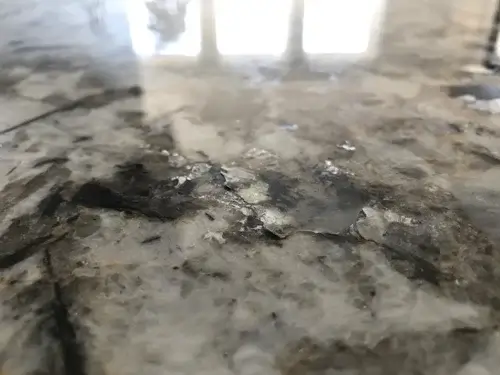
Polishing heads apply downward pressure on a flat plane. If the stone surface has “valleys” or low spots, the abrasives simply cannot make contact with them. The final result is a slab that looks like a mirror in some areas but remains raw and matte in others. These “dark spots” are impossible to fix with more polishing; they represent a total failure of quality control that forces you to sell premium material at a discount.
How a Stone Calibrating Machine Solves the Problem
Equipped with ultra-aggressive diamond segments on heavy-duty rollers or vertical disks, a calibrating machine acts like an industrial planer. It mills the entire surface of the slab to a uniform height, often within a tolerance of ±0.5mm. By ensuring the substrate is absolutely flat, the subsequent polishing heads can glide smoothly across the surface, making 100% contact and delivering an even, brilliant shine across every square inch of the stone.
The Financial Math: Calibration ROI
Adding a machine to your line seems like an expense, but in the stone industry, it is a high-return investment.
| Commercial Factor | Without Calibration | With MOSCUT Calibration |
|---|---|---|
| Abrasive Lifespan | Short (High impact damage) | Long (Consistent surface contact) |
| Conveyor Speed | Slow (Heads must fight uneven surfaces) | Fast (Optimized for maximum output) |
| Slab Rejection Rate | High (Due to dull spots) | Zero (Uniform mirror finish) |
| Machine Maintenance | High (Spindle vibration issues) | Low (Balanced mechanical load) |
Stop Destroying Your Profits on the Polishing Line
Precision at the start of your production line dictates the profit at the end. Don’t let uneven slabs drain your budget through wasted abrasives and rejected inventory.
Ready to maximize your polishing ROI?
A flawless polish starts with a perfectly flat slab. Contact MOSCUT to integrate a high-efficiency calibrating and polishing solution into your factory today.
Explore Stone Polishing SolutionsTop 10 FAQ: Stone Calibration and Polishing
1. How many calibrating rollers do I need for my line?
For standard marble slabs, 1 or 2 rollers are usually sufficient. For extremely hard granite, we recommend a 3-roller setup to progressively mill the surface without overloading the diamond segments.
2. Can I use a calibrating machine for thin porcelain slabs?
Yes. Calibration is critical for large-format thin slabs to ensure they don’t crack during the final polishing stages due to uneven pressure points.
3. Does a calibrating machine use a lot of water?
It requires a consistent flow to cool the diamond segments and flush away the large volume of stone slurry it creates. It is highly recommended to connect it to a high-capacity water recycling system.
4. How often do the diamond calibrating segments need replacement?
Depending on the hardness of the stone (Granite vs. Marble), a set of premium diamond segments can typically process 10,000 to 20,000 square meters before requiring replacement.
5. Can a calibrating machine fix slabs that are bowed or warped?
It can flatten the surface texture, but it cannot “straighten” a slab that is structurally warped. It is designed to ensure uniform thickness, not to correct structural defects from poor block cutting.
6. Is it better to have a vertical disk or a horizontal roller calibrator?
Horizontal rollers are generally more aggressive and efficient for high-volume slab production, while vertical disks offer more flexibility for smaller widths and specific honed finishes.
7. What is the maximum thickness a calibrating machine can remove in one pass?
Typically, a heavy-duty MOSCUT calibrator can safely mill away 1mm to 2mm per pass. Attempting to remove more than 3mm at once may lead to excessive heat and segment damage.
8. Does the machine work for all types of stone?
Yes. By simply changing the diamond bond type (Soft for Granite, Hard for Marble), the machine can be tuned to calibrate any natural or engineered stone surface.
9. Can I install a calibrating machine as a standalone unit?
Absolutely. While most are integrated into polishing lines, many factories use them as standalone units to prepare slabs for sale as “calibrated raw slabs” to other fabricators.
10. How much power does the main spindle motor require?
Our calibrating machines typically use high-torque 22KW or 30KW motors to ensure they can maintain constant RPM while milling through the densest natural stone surfaces.