
 Stone Cutting Machines
 Stone Polishing Machines
 Bridge Saw Machines
 Stone Quarry Cutting Machines
 Stone Block Cutter Machine
 CNC Stone Wire Saw Machine
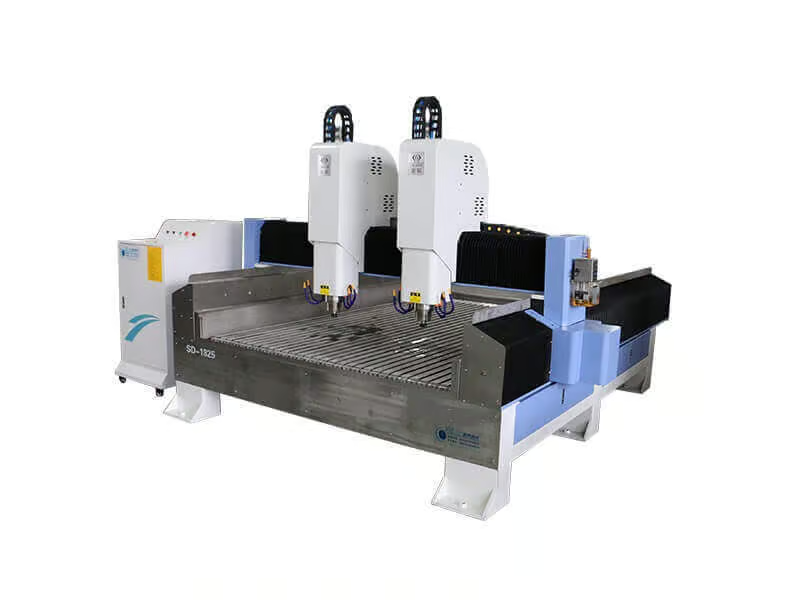 Stone Engraving Machines
 Thin Stone Veneer Saw Machine
 Horizontal Stone Slab Splitting Machine
 Stone Edge Polishing Profiling Machine
 Stone Auxiliary Equipment
The global luxury stone market is currently witnessing an unprecedented surge in demand for exotic and highly varied materials, ranging from translucent soft marbles to ultra-dense, abrasive quartzites. According to recent stone industry export analysis provided by the National Stone Institute (NSI), the diversification of material hardness in modern fabrication plants has rendered “fixed-speed” machinery obsolete. To maintain profitability in 2026, factory directors must transition toward intelligent automation that allows for rapid, material-specific calibration, ensuring that thin-slab integrity and high-gloss uniformity are preserved across every unique project.
Located in the heart of Carrara, Italy, a high-end luxury stone gallery faced a significant operational hurdle: their production schedule required them to switch between processing delicate local Carrara Marble and extremely hard imported Granites multiple times a day. Their legacy machinery required hours of manual mechanical adjustment and trial-and-error, leading to frequent edge chipping and inconsistent polish. After upgrading to a MosCut bridge polishing machine, they fully embraced our intelligent PLC “Recipe” system. By utilizing pre-saved profiles, the gallery was able to switch between marble and granite polishing modes in under 30 seconds via the touch screen. This digital transition increased their mixed-material throughput by 35% and virtually eliminated material waste from edge chipping, setting a new standard for their luxury fabrication workflow.
Quick Navigation
Understanding the Mohs Hardness Impact on Polishing
The physical composition of calcium-based marble versus silicate-based granite dictates an entirely different mechanical approach during the grinding and buffing phases.
Why Pressure is the Variable, Not the Constant
Hardness directly affects how much resistance the stone offers to the diamond abrasive. For marble, which sits at a 3 or 4 on the Mohs scale, the PLC must be configured to prioritize “Floating” sensitivity. Conversely, for granite (Mohs 6-7), the system must apply significant downward torque to physically break down the stone’s crystalline structure without the head skipping or vibrating.
Heat Dissipation Requirements for Different Minerals
Different stone minerals react differently to the friction-induced heat of a bridge polisher. Granite can withstand high heat but requires massive water flow for diamond cooling, whereas certain marbles and engineered stones are prone to “thermal shock” or resin-burn. Adjusting your travel speed and RPM via the PLC ensures that heat is managed efficiently according to the mineral’s thermal stability.
Mastering Pneumatic Pressure (MPa) for Soft Marble
Marble is notoriously prone to “gouging” or the “orange peel” effect if the polishing head applies excessive force. The PLC must be tuned to a delicate balance.
Setting the “Floating” Head Sensitivity
When processing marble, your PLC settings should utilize a lower MPa value for the pneumatic cylinders. Modern bridge polishers allow for a “back-pressure” setting that counteracts the weight of the heavy cast-iron spindle, allowing the abrasive head to “float” over the marble surface. This prevents the abrasive from digging deep into the soft calcium-carbonate structure.

Preventing Edge Drop-off on Calcareous Stones
Soft stones are susceptible to “edge rounding” if the machine over-travels the slab boundaries. By configuring the PLC’s bridge-limit sensors and reducing travel speed at the edges, you ensure that the pressure is released just before the head leaves the stone, maintaining a perfectly crisp, flat edge across the entire slab.
Optimizing Spindle RPM and Torque for Hard Granite
Granite requires aggressive rotary action and significant downward force to break down silicate crystals. This section explores how to maximize your cutting efficiency through PLC-driven inverters.
The Relationship Between RPM and Abrasive Heat
For hard granite, a higher RPM is generally used to increase the “impact frequency” of the diamond grit. However, if the RPM is too high, the diamonds may glaze over. Using the PLC to control the frequency inverter allows the operator to find the “sweet spot” where the diamonds are constantly self-sharpening while effectively milling away the hard granite surface.
Adjusting Crossbeam Travel Speed for Dense Materials
When processing dense exotic granites or quartzites, the crossbeam travel speed (X-axis) should be slowed down via the PLC. This gives the abrasive heads more “dwell time” over each square centimeter of the stone, ensuring that even the hardest minerals are successfully honed before the machine moves to the next pass.
Creating and Saving Custom Material “Recipes”
One of the greatest advantages of a modern bridge polisher is the ability to store optimal settings for every stone type, ensuring consistent quality regardless of the operator’s experience.
Parameters to Include in Your “Granite Profile”
A comprehensive granite recipe should include high pneumatic pressure, high spindle RPM, and a slower crossbeam travel speed. Additionally, you can program the PLC to trigger a more generous water-flow valve setting specifically for your granite runs to manage the increased friction heat.
Parameters to Include in Your “Marble Profile”
Your marble recipe should feature a high “floating” back-pressure setting, moderate spindle RPM to prevent resin-burning, and a faster travel speed to prevent the head from sitting in one spot too long. Saving these parameters ensures that every Carrara or Calacatta slab leaves your factory with a mirror-like finish every single time.
Switch to Intelligent Automation Today
If you are still relying on manual mechanical adjustments to switch between stone types, you are losing valuable production time. It is time to upgrade to a system that thinks as fast as you work.
Master Every Material with the MosCut Bridge Polishing Machine
Featuring a user-friendly PLC interface and smart pneumatic pressure controls. Seamlessly switch between marble, granite, and quartz profiles to achieve professional results with zero guesswork.
Explore Intelligent Polishing SolutionsTop 10 FAQ About PLC Stone Settings
We have compiled the most technical questions from factory supervisors regarding PLC calibration, material-specific settings, and troubleshooting gloss issues.