
 Stone Cutting Machines
 Stone Polishing Machines
 Bridge Saw Machines
 Stone Quarry Cutting Machines
 Stone Block Cutter Machine
 CNC Stone Wire Saw Machine
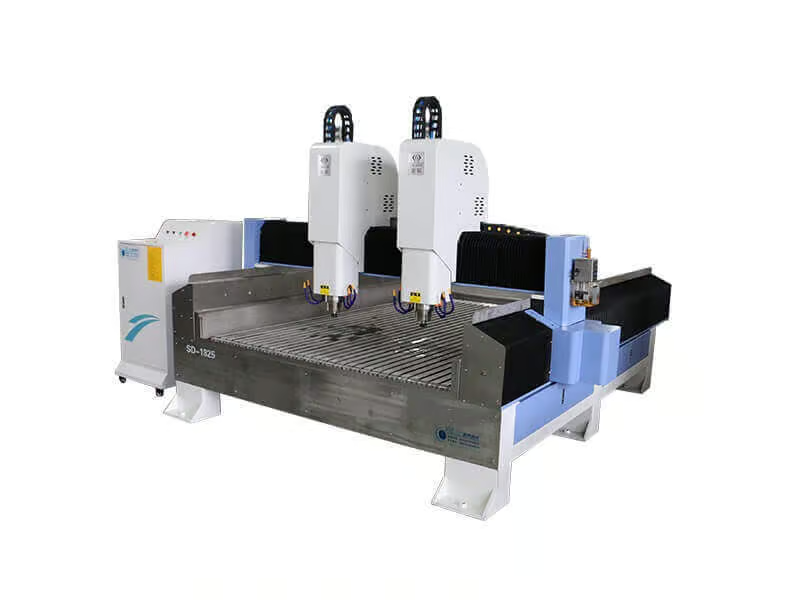 Stone Engraving Machines
 Thin Stone Veneer Saw Machine
 Horizontal Stone Slab Splitting Machine
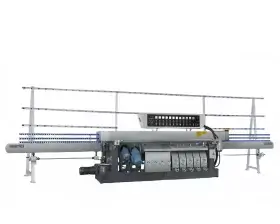 Stone Edge Polishing Profiling Machine
 Stone Auxiliary Equipment
In the complex geometry of quarry extraction, the inability to drill intersecting holes is the most common cause of production bottlenecks. According to operational guidelines published by the Society for Mining, Metallurgy & Exploration (SME), ‘Drill Deviation’—where long boreholes fail to intersect perfectly inside the rock mass—leads to significant block yield losses and hazardous wire saw jamming. To eliminate this risk, modern quarries deploy mechanical ‘Blind Plunge Cutting’ as the definitive engineering solution for narrow benches and inaccessible corners.
A renowned underground gallery quarry in Carrara, Italy, perfectly illustrates this necessity. Operating inside a mountain, overhead and rear clearances were extremely tight, making it physically impossible to position traditional DTH (Down-The-Hole) drilling rigs to set up wire saw loops. By deploying the MosCut Chain Saw Machine, operators were able to execute direct vertical and horizontal blind cuts straight into the solid face. This completely bypassed the drilling phase, prevented wire jamming, and shortened the extraction cycle of a single massive block by three full days.
The Drilling Bottleneck: Where Wire Saws Fail
Diamond wire saws are fantastic for high-speed separation, but they all share one fatal dependency: they require a continuous, pre-drilled loop.A wire saw cannot cut what it cannot wrap around. To extract a block, quarry workers must drill a vertical hole and a horizontal hole that intersect perfectly deep inside the mountain. This process is inherently flawed.
If the drill hits a soft mud seam or a heavily fractured zone, the borehole often collapses, trapping the expensive drill bit and making it impossible to thread the diamond wire. Furthermore, at the absolute bottom of a quarry pit or tight inside corners, there simply isn’t enough physical space to position the drilling rig. When you cannot drill, the wire saw becomes useless. The chain saw, however, requires zero threading and zero intersecting boreholes.

The Physics of the Plunge Cut
How does a 3-meter solid steel arm penetrate a solid rock face? It is a masterclass in engineered geometry and controlled torque.A chain saw does not simply ‘stab’ into the rock. The process, known as a Plunge Cut, is highly controlled. The operator uses the wireless remote to slowly pivot the cutting arm into the stone at a slight angle of attack.
Driven by the main motor, the high-tensile steel chain rapidly pulls heavy-duty Tungsten Carbide or PCD inserts across the rock face. These inserts act like industrial planers, violently shaving away the stone and pulling the dry dust out of the slot. As the inserts carve out a perfectly straight 40mm-wide channel, the rigid steel arm smoothly advances deeper into the mountain until it reaches its maximum depth, completely independent of any pre-existing holes.

Executing the Horizontal Undercut
The most critical cut in any quarry is the base. A flawless undercut ensures the block separates cleanly without catastrophic bottom fracturing.To execute a horizontal blind cut (base undercut), the machine’s 90° rotating turret is locked into the horizontal position. The arm plunges into the side of the bench at floor level. Once fully inserted to a depth of, for example, 3.5 meters, the entire machine begins to travel slowly along its steel tracks (or crawler chassis).
This lateral movement completely severs the block from its bedrock foundation. If this undercut is not performed, operators are forced to use excavators to pry the block upward to snap it off the base. This brutal prying action frequently causes unpredictable tearing and fracturing at the bottom of the block, wasting cubic meters of highly valuable marble. The chain saw ensures a perfectly flat, clean release.

Vertical Corner Cuts: Freeing the Block
Freeing a block from a tight corner bench used to require massive waste. The chain saw delivers surgical precision exactly where you need it.After the base is undercut, the block must be freed from the back wall. In a tight ‘inside corner’ of a quarry terrace, drilling a vertical hole is notoriously difficult. With a MosCut chain saw, the operator simply rotates the turret 90 degrees to the vertical position.
The arm is plunged straight down into the top of the bench, slicing through 3 to 4 meters of solid rock to sever the block from the rear mountain face. This vertical blind cut not only frees the corner block but also creates a perfect, clean slot. This slot is exactly what wire saw operators need to easily thread their diamond wire to finish the remaining cuts—a strategy known as the ultimate Italian Extraction Method.

Conquer the Blind Cut Today
Eliminate the frustration of collapsed drill holes and inaccessible corners. Maximize your marble yield with the raw power of the MosCut Chain Saw Machine.
View the Chain Saw Machine