
 Stone Cutting Machines
 Stone Polishing Machines
 Bridge Saw Machines
 Stone Quarry Cutting Machines
 Stone Block Cutter Machine
 CNC Stone Wire Saw Machine
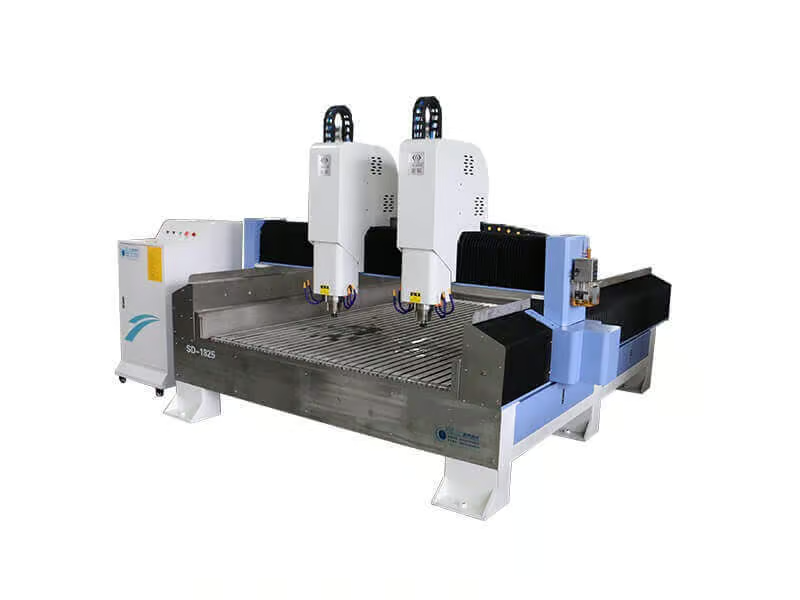 Stone Engraving Machines
 Thin Stone Veneer Saw Machine
 Horizontal Stone Slab Splitting Machine
 Stone Edge Polishing Profiling Machine
 Stone Auxiliary Equipment
In the field of industrial stone extraction, ‘Abrasive Wear’ is the ultimate enemy of cutting tools. According to extensive research on machining sedimentary rocks by the Industrial Diamond Association (IDA), the presence of loose quartz particles in soft stones causes a devastating grinding effect on metal bonding matrices. In sandstone and limestone quarries, circular blades rarely fail due to direct impact; they fail because inadequate slurry clearance causes extreme thermal expansion, leading to structural deformation (warping) of the steel core.
A massive volcanic ash and sandstone quarry in Indonesia learned this lesson the hard way. Attempting to cut costs, they procured generic, multi-purpose circular blades with narrow segment gaps. The thick sandstone slurry quickly packed into these narrow slots, causing the blades to overheat. The steel cores ‘lost their tension’ and began to wobble wildly, producing wavy cuts and forcing the quarry to scrap an entire set of expensive blades every 3 days. By switching to custom MosCut sandstone blades engineered with extra-wide flushing gullets and a specific hard-bond matrix—and optimizing their cooling water flow—they eliminated blade warping entirely, astonishingly extending their blade lifespan by 400%.
The Quartz Problem: Why “Soft” Stone is a Blade Killer
It is one of the greatest paradoxes in quarrying: rocks with low compressive strength can destroy tools faster than solid granite.To the naked eye, sandstone is easy to break. It has a relatively low compressive strength, which is why operators love cutting it. However, you must look at its chemical composition. Sandstone is primarily composed of quartz sand cemented together. Quartz boasts a brutal Mohs hardness of 7.
When the diamond blade cuts through sandstone, it liberates millions of microscopic, razor-sharp quartz crystals. Unlike the fine, powdery dust of marble, this coarse sandstone slurry acts like liquid industrial sandpaper. As the blade spins, this abrasive mixture constantly grinds against the sides of the diamond segments and the exposed steel core. If this slurry is not aggressively managed, the ‘sandpaper effect’ will literally grind the blade down to nothing.

The Counter-Intuitive Matrix: Hard Bond for Soft Rock
If you use a soft-bond diamond segment designed for hard granite on a sandstone bench, it will disappear within hours.Diamond segment selection is entirely dictated by the abrasiveness of the stone. When cutting ultra-hard granite, you need a ‘soft’ metal bond that wears away quickly to constantly expose fresh, sharp diamonds. But when cutting highly abrasive sandstone, that logic completely flips.
Because the sandstone slurry is actively trying to grind away the metal holding the diamonds, you must use a Hard Bond Matrix. A hard metal bond firmly grips the diamond crystals, resisting the intense frictional wear of the loose quartz sand. If you mistakenly use a soft bond, the metal matrix will erode too fast, causing the expensive industrial diamonds to fall out (diamond pull-out) long before they have done any actual cutting work.

The U-Slot Geometry: Surviving Heavy Slurry
The gap between the diamond teeth is just as important as the teeth themselves. Narrow slots spell doom in a sandstone pit.Look closely at a MosCut sandstone blade and you will notice something distinct: the gaps between the diamond segments are incredibly wide and shaped like a deep ‘U’. This is not to save manufacturing costs; it is vital fluid dynamics.
Because soft stone cuts so quickly, it generates an enormous volume of heavy, thick mud in seconds. If a blade has narrow gaps (like those used for marble), this thick mud will pack tightly between the teeth, sealing the blade in a jacket of hot friction. The Wide U-Slot Gullets act as high-velocity centrifugal pumps. As the massive blade spins at high RPM, these wide slots scoop up the thick slurry and violently throw it out of the cut, keeping the steel core cool and preventing catastrophic jamming.

Flushing Dynamics: Volume Over Pressure
In soft stone extraction, water is not just a coolant; it is your primary waste removal system.Many novice operators make the mistake of hooking up high-pressure, low-volume pressure washers to their cutting machines. In sandstone and limestone extraction, Flow Volume is vastly more important than Water Pressure.
You do not need to blast the blade; you need to flood the channel. High-volume water manifolds must be directed precisely at the point where the blade enters the rock. The goal is to create an absolute deluge of water that instantly dilutes the thick stone dust into a thin liquid, rapidly washing the abrasive quartz particles out of the 10mm kerf before they have a chance to rub against the spinning steel core.

Regulating the Advance Speed
The machine possesses massive horsepower, but reckless speed translates directly to shattered tools.Because soft stone yields so easily to the diamond blades, there is a tremendous temptation for operators to crank the VFD (Variable Frequency Drive) travel speed to the absolute maximum. This is the fastest way to ruin a blade.
If you push the machine faster than the U-slots and water can flush the slurry, the blade will choke. The mud will pack solid, the blade will bind, and the 75kW main motor will suffer a massive amp spike. Operators must be trained to watch the amp meter on the control panel. Maintaining a smooth, steady advance speed that keeps the motor current stable ensures perfect, straight cuts and extends the life of your diamond segments exponentially.

Stop Burning Through Cheap Blades
Equip your quarry with the precision-engineered MosCut Sandstone & Limestone Cutting Machine and maximize your consumable ROI.
Explore the Soft Stone Cutter