
 Stone Cutting Machines
 Stone Polishing Machines
 Bridge Saw Machines
 Stone Quarry Cutting Machines
 Stone Block Cutter Machine
 CNC Stone Wire Saw Machine
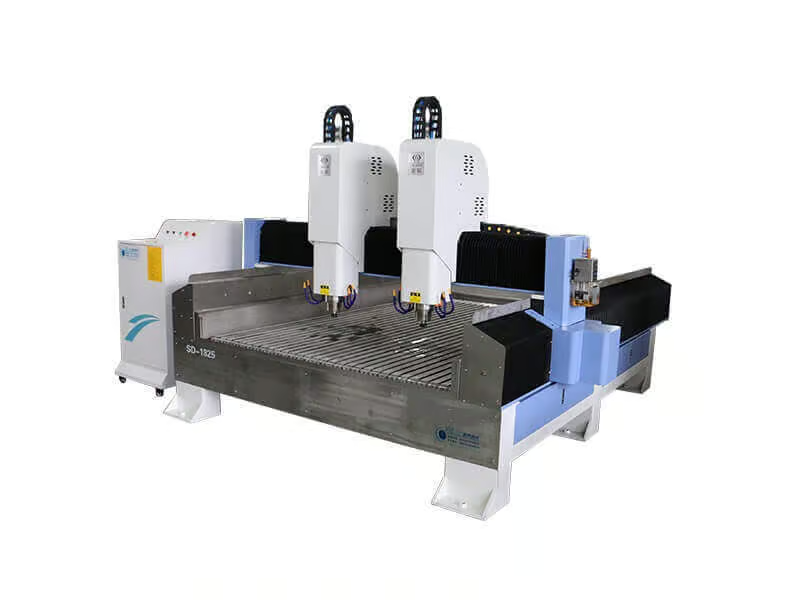 Stone Engraving Machines
 Thin Stone Veneer Saw Machine
 Horizontal Stone Slab Splitting Machine
 Stone Edge Polishing Profiling Machine
 Stone Auxiliary Equipment
In the stone fabrication business, throwing away raw material is exactly like throwing away cash. According to a Q3 2026 MOSCUT global material consumption survey, traditional fabrication shops waste an average of 12% to 15% of usable stone purely due to alignment errors and cutting deviations. This is a staggering hidden cost that eats directly into your net profit margin.
Consider a high-end marble exporter in Istanbul, Turkey. Last year, they were processing a highly expensive block of Calacatta Gold marble for a luxury hotel project. Their older bridge saw was equipped with a cheap, low-wattage laser that completely washed out under the bright factory lights. The operator, forced to cut based on intuition, misaligned the blade by just 5 millimeters. That single mistake ruined a $2,000 waterfall island panel. Shortly after, they upgraded to the MOSCUT Standard Laser Bridge Saw, equipped with a high-intensity industrial red laser. With 100% visual predictability, their overall material yield increased by 9% within three months, recovering tens of thousands of dollars in otherwise wasted stone. When handling premium slabs, precision is your most powerful money-making tool.
The High Cost of “Eyeballing” and Budget Lasers
Many shop owners accept high scrap rates as a normal cost of doing business. The root cause is almost always a lack of clear visual guidance at the cutting table.

The “Blade Drop” Guessing Game
When a machine lacks a reliable laser guide, operators are forced to play a risky guessing game. They lower the rapidly spinning diamond blade to within a few millimeters of the stone, check the alignment, lift it back up, adjust the bridge, and try again. Not only does this repetitive process destroy your daily output speed, but if the operator miscalculates the 4-5mm width of the blade’s kerf, the cut will instantly bite into usable material.

The Fading Light of Cheap Lasers
Many budget bridge saws advertise a “laser guide,” but use cheap, commercial-grade 5mW diodes. Under bright overhead factory lighting or semi-outdoor environments, these weak red lines practically vanish. Even worse, the moment you turn on the high-volume water cooling system, the weak beam hits the splashing mud and scatters into a blurry red haze, leaving the operator to finish the cut completely blind.
How Industrial Laser Alignment Changes the Game
True precision requires industrial-grade optics. Our standard bridge saws are equipped with advanced alignment technology to guarantee flawless execution.

Absolute Visual Predictability
We utilize industrial-grade 50mW/100mW red laser generators. These units project an incredibly sharp, ultra-thin (1mm) beam that perfectly simulates the exact path of the diamond blade across the entire length of the slab. What you see is exactly what you cut. Operators can confidently drop the blade at full speed without hesitation, drastically reducing cycle times and eliminating alignment errors.

Piercing Through the Mud
Our lasers are IP67-rated to withstand extreme moisture and dust. More importantly, the high-intensity beam is powerful enough to pierce right through heavy water spray and granite mud. From the moment the blade enters the stone to the moment it exits, the operator has an uninterrupted, crystal-clear visual guide.
Strategic Nesting: Squeezing Extra Profit from Off-Cuts
After cutting the primary kitchen islands, a slab is usually left with irregular off-cuts (remnants). Without a laser, workers often discard these because it is too risky or time-consuming to measure them for smaller pieces. With a high-visibility laser, the operator can simply rotate the table and use the beam to visually “scan” the remnant. They can effortlessly fit a 10cm wide backsplash or a small vanity top into the tightest possible space. Turning what would have been dumpster waste into a $200 backsplash is the ultimate yield optimization.
Visual Vein Matching Without Expensive Software
Achieving perfect vein continuity (vein matching) on luxury waterfall edges typically requires investing in extremely expensive overhead camera systems and CAD software like Slabsmith. However, an experienced operator using a high-intensity laser bridge saw can achieve stunning results visually. By carefully aligning the laser beam exactly down the center of a prominent natural vein, the operator can split the pattern perfectly. When the two pieces are folded into a 90-degree miter, the visual flow remains entirely unbroken—delivering a premium aesthetic without the premium software overhead.
Stop Putting Your Profits in the Dumpster
Every millimeter of miscalculated stone is money stolen from your bottom line. Do not let cheap equipment blind your operators and increase your scrap rate.
Ready to achieve zero-waste cutting?
Equip your fabrication shop with the unshakeable accuracy and industrial laser guidance of our flagship machines.
Explore the Standard Laser Bridge SawTop 10 FAQ: Laser Guides and Stone Yield
1. Is the laser visible in bright outdoor or semi-outdoor sunlight?
While direct, harsh sunlight can wash out any light source, our 50mW/100mW industrial lasers are significantly more visible than standard 5mW commercial lasers. For fully outdoor setups, a simple overhead shade is recommended for perfect visibility.
2. Does the laser line need to be calibrated frequently?
No. Once the laser is securely locked and aligned with the blade’s exact kerf during the initial machine installation, it rarely requires adjustment unless the housing is physically struck by a heavy object.
3. What is the difference between red and green laser guides?
Green lasers appear brighter to the human eye, but red lasers are the industry standard for stone cutting due to their superior reliability, lower cost of replacement, and excellent contrast against light-colored stones like marble.
4. Does the laser show the exact thickness of the diamond blade?
The laser projects a thin 1mm line. Most operators calibrate the laser to align perfectly with the *outside edge* of the diamond blade, ensuring they know exactly where the waste side of the cut will be.
5. Are these lasers waterproof?
Yes. The laser diodes are housed in IP67-rated aluminum or brass casings, making them fully impervious to the constant water spray and fine stone dust in the workshop.
6. How long does the laser diode typically last?
Industrial laser diodes generally have a lifespan of over 10,000 continuous hours. Because they are only turned on during alignment and cutting, they typically last for years without needing replacement.
7. Can I retrofit my old manual saw with this industrial laser?
While aftermarket retrofits exist, they lack synchronized power supplies and rigid mounting brackets. We highly recommend upgrading to a fully integrated machine where the laser is vibration-isolated on the cast-iron bridge.
8. Is the laser dangerous to the operator’s eyes?
The lasers used are typically Class 3R or 3B. While you should never stare directly into the emitter, viewing the line projected onto the stone slab is completely safe for operators during standard daily use.
9. If the laser breaks, does the machine stop working?
No. The laser is a visual aid. If it gets damaged, the mechanical components of the bridge saw will continue to function perfectly, and you can temporarily cut using manual measurements until the diode is replaced.
10. How quickly does a high-intensity laser pay for itself?
By saving just one or two premium slabs (like Calacatta or Taj Mahal Quartzite) from being ruined by a misaligned cut, the industrial laser effectively pays for itself within the first few months of operation.