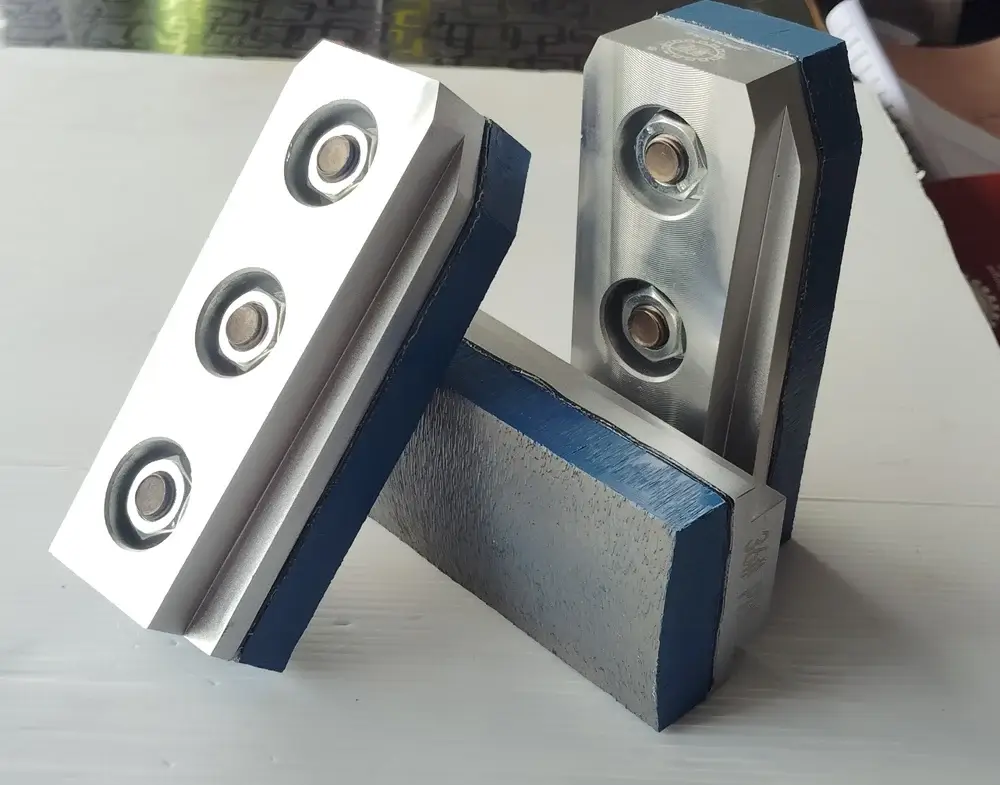
Automatic Stone Polishing Line: Flawless Slab Mirror Surfaces For Marble Granite Quartz Travertine

Maximize your slab output with MOSCUT’s heavy-duty automatic stone polishing line. Featuring 8 to 22 pneumatic heads, PLC control, and a flawless mirror surface finish for marble, granite, quartz, travertine etc. In the wholesale slab market, volume and gloss level are the only two metrics that dictate your dominance. According to a Q2 2026 MOSCUT analysis of 150 global slab processing plants, facilities that upgraded from semi-automatic equipment to a continuous automatic stone polishing line saw their daily output surge by 450%, while abrasive costs per slab dropped by 22%.
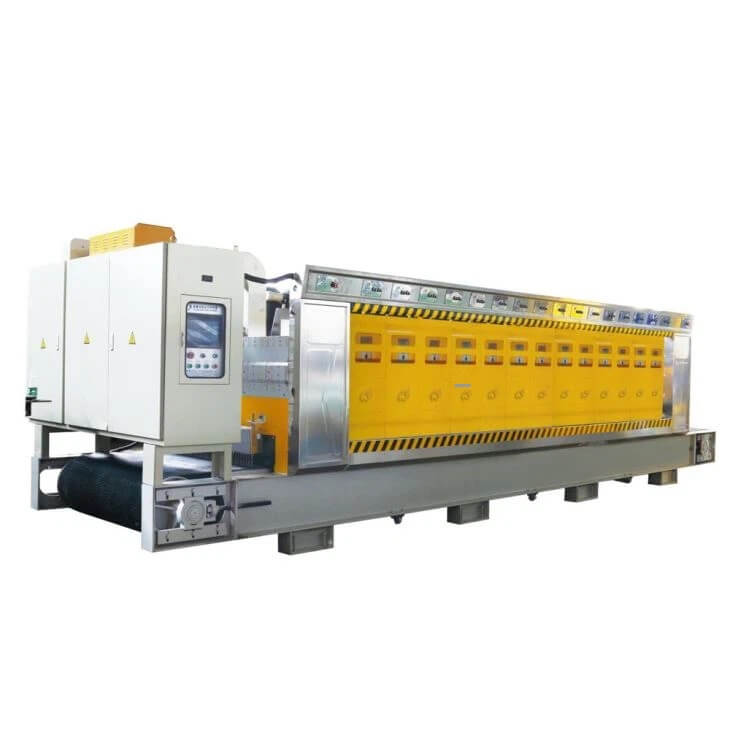
Automatic Stone Slab Polishing Line

Consider a large-scale granite exporter in Vitória, Brazil. Last year, they faced a critical bottleneck: their four older bridge polishers, running 24/7, simply could not keep up with the massive volume of raw slabs being sliced by their multi-wire saws. Tens of thousands of square meters of semi-finished inventory sat weathering in their yard. After installing a MOSCUT 20-head multi head stone polishing machine, they not only cleared their entire backlog in weeks, but the resulting high-gloss finish allowed them to command a 15% price premium in the US market. The automatic line is not just a machine; it is the ultimate cash-flow multiplier.

Breaking the High-Volume Bottleneck

Old equipment doesn’t just slow you down; it actively destroys your raw material value and stalls your working capital.

Massive backlog of unpolished raw stone slabs

The Nightmare of Semi-Finished Backlogs

If your front-end gang saws or multi-wire saws are cutting faster than your polishing department can finish the slabs, your factory is bleeding money. Piles of unpolished slabs represent hundreds of thousands of dollars in frozen capital. A continuous polishing line swallows raw stone at an astonishing rate, turning backlogs into ready-to-ship, invoiceable inventory instantly.

Uneven polishing marks and dull spots on a slab

Uneven Pressure, Uneven Gloss

Relying on manual labor or outdated mechanical-spring polishing heads means the downward pressure fluctuates constantly. This results in horrific “water ripples,” swirl marks, and dull dark patches across the slab. In today’s premium architectural market, inconsistent gloss means your slabs will be rejected or downgraded to B-grade status, slashing your profit margins.

Engineered for Perfection: Hardcore Tech Specs

Our polishing lines are heavy-duty industrial behemoths. We over-engineer every single component to guarantee 24/7 reliability and a flawless mirror finish.

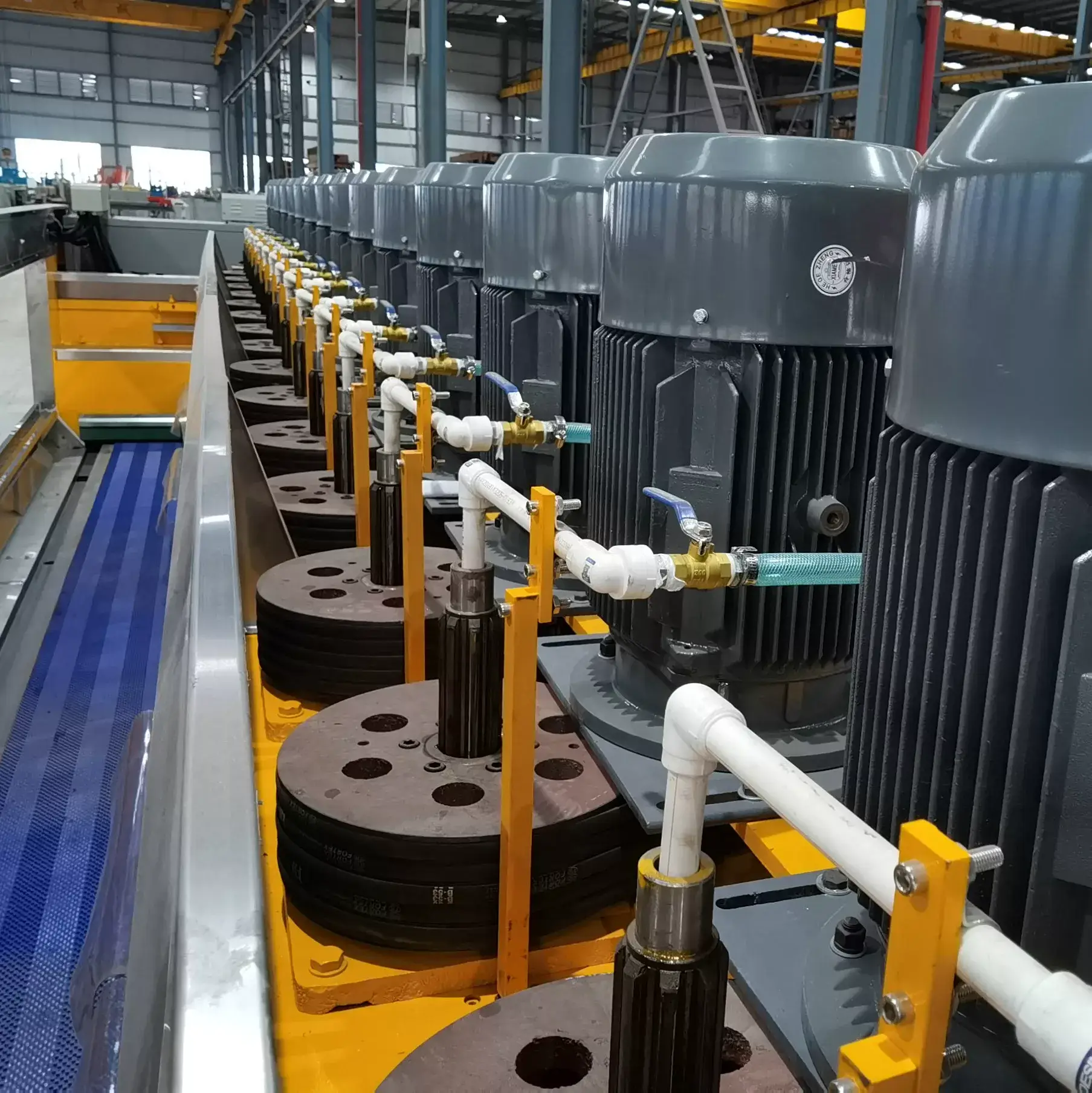
Row of independent heavy-duty motors for each polishing head

Dedicated High-Power Motor per Spindle (1-to-1 Drive)

To guarantee uncompromising torque transfer, we utilize a strict 1-to-1 motor-to-head architecture. Whether you configure a 12-head strip polisher or a massive 24-head jumbo line, every single polishing spindle is powered by its own dedicated 11KW or 15KW heavy-duty motor. Unlike outdated systems that use belts to share power across multiple heads—causing RPM drops when hitting dense spots—our independent direct-drive design ensures that every single abrasive block receives maximum, uninterrupted rotational power, resulting in a perfectly uniform cut across the entire slab.

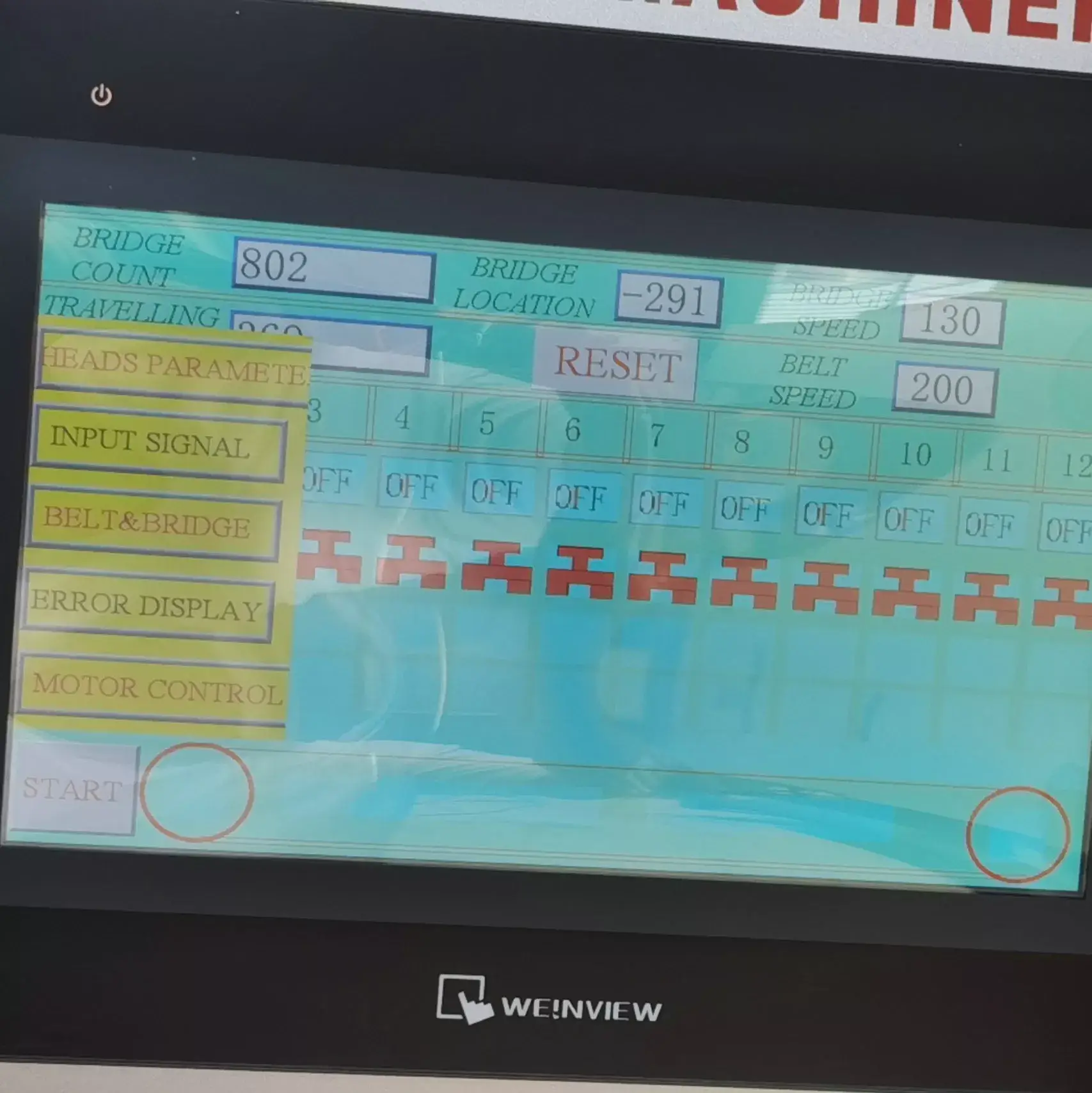
WEINVIEW HMI touch screen showing real-time polishing head status
Industrial control panel with touch screen and robust physical buttons

Intuitive HMI Touch Screen & Hybrid Control Panel

Complete control is at your operator’s fingertips. We integrate premium WEINVIEW industrial HMI touch screens that provide a highly visual, real-time map of your entire production line. Operators can instantly monitor the precise status of every single polishing head (from Head 1 to 24), and adjust critical variables like “Belt Speed” and “Bridge Speed” on the fly.

To maximize uptime, the software features an integrated “Error Display” module for immediate diagnostic troubleshooting. Furthermore, we intentionally utilize a hybrid panel design: the smart screen is paired with robust, heavy-duty physical push-buttons for critical Start/Stop commands. This ensures 100% reliable operation even when your workers are wearing wet, heavy industrial gloves.

Contact sensors scanning stone slab shape on conveyor

High-Reliability Mechanical Slab Scanning

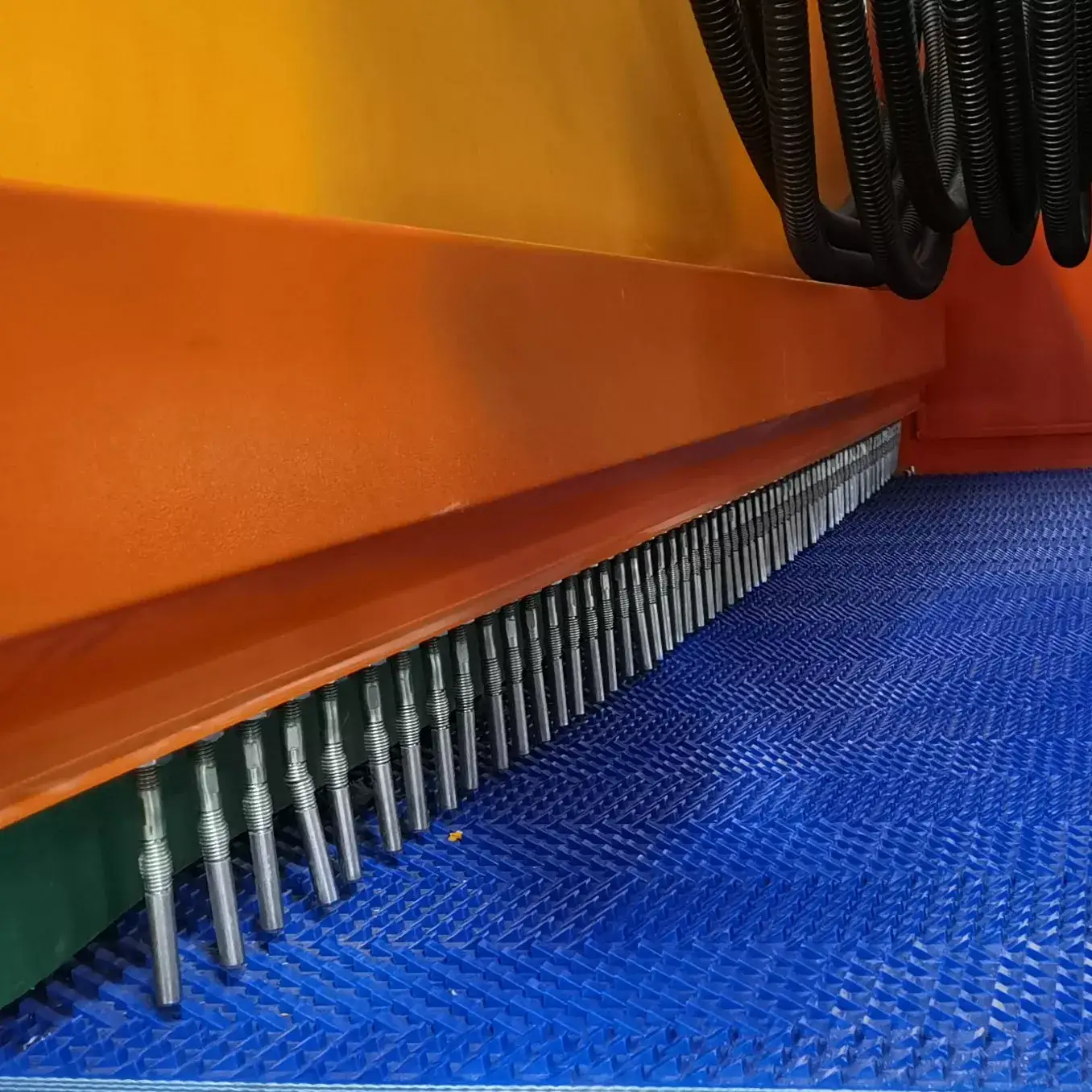
At the entrance of the machine, a high-precision mechanical sensing array (reading barrier) physically maps the exact shape and width of every incoming slab. Unlike optical laser sensors that frequently malfunction when blinded by dirty water and stone mud, our physical contact sensors provide 100% reliable data to the PLC in the harshest environments. The PLC brain then instructs the polishing heads to drop and lift with millisecond precision exactly at the stone’s edges, preventing slab breakage and saving up to 30% in abrasive wear.

Pneumatic cylinders applying pressure to polishing heads

Proportional Pneumatic Pressure System

We abandoned stiff mechanical springs long ago. Utilizing premium pneumatic proportional valves, each head maintains its own independent, constant pneumatic polishing head pressure. Like independent suspension on a luxury car, the heads gently follow the micro-contours of the stone, ensuring 100% uniform grinding force without burning the surface.

Heavy duty cast iron polishing main body

Heavy-Duty Cast Iron Spindles

We refuse to use lightweight aluminum housings. Our massive, up to 15KW cast-iron polishing spindles are designed to transmit brutal torque while completely absorbing the violent, high-frequency vibrations generated when grinding ultra-hard granite. This rigidity is the secret to eliminating chatter marks on the stone.

Sequential array of polishing heads working together

Sequential Multi-Head Array (8 to 24 Heads)

Polishing is a science of sequential refinement. The first few heads (equipped with metal diamonds) aggressively level the stone. The middle heads (resin bond) erase deep scratches. The final heads (buffing/felt pads) close the pores and force the gloss to its absolute peak. They work in perfect harmony to process slabs in a single, uninterrupted pass.

High traction PVC conveyor belt moving heavy slabs

High-Traction PVC Conveyor Belt

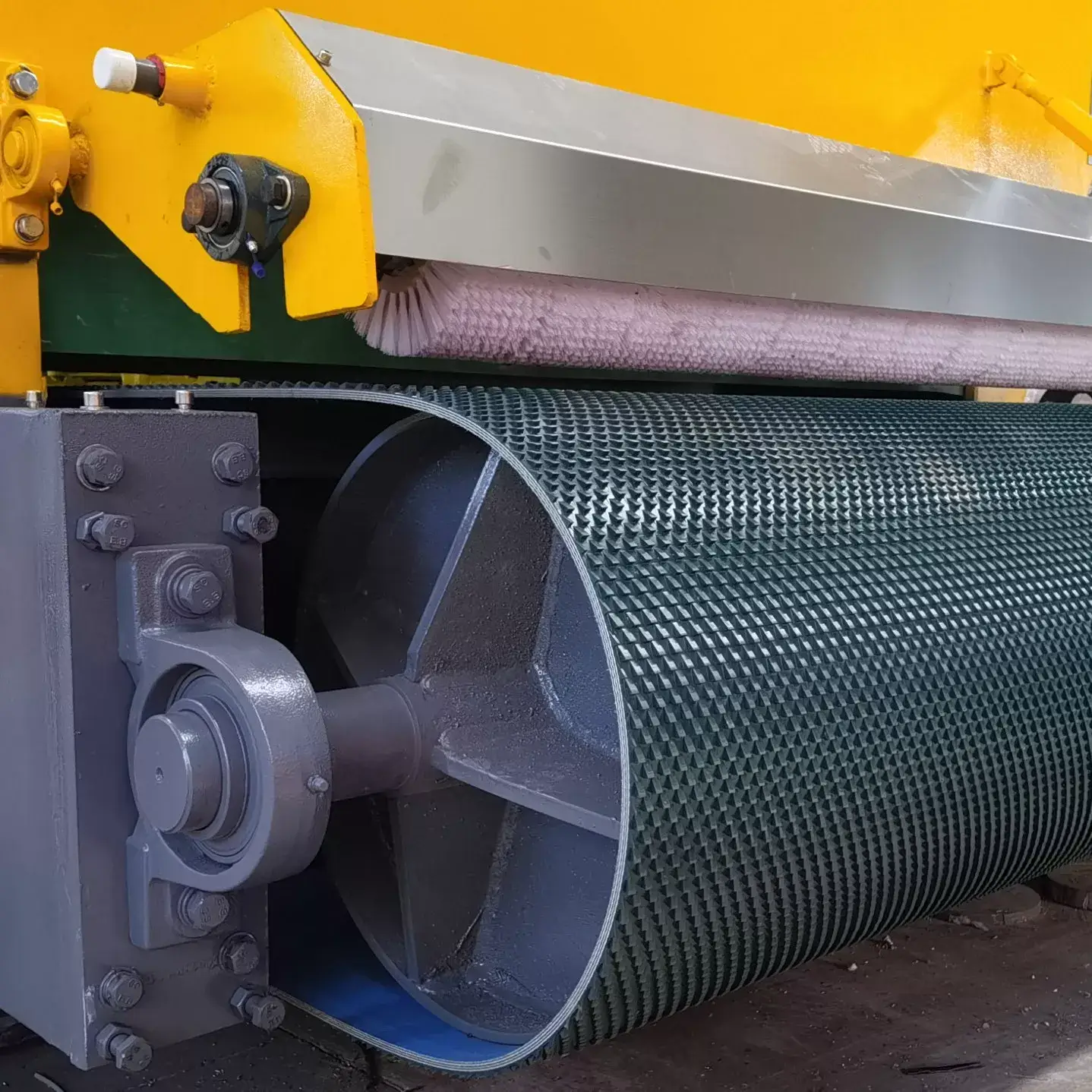
To move multi-ton slabs smoothly under aggressive grinding friction, the machine utilizes a premium, heavy-duty PVC conveyor belt. Engineered with a specialized anti-slip texture, it grips the wet, heavy slabs securely, guaranteeing they advance at a perfectly uniform speed without slipping, shifting, or breaking alignment.

Hydraulic tilting loading table for stone slabs

Hydraulic Tilting Loading Table

Located at the front of the line, this heavy-duty auxiliary loading table hydraulically tilts to an 85-degree angle. Forklifts can safely rest fragile slabs against it; the hydraulics then smoothly lower the table to a horizontal position, feeding the slab directly onto the conveyor. This completely eliminates the danger of slabs snapping during manual loading.

Motorized roller table for unloading polished stone

Motorized Roller Unloading Table

At the exit of the machine, polished slabs glide seamlessly onto a motorized (or free-spinning) roller table. This prevents the finished mirror surface from dragging against stationary metal and allows vacuum lifters or specialized forklifts to quickly and safely remove the finished product without halting the continuous line.

Isolated electrical control cabinet with ventilation

Isolated Industrial Electrical Cabinet

A wet polishing factory is a harsh environment. We physically isolate our heavy-duty electrical control cabinet away from the machine’s splash zone. Designed with high-efficiency cooling fans and strict humidity isolation, it protects the sensitive Siemens PLCs, Schneider contactors, and inverters from water vapor and machine vibration, ensuring 24/7 electrical stability.

Metal safety doors enclosing the polishing line

Optional Metal Safety Doors

To maintain a clean factory and protect your workforce, you can equip the machine with sliding metal safety enclosures along both sides. These heavy-duty steel doors securely contain all flying abrasive debris and high-pressure mud splashing, keeping your factory floors dry while providing an impenetrable physical barrier for operator safety.

Industrial air compressor system for pneumatic polishing heads

Dedicated Air Compressor System Compatibility

The rapid lifting and lowering of the heavy spindle heads rely entirely on robust pneumatic cylinders. The MOSCUT polishing line integrates seamlessly with high-capacity industrial air compressors. This ensures absolutely stable air pressure delivery, so the downforce of head #1 is exactly the same as head #20, preventing mid-polish pressure drops.

Worker checking stone with a gloss meter reading 98 GU

100+ GU Mirror Finish Guaranteed

The ultimate proof is in the reflection. Thanks to the massive structural rigidity, high-torque motors, and perfectly calibrated sequential abrasives, slabs exiting our automatic line consistently register a Gloss Unit (GU) reading nearing 100 on the gloss meter. It is a genuine, flawless mirror finish that commands top dollar in the architectural market.

Oscillating Frankfurt abrasive holding plate for marble polishing

Oscillating Frankfurt Spindles (For Soft Stone & Marble)

When configured for marble processing, the machine’s spindles are outfitted with specialized aluminum abrasive plates designed to securely grip horseshoe-shaped Frankfurt abrasives. Instead of purely aggressive rotary grinding, the mechanical design utilizes a highly calibrated, sweeping oscillating motion. This dynamic lateral movement, paired with sensitive low-pressure pneumatic settings, gently “buffs” the softer, porous surface of marble. It effectively prevents the abrasives from digging into the stone, ensuring a flawless, glass-like finish completely free of mechanical swirl marks.

Heavy duty 6 claw Fickert rotary head for granite polishing

High-Torque Fickert Rotary Heads (For Hard Granite)

To conquer the extreme density of igneous rocks like granite and quartzite, the line is equipped with robust 6-claw or 8-claw rotary heads holding elongated Fickert abrasive blocks. Unlike the sweeping motion used for marble, this configuration relies on brutal, high-torque planetary rotation. Driven by our 15KW cast-iron spindles and massive pneumatic downforce, these heads aggressively mill through the stubborn quartz crystal matrix at high RPMs. This raw mechanical cutting power guarantees rapid surface leveling and extracts a deep, black-mirror reflection that lighter machines simply cannot replicate.

Flawless Finishes: Materials We Perfect

By simply changing the abrasive tooling and adjusting the PLC parameters, this versatile beast can conquer any commercial stone material.

Polished high gloss marble slab

Marble Slabs

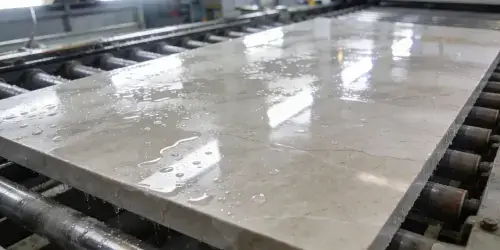
Using oscillating Frankfurt heads and gentle pneumatic pressure, the machine closes the natural pores of the marble, yielding a warm, liquid-like high reflection without scratching the soft surface.

Grey polished granite slab

Granite Slabs

Armed with aggressive Fickert blocks and high spindle RPM, the machine brutally cuts through the quartz and feldspar crystals, revealing the deep, flawless black and rich textures of the hardest granites.

Polished engineered quartz stone

Artificial Stone / Quartz Slabs

With precise inverter-controlled speeds and massive water cooling, the machine achieves a uniform, brilliant finish on engineered stones without overheating or yellowing the synthetic resin binders.

Lightly honed slate stone surface

Slate Slabs

Configured with a shorter sequence of coarse abrasives, the machine acts as a precision honer—smoothing out the violently rough clefts while intentionally retaining the slate’s natural, matte rustic charm.

Filled and polished travertine slab

Travertine Slabs

After the factory pore-filling process, our polishers glide smoothly over the filled travertine, leveling the cement/resin filler perfectly flush with the stone to create a luxurious, glass-like unified surface.

How to Choose the Right Configuration: 12, 16, 20, or 24 Heads?

The rule of thumb is simple: The more heads you have, the higher the gloss you achieve without having to slow down the conveyor belt. Let’s find your perfect match.

12 head marble polishing machine processing stone strips

Strip Slabs Polishing (12 to 16 Heads)

If your primary business involves cutting blocks into narrower strips (800mm – 1200mm wide) for countertops, stair treads, or monuments, you don’t need a massive footprint. A 12 heads marble polishing machine or a 16-head configuration is the most cost-effective choice. It provides ample grit progression to achieve an excellent shine on narrower formats.

Massive 24 head automatic stone slab polishing line

Full Slab Polishing (20 to 24 Heads)

If you are processing full-sized jumbo slabs (1200mm – 2100mm wide), or if you specialize in extremely hard exotic granites where every microscopic scratch must be erased, you must invest in a heavy-duty 20 or 24-head automatic stone slab polishing line. The extra heads allow for a highly gradual, micro-refining abrasive sequence, pushing the gloss meter to its absolute limit at high speeds.

The Science of Speed: 6 Variables That Dictate Polishing Efficiency

Conveyor speed (m/min) is not just a dial you turn up to maximum. It is a delicate balance of mechanical power, physical resistance, and abrasive chemistry. Understanding these factors is the key to maximizing your daily slab output.

1. Number of Polishing Heads (The Driving Force)

This is the most critical mechanical factor. A 24-head automatic stone polishing line can run its conveyor belt up to 40% faster than a 16-head machine on the exact same stone. Why? Because more heads mean smaller “jumps” between abrasive grits. Each head does less work per square inch, allowing the slab to pass through the machine at a much higher velocity without sacrificing quality.

2. Target Gloss Level (The Finish Line)

Speed and gloss are inversely related. If you are satisfied with a standard commercial 80 GU (Gloss Units) finish, the conveyor can be set to maximum speed. However, if your clients demand a flawless, 100+ GU premium mirror reflection, the belt speed must be slightly reduced to give the final buffing resin pads enough time to generate the necessary friction-heat to close the stone’s pores.

3. Slab Width (The Lateral Footprint)

The wider the slab, the longer the bridge must travel laterally (left to right) to cover the surface. Processing a massive 2000mm jumbo slab requires a slower forward belt advance compared to processing a 1200mm strip. If the belt moves too fast on a very wide slab, the oscillating heads will leave “Z-shaped” unpolished blind spots across the surface.

4. Quality of Abrasive Consumables

Cheap abrasives are a false economy. Low-quality diamond blocks quickly “glaze over,” losing their biting edge and forcing the operator to slow down the entire line to achieve a cut. Premium resin and metal bonds maintain a sharp, aggressive cutting face, allowing your machine to maintain its highest designed transfer speeds hour after hour.

5. Stone Hardness & Composition

Not all stones are created equal. Marble, composed mostly of soft calcite, can be polished rapidly. Granite, however, is packed with incredibly dense quartz and feldspar crystals. To physically cut through these dense crystals without burning the stone, granite polishing lines inherently require slower belt speeds and higher spindle RPMs compared to marble lines.

6. Pre-Calibration Flatness (The Foundation)

If a raw slab enters the polishing line with severe saw marks and uneven thickness, the conveyor must be slowed to a crawl so the first few coarse metal heads have enough time to grind down the “hills.” By running the slab through a stone calibrating machine first, the slab is perfectly flattened, allowing the polishing line to run at absolute peak velocity.

Technical Specifications

We offer two distinct series tailored to your raw material dimensions: The HLMJX Series for strips, and the DLM-2000 Series for full jumbo slabs.

Series 1: HLMJX Series (Strip Polishing Line)

Model No.HLMJX-8HLMJX-12HLMJX-16HLMJX-20/24
Quantity of grinding head (pc)8121620 / 24
Useful working width (mm)300 – 1250300 – 1250300 – 1250300 – 1250
Processable thickness (mm)10 – 6010 – 6010 – 6010 – 60
Power of spindle motor (kw)7.57.57.57.5
Speed of belt advance (m/min)0 – 3.80 – 3.80 – 3.80 – 3.8
Water consumption (m³/min)10162023 / 25
Gross weight (kg)9000120001500018000 / 21000

Series 2: DLM-2000 Series (Jumbo Slab Polishing Line)

TypeDLM-2000-12CDLM-2000-16CDLM-2000-20C
Quantity of polishing head (pcs)121620
Useful working width (mm)600 – 2100600 – 2100600 – 2100
Useful working thickness (mm)15 – 5015 – 5015 – 50
Motor power of grinding head (kw)9 / 11 / 159 / 11 / 159 / 11 / 15
Transfer speed (mm/min)0 – 35000 – 35000 – 3500
Water consumption (m³/h)222528
Gross weight (T)242729

100% Flexible OEM Customization & Turnkey Integration

Your factory is unique, and your machinery should be too. As the direct manufacturer, we offer unparalleled customization to ensure the line fits your exact business model.

Customized Head Quantities

Don’t pay for heads you don’t need, or suffer with too few. We build the exact chassis length required for your chosen 8, 12, 16, 20, or 24 head configuration based on your target gloss and throughput goals.

Tailored Working Widths

We manufacture precise bridge widths ranging from 600mm up to 2100mm+. You will never waste electricity spinning heads over empty conveyor space if you only process narrow strips.

Personalized Colors & Logos

Elevate your factory’s professional appearance. We offer custom anti-rust paint color matching and will proudly integrate your company’s logo onto the machine, supporting machinery dealers in building their own brands.

Component Designation

Prefer specific electrical components for easier local maintenance? Let us know. We gladly accommodate requests to install full Siemens, Schneider, Mitsubishi, or SMC/Airtac pneumatic ecosystems.

Why Choose MOSCUT? The Power of the Source Factory

When you are buying heavy industrial equipment, you aren’t just buying steel; you are buying the engineering depth, logistics capability, and lifelong support of the factory behind it.

MOSCUT factory manufacturing capacity

Unrivaled Manufacturing Capacity

We are not a trading company. MOSCUT operates a massive, state-of-the-art manufacturing facility equipped with heavy-duty CNC gantry milling machines. Every cast-iron bridge and steel chassis is machined in-house under uncompromising quality control, guaranteeing absolute structural precision.

Polishing line securely packed in a shipping container

Professional Global Shipping

A 24-head polishing line is a logistical giant. Our specialized shipping team has decades of experience expertly dismantling, anti-rust coating, and securely strapping these multi-ton behemoths into standard and open-top containers, ensuring they cross oceans safely to reach your door.

MOSCUT engineer installing machine at customer factory

On-Site Turnkey Installation

We don’t just drop off boxes. For major automatic line installations, MOSCUT dispatches senior engineers directly to your global facility. They personally oversee the foundation leveling, electrical wiring, pneumatic setup, and the crucial first-run calibration to ensure your factory starts producing perfect slabs on day one.

Large inventory of spare parts

Lifetime Technical & Parts Support

A machine down is revenue lost. We maintain a massive inventory of standardized spare parts, from V-belts to pneumatic valves and grinding heads. Combined with our remote video troubleshooting support, we ensure your line keeps running efficiently 10 or 15 years down the road.

Proven in the Field: Global Success Stories

Join the ranks of the world’s most profitable stone fabrication plants.

20 head granite polishing line in India

Rajasthan Granite Mills – India

Upgraded to a 20-head DLM-2000 granite line. By utilizing the 15KW heavy-duty spindles, they conquered the dense local black granite, increasing their daily export output by 300% with zero slab rejections.

16 head marble strip polisher in Turkey

Izmir Marble Exports – Turkey

Installed a 16-head HLMJX strip polishing line specifically for narrow travertine and marble architectural panels. The gentle pneumatic pressure eliminated surface scratching and saved 25% on resin abrasive costs.

Quartz polishing line in USA

Texas Engineered Stone – USA

Processing heat-sensitive Quartz, they utilized our inverter-controlled conveyor and massive water cooling system. The result was a flawless, burn-free mirror finish on artificial stone that met strict US market standards.

Polishing line processing large tiles in Vietnam

Hanoi Tile Co. – Vietnam

Transitioned from manual floor polishers to a 12-head continuous line for high-volume large-format stone tiles. Labor costs dropped by 70%, allowing them to outbid competitors on major hotel construction projects.

Watch the Automatic Polishing Line in Action

See the relentless power and precision of the MOSCUT multi-head system.

Build Your High-Output Slab Factory Today

Stop letting unpolished inventory hold your working capital hostage. It is time to equip your factory with the industry’s most reliable high-volume finishing engine.

Ready to scale your production capacity?

Contact our engineering team today to design the perfect machine length, width, and spindle configuration for your specific material and factory layout.

Request a Custom Quote

Expert Insights on Automatic Polishing

Maintaining pneumatic cylinders on stone polisher

How to Maintain Pneumatic Cylinders on Your Stone Polishing Line

Learn the daily and weekly lubrication routines required to keep your machine’s pressure valves highly responsive and prevent uneven slab grinding.

Read Article →
Resin vs metal bond diamond abrasives

Resin vs. Metal Bond: Optimizing Your 20-Head Polishing Sequence

Stop guessing your abrasive order. Discover exactly which heads should carry coarse metal diamonds and where the resin transition must happen for maximum gloss.

Read Article →
Water recycling system for stone factory

Water Recycling Systems: A Must-Have for Continuous Polishing

A 20-head machine consumes massive amounts of water. Learn how integrating a closed-loop mud press system saves your water bill and protects the environment.

Read Article →
Hydraulic loading table preventing slab breakage

Preventing Slab Breakage: The Critical Role of Hydraulic Loading Tables

Why loading slabs by hand or crane is costing you money. Discover how auxiliary hydraulic tables reduce slab stress and eliminate workplace loading hazards.

Read Article →

Top 10 FAQ: Automatic Stone Polishing Lines

1. How long is a 20-head automatic polishing line?

Including the hydraulic loading table, the main polishing bridge, and the unloading roller table, a complete 20-head DLM-2000 series line requires approximately 18 to 22 meters of straight factory floor space.

2. Can the machine process slabs of different thicknesses at the same time?

No. To ensure the pneumatic heads apply uniform pressure and to prevent the abrasive blocks from snapping upon hitting a sudden edge, slabs fed sequentially onto the belt must be pre-calibrated to the exact same thickness.

3. What size air compressor do I need to support this machine?

Because the rapid lifting and lowering of the spindles rely heavily on pneumatics, we highly recommend an industrial rotary screw air compressor (at least 15KW to 22KW) with a large air receiver tank to ensure absolutely stable air pressure.

4. How often do I need to replace the resin polishing pads?

This depends entirely on the stone’s hardness and the daily production volume. Generally, coarse metal diamond blocks last for thousands of square meters, while the final fine-grit resin pads may need replacing every few hundred to a thousand square meters.

5. What happens if an abrasive block wears out completely during a run?

Our machines are equipped with abrasive wear limit sensors. If a polishing head reaches its minimum safe height, the PLC will trigger an alarm and automatically lift the head to prevent the metal abrasive holder from scraping and destroying the slab.

6. Do I need a thick concrete foundation for the DLM-2000 series?

Yes. The machine weighs nearly 30 tons and the high-speed rotating spindles generate significant force. We will provide a detailed civil engineering blueprint for a reinforced concrete foundation to guarantee zero vibration over decades of use.

7. Can this machine polish extremely thin porcelain slabs?

While primarily designed for 10mm-60mm natural stone, the machine’s precision pneumatic proportional valves can be tuned to lightly polish thicker formats of sintered stone or porcelain, provided the material is perfectly flat.

8. Is it difficult to switch from polishing Marble to Granite?

Switching materials requires swapping out the Frankfurt abrasive heads for Fickert heads (and vice versa) across all 16 to 24 spindles, and adjusting the PLC pressure settings. It takes time, which is why large factories typically dedicate one line entirely to marble and another to granite.

9. What maintenance is required for the conveyor belt?

The heavy-duty PVC belt requires routine cleaning to prevent abrasive slurry buildup underneath, which can cause slipping. Additionally, operators must check and grease the tensioning rollers periodically to ensure straight, aligned tracking.

10. What electrical supply is needed to run a 24-head line?

A massive 24-head line requires significant power, often exceeding 200KW of total gross power. Your factory must be equipped with industrial 3-phase electricity (380V or customized to your local grid) and heavy-duty transformers.

Ask For Quote

Consider a large-scale granite exporter in Vitória, Brazil. Last year, they faced a critical bottleneck: their four older bridge polishers, running 24/7, simply could not keep up with the massive volume of raw slabs being sliced by their multi-wire saws. Tens of thousands of square meters of semi-finished inventory sat weathering in their yard. After installing a MOSCUT 20-head multi head stone polishing machine, they not only cleared their entire backlog in weeks, but the resulting high-gloss finish allowed them to command a 15% price premium in the US market. The automatic line is not just a machine; it is the ultimate cash-flow multiplier.

Breaking the High-Volume Bottleneck

Old equipment doesn’t just slow you down; it actively destroys your raw material value and stalls your working capital.

Massive backlog of unpolished raw stone slabs

The Nightmare of Semi-Finished Backlogs

If your front-end gang saws or multi-wire saws are cutting faster than your polishing department can finish the slabs, your factory is bleeding money. Piles of unpolished slabs represent hundreds of thousands of dollars in frozen capital. A continuous polishing line swallows raw stone at an astonishing rate, turning backlogs into ready-to-ship, invoiceable inventory instantly.

Uneven polishing marks and dull spots on a slab

Uneven Pressure, Uneven Gloss

Relying on manual labor or outdated mechanical-spring polishing heads means the downward pressure fluctuates constantly. This results in horrific “water ripples,” swirl marks, and dull dark patches across the slab. In today’s premium architectural market, inconsistent gloss means your slabs will be rejected or downgraded to B-grade status, slashing your profit margins.

Engineered for Perfection: Hardcore Tech Specs

Our polishing lines are heavy-duty industrial behemoths. We over-engineer every single component to guarantee 24/7 reliability and a flawless mirror finish.

Row of independent heavy-duty motors for each polishing head

Dedicated High-Power Motor per Spindle (1-to-1 Drive)

To guarantee uncompromising torque transfer, we utilize a strict 1-to-1 motor-to-head architecture. Whether you configure a 12-head strip polisher or a massive 24-head jumbo line, every single polishing spindle is powered by its own dedicated 11KW or 15KW heavy-duty motor. Unlike outdated systems that use belts to share power across multiple heads—causing RPM drops when hitting dense spots—our independent direct-drive design ensures that every single abrasive block receives maximum, uninterrupted rotational power, resulting in a perfectly uniform cut across the entire slab.

WEINVIEW HMI touch screen showing real-time polishing head status
Industrial control panel with touch screen and robust physical buttons

Intuitive HMI Touch Screen & Hybrid Control Panel

Complete control is at your operator’s fingertips. We integrate premium WEINVIEW industrial HMI touch screens that provide a highly visual, real-time map of your entire production line. Operators can instantly monitor the precise status of every single polishing head (from Head 1 to 24), and adjust critical variables like “Belt Speed” and “Bridge Speed” on the fly.

To maximize uptime, the software features an integrated “Error Display” module for immediate diagnostic troubleshooting. Furthermore, we intentionally utilize a hybrid panel design: the smart screen is paired with robust, heavy-duty physical push-buttons for critical Start/Stop commands. This ensures 100% reliable operation even when your workers are wearing wet, heavy industrial gloves.

Contact sensors scanning stone slab shape on conveyor

High-Reliability Mechanical Slab Scanning

At the entrance of the machine, a high-precision mechanical sensing array (reading barrier) physically maps the exact shape and width of every incoming slab. Unlike optical laser sensors that frequently malfunction when blinded by dirty water and stone mud, our physical contact sensors provide 100% reliable data to the PLC in the harshest environments. The PLC brain then instructs the polishing heads to drop and lift with millisecond precision exactly at the stone’s edges, preventing slab breakage and saving up to 30% in abrasive wear.

Pneumatic cylinders applying pressure to polishing heads

Proportional Pneumatic Pressure System

We abandoned stiff mechanical springs long ago. Utilizing premium pneumatic proportional valves, each head maintains its own independent, constant pneumatic polishing head pressure. Like independent suspension on a luxury car, the heads gently follow the micro-contours of the stone, ensuring 100% uniform grinding force without burning the surface.

Heavy duty cast iron polishing main body

Heavy-Duty Cast Iron Spindles

We refuse to use lightweight aluminum housings. Our massive, up to 15KW cast-iron polishing spindles are designed to transmit brutal torque while completely absorbing the violent, high-frequency vibrations generated when grinding ultra-hard granite. This rigidity is the secret to eliminating chatter marks on the stone.

Sequential array of polishing heads working together

Sequential Multi-Head Array (8 to 24 Heads)

Polishing is a science of sequential refinement. The first few heads (equipped with metal diamonds) aggressively level the stone. The middle heads (resin bond) erase deep scratches. The final heads (buffing/felt pads) close the pores and force the gloss to its absolute peak. They work in perfect harmony to process slabs in a single, uninterrupted pass.

High traction PVC conveyor belt moving heavy slabs

High-Traction PVC Conveyor Belt

To move multi-ton slabs smoothly under aggressive grinding friction, the machine utilizes a premium, heavy-duty PVC conveyor belt. Engineered with a specialized anti-slip texture, it grips the wet, heavy slabs securely, guaranteeing they advance at a perfectly uniform speed without slipping, shifting, or breaking alignment.

Hydraulic tilting loading table for stone slabs

Hydraulic Tilting Loading Table

Located at the front of the line, this heavy-duty auxiliary loading table hydraulically tilts to an 85-degree angle. Forklifts can safely rest fragile slabs against it; the hydraulics then smoothly lower the table to a horizontal position, feeding the slab directly onto the conveyor. This completely eliminates the danger of slabs snapping during manual loading.

Motorized roller table for unloading polished stone

Motorized Roller Unloading Table

At the exit of the machine, polished slabs glide seamlessly onto a motorized (or free-spinning) roller table. This prevents the finished mirror surface from dragging against stationary metal and allows vacuum lifters or specialized forklifts to quickly and safely remove the finished product without halting the continuous line.

Isolated electrical control cabinet with ventilation

Isolated Industrial Electrical Cabinet

A wet polishing factory is a harsh environment. We physically isolate our heavy-duty electrical control cabinet away from the machine’s splash zone. Designed with high-efficiency cooling fans and strict humidity isolation, it protects the sensitive Siemens PLCs, Schneider contactors, and inverters from water vapor and machine vibration, ensuring 24/7 electrical stability.

Metal safety doors enclosing the polishing line

Optional Metal Safety Doors

To maintain a clean factory and protect your workforce, you can equip the machine with sliding metal safety enclosures along both sides. These heavy-duty steel doors securely contain all flying abrasive debris and high-pressure mud splashing, keeping your factory floors dry while providing an impenetrable physical barrier for operator safety.

Industrial air compressor system for pneumatic polishing heads

Dedicated Air Compressor System Compatibility

The rapid lifting and lowering of the heavy spindle heads rely entirely on robust pneumatic cylinders. The MOSCUT polishing line integrates seamlessly with high-capacity industrial air compressors. This ensures absolutely stable air pressure delivery, so the downforce of head #1 is exactly the same as head #20, preventing mid-polish pressure drops.

Worker checking stone with a gloss meter reading 98 GU

100+ GU Mirror Finish Guaranteed

The ultimate proof is in the reflection. Thanks to the massive structural rigidity, high-torque motors, and perfectly calibrated sequential abrasives, slabs exiting our automatic line consistently register a Gloss Unit (GU) reading nearing 100 on the gloss meter. It is a genuine, flawless mirror finish that commands top dollar in the architectural market.

Oscillating Frankfurt abrasive holding plate for marble polishing

Oscillating Frankfurt Spindles (For Soft Stone & Marble)

When configured for marble processing, the machine’s spindles are outfitted with specialized aluminum abrasive plates designed to securely grip horseshoe-shaped Frankfurt abrasives. Instead of purely aggressive rotary grinding, the mechanical design utilizes a highly calibrated, sweeping oscillating motion. This dynamic lateral movement, paired with sensitive low-pressure pneumatic settings, gently “buffs” the softer, porous surface of marble. It effectively prevents the abrasives from digging into the stone, ensuring a flawless, glass-like finish completely free of mechanical swirl marks.

Heavy duty 6 claw Fickert rotary head for granite polishing

High-Torque Fickert Rotary Heads (For Hard Granite)

To conquer the extreme density of igneous rocks like granite and quartzite, the line is equipped with robust 6-claw or 8-claw rotary heads holding elongated Fickert abrasive blocks. Unlike the sweeping motion used for marble, this configuration relies on brutal, high-torque planetary rotation. Driven by our 15KW cast-iron spindles and massive pneumatic downforce, these heads aggressively mill through the stubborn quartz crystal matrix at high RPMs. This raw mechanical cutting power guarantees rapid surface leveling and extracts a deep, black-mirror reflection that lighter machines simply cannot replicate.

Flawless Finishes: Materials We Perfect

By simply changing the abrasive tooling and adjusting the PLC parameters, this versatile beast can conquer any commercial stone material.

Polished high gloss marble slab

Marble Slabs

Using oscillating Frankfurt heads and gentle pneumatic pressure, the machine closes the natural pores of the marble, yielding a warm, liquid-like high reflection without scratching the soft surface.

Grey polished granite slab

Granite Slabs

Armed with aggressive Fickert blocks and high spindle RPM, the machine brutally cuts through the quartz and feldspar crystals, revealing the deep, flawless black and rich textures of the hardest granites.

Polished engineered quartz stone

Artificial Stone / Quartz Slabs

With precise inverter-controlled speeds and massive water cooling, the machine achieves a uniform, brilliant finish on engineered stones without overheating or yellowing the synthetic resin binders.

Lightly honed slate stone surface

Slate Slabs

Configured with a shorter sequence of coarse abrasives, the machine acts as a precision honer—smoothing out the violently rough clefts while intentionally retaining the slate’s natural, matte rustic charm.

Filled and polished travertine slab

Travertine Slabs

After the factory pore-filling process, our polishers glide smoothly over the filled travertine, leveling the cement/resin filler perfectly flush with the stone to create a luxurious, glass-like unified surface.

How to Choose the Right Configuration: 12, 16, 20, or 24 Heads?

The rule of thumb is simple: The more heads you have, the higher the gloss you achieve without having to slow down the conveyor belt. Let’s find your perfect match.

12 head marble polishing machine processing stone strips

Strip Slabs Polishing (12 to 16 Heads)

If your primary business involves cutting blocks into narrower strips (800mm – 1200mm wide) for countertops, stair treads, or monuments, you don’t need a massive footprint. A 12 heads marble polishing machine or a 16-head configuration is the most cost-effective choice. It provides ample grit progression to achieve an excellent shine on narrower formats.

Massive 24 head automatic stone slab polishing line

Full Slab Polishing (20 to 24 Heads)

If you are processing full-sized jumbo slabs (1200mm – 2100mm wide), or if you specialize in extremely hard exotic granites where every microscopic scratch must be erased, you must invest in a heavy-duty 20 or 24-head automatic stone slab polishing line. The extra heads allow for a highly gradual, micro-refining abrasive sequence, pushing the gloss meter to its absolute limit at high speeds.

The Science of Speed: 6 Variables That Dictate Polishing Efficiency

Conveyor speed (m/min) is not just a dial you turn up to maximum. It is a delicate balance of mechanical power, physical resistance, and abrasive chemistry. Understanding these factors is the key to maximizing your daily slab output.

1. Number of Polishing Heads (The Driving Force)

This is the most critical mechanical factor. A 24-head automatic stone polishing line can run its conveyor belt up to 40% faster than a 16-head machine on the exact same stone. Why? Because more heads mean smaller “jumps” between abrasive grits. Each head does less work per square inch, allowing the slab to pass through the machine at a much higher velocity without sacrificing quality.

2. Target Gloss Level (The Finish Line)

Speed and gloss are inversely related. If you are satisfied with a standard commercial 80 GU (Gloss Units) finish, the conveyor can be set to maximum speed. However, if your clients demand a flawless, 100+ GU premium mirror reflection, the belt speed must be slightly reduced to give the final buffing resin pads enough time to generate the necessary friction-heat to close the stone’s pores.

3. Slab Width (The Lateral Footprint)

The wider the slab, the longer the bridge must travel laterally (left to right) to cover the surface. Processing a massive 2000mm jumbo slab requires a slower forward belt advance compared to processing a 1200mm strip. If the belt moves too fast on a very wide slab, the oscillating heads will leave “Z-shaped” unpolished blind spots across the surface.

4. Quality of Abrasive Consumables

Cheap abrasives are a false economy. Low-quality diamond blocks quickly “glaze over,” losing their biting edge and forcing the operator to slow down the entire line to achieve a cut. Premium resin and metal bonds maintain a sharp, aggressive cutting face, allowing your machine to maintain its highest designed transfer speeds hour after hour.

5. Stone Hardness & Composition

Not all stones are created equal. Marble, composed mostly of soft calcite, can be polished rapidly. Granite, however, is packed with incredibly dense quartz and feldspar crystals. To physically cut through these dense crystals without burning the stone, granite polishing lines inherently require slower belt speeds and higher spindle RPMs compared to marble lines.

6. Pre-Calibration Flatness (The Foundation)

If a raw slab enters the polishing line with severe saw marks and uneven thickness, the conveyor must be slowed to a crawl so the first few coarse metal heads have enough time to grind down the “hills.” By running the slab through a stone calibrating machine first, the slab is perfectly flattened, allowing the polishing line to run at absolute peak velocity.

Technical Specifications

We offer two distinct series tailored to your raw material dimensions: The HLMJX Series for strips, and the DLM-2000 Series for full jumbo slabs.

Series 1: HLMJX Series (Strip Polishing Line)

Model No.HLMJX-8HLMJX-12HLMJX-16HLMJX-20/24
Quantity of grinding head (pc)8121620 / 24
Useful working width (mm)300 – 1250300 – 1250300 – 1250300 – 1250
Processable thickness (mm)10 – 6010 – 6010 – 6010 – 60
Power of spindle motor (kw)7.57.57.57.5
Speed of belt advance (m/min)0 – 3.80 – 3.80 – 3.80 – 3.8
Water consumption (m³/min)10162023 / 25
Gross weight (kg)9000120001500018000 / 21000

Series 2: DLM-2000 Series (Jumbo Slab Polishing Line)

TypeDLM-2000-12CDLM-2000-16CDLM-2000-20C
Quantity of polishing head (pcs)121620
Useful working width (mm)600 – 2100600 – 2100600 – 2100
Useful working thickness (mm)15 – 5015 – 5015 – 50
Motor power of grinding head (kw)9 / 11 / 159 / 11 / 159 / 11 / 15
Transfer speed (mm/min)0 – 35000 – 35000 – 3500
Water consumption (m³/h)222528
Gross weight (T)242729

100% Flexible OEM Customization & Turnkey Integration

Your factory is unique, and your machinery should be too. As the direct manufacturer, we offer unparalleled customization to ensure the line fits your exact business model.

Customized Head Quantities

Don’t pay for heads you don’t need, or suffer with too few. We build the exact chassis length required for your chosen 8, 12, 16, 20, or 24 head configuration based on your target gloss and throughput goals.

Tailored Working Widths

We manufacture precise bridge widths ranging from 600mm up to 2100mm+. You will never waste electricity spinning heads over empty conveyor space if you only process narrow strips.

Personalized Colors & Logos

Elevate your factory’s professional appearance. We offer custom anti-rust paint color matching and will proudly integrate your company’s logo onto the machine, supporting machinery dealers in building their own brands.

Component Designation

Prefer specific electrical components for easier local maintenance? Let us know. We gladly accommodate requests to install full Siemens, Schneider, Mitsubishi, or SMC/Airtac pneumatic ecosystems.

Why Choose MOSCUT? The Power of the Source Factory

When you are buying heavy industrial equipment, you aren’t just buying steel; you are buying the engineering depth, logistics capability, and lifelong support of the factory behind it.

MOSCUT factory manufacturing capacity

Unrivaled Manufacturing Capacity

We are not a trading company. MOSCUT operates a massive, state-of-the-art manufacturing facility equipped with heavy-duty CNC gantry milling machines. Every cast-iron bridge and steel chassis is machined in-house under uncompromising quality control, guaranteeing absolute structural precision.

Polishing line securely packed in a shipping container

Professional Global Shipping

A 24-head polishing line is a logistical giant. Our specialized shipping team has decades of experience expertly dismantling, anti-rust coating, and securely strapping these multi-ton behemoths into standard and open-top containers, ensuring they cross oceans safely to reach your door.

MOSCUT engineer installing machine at customer factory

On-Site Turnkey Installation

We don’t just drop off boxes. For major automatic line installations, MOSCUT dispatches senior engineers directly to your global facility. They personally oversee the foundation leveling, electrical wiring, pneumatic setup, and the crucial first-run calibration to ensure your factory starts producing perfect slabs on day one.

Large inventory of spare parts

Lifetime Technical & Parts Support

A machine down is revenue lost. We maintain a massive inventory of standardized spare parts, from V-belts to pneumatic valves and grinding heads. Combined with our remote video troubleshooting support, we ensure your line keeps running efficiently 10 or 15 years down the road.

Proven in the Field: Global Success Stories

Join the ranks of the world’s most profitable stone fabrication plants.

20 head granite polishing line in India

Rajasthan Granite Mills – India

Upgraded to a 20-head DLM-2000 granite line. By utilizing the 15KW heavy-duty spindles, they conquered the dense local black granite, increasing their daily export output by 300% with zero slab rejections.

16 head marble strip polisher in Turkey

Izmir Marble Exports – Turkey

Installed a 16-head HLMJX strip polishing line specifically for narrow travertine and marble architectural panels. The gentle pneumatic pressure eliminated surface scratching and saved 25% on resin abrasive costs.

Quartz polishing line in USA

Texas Engineered Stone – USA

Processing heat-sensitive Quartz, they utilized our inverter-controlled conveyor and massive water cooling system. The result was a flawless, burn-free mirror finish on artificial stone that met strict US market standards.

Polishing line processing large tiles in Vietnam

Hanoi Tile Co. – Vietnam

Transitioned from manual floor polishers to a 12-head continuous line for high-volume large-format stone tiles. Labor costs dropped by 70%, allowing them to outbid competitors on major hotel construction projects.

Watch the Automatic Polishing Line in Action

See the relentless power and precision of the MOSCUT multi-head system.

Build Your High-Output Slab Factory Today

Stop letting unpolished inventory hold your working capital hostage. It is time to equip your factory with the industry’s most reliable high-volume finishing engine.

Ready to scale your production capacity?

Contact our engineering team today to design the perfect machine length, width, and spindle configuration for your specific material and factory layout.

Request a Custom Quote

Expert Insights on Automatic Polishing

Maintaining pneumatic cylinders on stone polisher

How to Maintain Pneumatic Cylinders on Your Stone Polishing Line

Learn the daily and weekly lubrication routines required to keep your machine’s pressure valves highly responsive and prevent uneven slab grinding.

Read Article →
Resin vs metal bond diamond abrasives

Resin vs. Metal Bond: Optimizing Your 20-Head Polishing Sequence

Stop guessing your abrasive order. Discover exactly which heads should carry coarse metal diamonds and where the resin transition must happen for maximum gloss.

Read Article →
Water recycling system for stone factory

Water Recycling Systems: A Must-Have for Continuous Polishing

A 20-head machine consumes massive amounts of water. Learn how integrating a closed-loop mud press system saves your water bill and protects the environment.

Read Article →
Hydraulic loading table preventing slab breakage

Preventing Slab Breakage: The Critical Role of Hydraulic Loading Tables

Why loading slabs by hand or crane is costing you money. Discover how auxiliary hydraulic tables reduce slab stress and eliminate workplace loading hazards.

Read Article →

Top 10 FAQ: Automatic Stone Polishing Lines

1. How long is a 20-head automatic polishing line?

Including the hydraulic loading table, the main polishing bridge, and the unloading roller table, a complete 20-head DLM-2000 series line requires approximately 18 to 22 meters of straight factory floor space.

2. Can the machine process slabs of different thicknesses at the same time?

No. To ensure the pneumatic heads apply uniform pressure and to prevent the abrasive blocks from snapping upon hitting a sudden edge, slabs fed sequentially onto the belt must be pre-calibrated to the exact same thickness.

3. What size air compressor do I need to support this machine?

Because the rapid lifting and lowering of the spindles rely heavily on pneumatics, we highly recommend an industrial rotary screw air compressor (at least 15KW to 22KW) with a large air receiver tank to ensure absolutely stable air pressure.

4. How often do I need to replace the resin polishing pads?

This depends entirely on the stone’s hardness and the daily production volume. Generally, coarse metal diamond blocks last for thousands of square meters, while the final fine-grit resin pads may need replacing every few hundred to a thousand square meters.

5. What happens if an abrasive block wears out completely during a run?

Our machines are equipped with abrasive wear limit sensors. If a polishing head reaches its minimum safe height, the PLC will trigger an alarm and automatically lift the head to prevent the metal abrasive holder from scraping and destroying the slab.

6. Do I need a thick concrete foundation for the DLM-2000 series?

Yes. The machine weighs nearly 30 tons and the high-speed rotating spindles generate significant force. We will provide a detailed civil engineering blueprint for a reinforced concrete foundation to guarantee zero vibration over decades of use.

7. Can this machine polish extremely thin porcelain slabs?

While primarily designed for 10mm-60mm natural stone, the machine’s precision pneumatic proportional valves can be tuned to lightly polish thicker formats of sintered stone or porcelain, provided the material is perfectly flat.

8. Is it difficult to switch from polishing Marble to Granite?

Switching materials requires swapping out the Frankfurt abrasive heads for Fickert heads (and vice versa) across all 16 to 24 spindles, and adjusting the PLC pressure settings. It takes time, which is why large factories typically dedicate one line entirely to marble and another to granite.

9. What maintenance is required for the conveyor belt?

The heavy-duty PVC belt requires routine cleaning to prevent abrasive slurry buildup underneath, which can cause slipping. Additionally, operators must check and grease the tensioning rollers periodically to ensure straight, aligned tracking.

10. What electrical supply is needed to run a 24-head line?

A massive 24-head line requires significant power, often exceeding 200KW of total gross power. Your factory must be equipped with industrial 3-phase electricity (380V or customized to your local grid) and heavy-duty transformers.