
 Stone Cutting Machines
 Stone Polishing Machines
 Bridge Saw Machines
 Stone Quarry Cutting Machines
 Stone Block Cutter Machine
 CNC Stone Wire Saw Machine
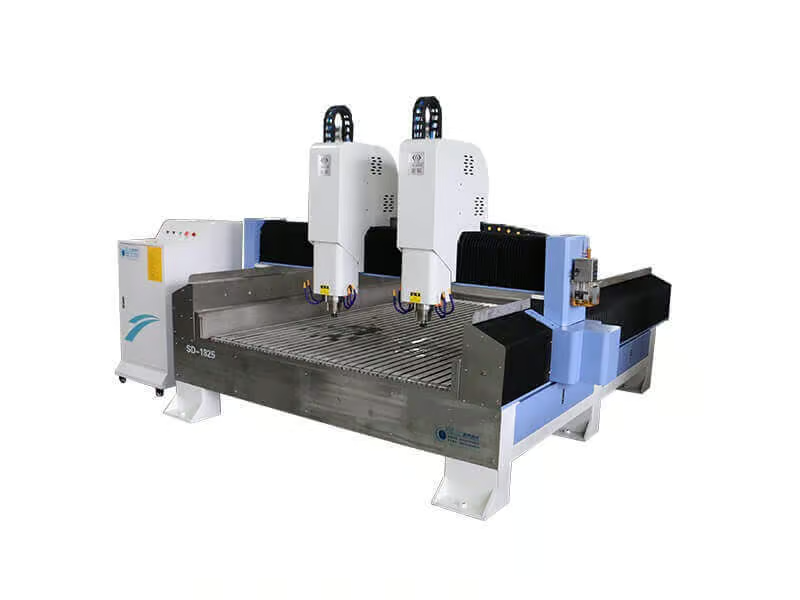 Stone Engraving Machines
 Thin Stone Veneer Saw Machine
 Horizontal Stone Slab Splitting Machine
 Stone Edge Polishing Profiling Machine
 Stone Auxiliary Equipment
In high-volume stone fabrication, gloss is not “pressed” onto the slab; it is meticulously revealed through a scientific stone polishing abrasive sequence. According to MOSCUT’s Q1 2026 global abrasive audit, up to 40% of resin-bond polishing pads are consumed prematurely due to incorrect sequence positioning and “grit skipping.”
Last year, we consulted for a major processing plant in Verona, Italy, specializing in dense quartzite. Their operators were jumping directly from a 120-grit metal diamond to a 400-grit resin pad to save time. The result was disastrous: the expensive resin pads were shredded within 72 hours, and the slabs retained permanent “under-layer” metal scratches that ruined the final polish. Understanding the physical limits of metal and resin bonds, and adhering to international standards such as those set by FEPA (Federation of European Producers of Abrasives), is the first step in stopping the drain on your factory’s profit margins.
The Physics of Polishing: Metal vs. Resin
Choosing between metal and resin isn’t about quality—it’s about their mechanical role in the grit progression.

Metal Bond Diamonds (The Bulldozer)
Metal bond abrasives utilize a sintered metal matrix to hold coarse diamond particles. Their primary mission is “leveling” and “stock removal.” They act like a bulldozer, grinding down the deep saw marks and peaks left by the multi-wire saw. While they create a flat surface, they also leave distinct mechanical grooves that must be removed by the next sequence.

Resin Bond Diamonds (The Polishing Cloth)
Resin bond abrasives suspend diamond particles in a polymer matrix. Their role is not to change the flatness of the stone, but to “buff” out the scratches left by the metal bond heads. They close the capillaries of the stone, gradually increasing the light reflection until a mirror-like finish is achieved.
The “Transition Point”: Where Most Factories Lose Money
The “Transition Point” is where you shift from metal bond to resin bond. If the stone surface is still too rough, the resin will be torn apart by the peaks of the metal scratches—a phenomenon known as “shredding.” To avoid this, you must use a bridge grit (typically a fine metal bond 200 or 400 grit) to smooth the path for the resin pads. This optimization can extend the life of your resin consumables by up to 50%.
The Blueprint: The Perfect 20-Head Sequence for Granite
Based on thousands of hours of production testing, here is the industry-standard sequence for a high-output 20-head polishing line.
| Spindle Phase | Head Numbers | Bond Type | Grit Range | Primary Function |
|---|---|---|---|---|
| Calibration | Heads 1 – 4 | 16, 24, 36, 46 | Aggressive stock removal and leveling | |
| Honing | Heads 5 – 8 | 60, 80, 120, 220 | Erasing saw marks; smoothing the surface | |
| Polishing | Heads 9 – 16 | RESIN | 400, 600, 800, 1200, 1500 | Closing stone pores; generating reflection |
| Buffing | Heads 17 – 20 | RESIN/FELT | 3000, 5000, Buff | Final mirror finish (95+ GU) |
Matching the Sequence to Your Machine Output
A perfect sequence is useless if your machine lacks the physical heads to accommodate the gradual grit progression. Skipping too many steps forces the operator to run the conveyor belt at a crawl to allow the abrasives to work, which kills your daily productivity.
Uncompromised Capacity for Uncompromised Gloss
Discover how the customizable MOSCUT Automatic Stone Polishing Line empowers you with up to 24 independent spindles, allowing for the most detailed abrasive sequences without slowing down your production.
View 24-Head Polishing LinesTop 10 FAQ: Abrasive Selection and Sequencing
1. Can I skip the 800-grit resin and go directly to 1200-grit?
It is not recommended. Skipping grits creates “ghost scratches”—faint marks from the previous coarse grit that the finer grit is not aggressive enough to remove. This results in a hazy, “cloudy” finish.
2. Do I still need metal bond heads when polishing soft marble?
Yes, but typically only for the first 2-3 heads. Even soft marble has saw marks that need to be leveled by metal bonds before the resin Frankfurt heads can take over.
3. Why are my resin pads “glazing over” and stopping their cut?
This usually happens when the stone is too hard or there is too much water. The resin surface becomes smooth and shiny rather than staying open. You can “dress” the pad by running it over a piece of abrasive concrete to reopen the diamond face.
4. How do I determine which specific head is failing in a 20-head line?
Inspect the water spray. If the slurry turns from dark gray (stone dust) to a lighter color, that head is not cutting effectively. Also, check the motor amperage; a drop in amps means the head is not under sufficient load.
5. Is magnesite-bond better than resin-bond for the final buffing?
Magnesite bonds are traditional and cost-effective, but resin bonds are generally more stable and less prone to “burning” the stone at high conveyor speeds.
6. How does water temperature affect the abrasive life?
Excessively hot water (above 40°C) can soften the resin matrix, causing the diamonds to fall out prematurely. Always ensure high-volume water flow to keep the contact point cool.
7. What is the role of the 5-Extra or Lux buffing head?
These are ultra-fine polishing heads often containing oxalic acid or specialized powders. They chemically react with the stone to create a high-luster, hardened “skin” on the slab.
8. Should I use more heads for dark stones vs. light stones?
Dark stones (like Absolute Black) show scratches much more easily. For these, a slower conveyor speed and a 20+ head sequence is almost mandatory to ensure zero visible swirl marks.
9. Can I mix different brands of abrasives on the same line?
You can, but be careful. Different manufacturers use different grit grading standards. Mixing them can create uneven steps in your sequence.
10. How much downtime is required to change a full set of 20 heads?
A skilled team of two operators using the MOSCUT quick-change abrasive holders can swap an entire set of 20 heads in approximately 30 to 45 minutes.