
 Stone Cutting Machines
 Stone Polishing Machines
 Bridge Saw Machines
 Stone Quarry Cutting Machines
 Stone Block Cutter Machine
 CNC Stone Wire Saw Machine
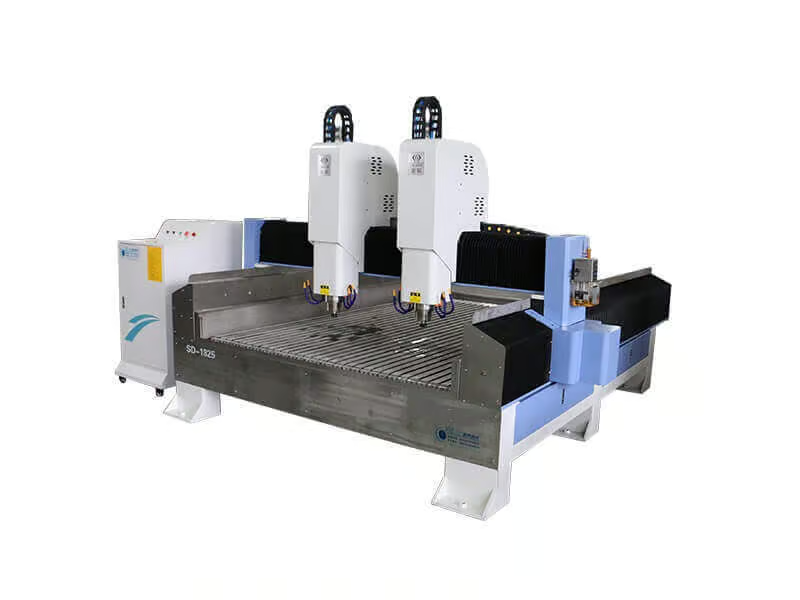 Stone Engraving Machines
 Thin Stone Veneer Saw Machine
 Horizontal Stone Slab Splitting Machine
 Stone Edge Polishing Profiling Machine
 Stone Auxiliary Equipment
In high-end stone fabrication, the value of a single jumbo slab can reach thousands of dollars. According to MOSCUT’s 2026 annual stone waste analysis, up to 12% of total material loss in global factories occurs not during cutting or polishing, but during the critical “loading phase”—the moment a slab is transitioned from vertical transport to the horizontal conveyor belt.
Last year, an exporter of premium Dolomite marble in Athens, Greece, faced devastating financial losses. Their marble featured exquisite natural veining but was notoriously fragile. Workers were using overhead cranes to tilt slabs directly onto the polishing machine’s conveyor. This “violent landing” created micro-fractures within the stone’s crystalline structure. Once those slabs entered the polishing line, the intense pneumatic pressure from the grinding heads caused the fractures to explode, shattering the marble mid-process. This not only wasted $4,000 worth of stone per slab but also caused catastrophic damage to the expensive resin polishing heads. By installing a heavy-duty hydraulic stone loading table, the factory reduced its breakage rate to absolute zero. In the world of exotic stone, a gentle transition is your ultimate profit insurance.
The High Cost of the “Crane Drop”
The Geometry of Stress
Natural stone slabs typically weigh between 500 and 800 kilograms. When a slab is suspended vertically and then forced flat by a crane, its own massive weight creates immense bending stress. Without uniform support across the entire surface during this pivot, slabs with natural fissures—common in luxury quartzite and travertine—will snap instantly at their weakest point.

How Hydraulic Tilting Tables Eliminate Stress
Engineering a “zero-gravity” descent is the only way to ensure 100% survival for fragile slabs.
85-Degree Vertical Reception
The hydraulic table first tilts to an 85-degree near-vertical position. This allows the forklift or vacuum lifter to gently rest the slab against the rubber-padded backboard. At this stage, the weight of the slab is distributed evenly across its entire height, preventing any point-load stress.
Zero-Gravity Controlled Descent
With the touch of a button, dual heavy-duty hydraulic cylinders take over. They lower the table from 85 degrees to a perfect 0-degree horizontal position at a slow, constant speed. This eliminates the “slam” of a crane drop and ensures that the stone never experiences bending stress during the transition.
Seamless Motorized Feeding
Once the table is horizontal, motorized rollers embedded in the table’s surface activate. They glide the slab forward with precision, aligning it perfectly with the polishing line’s main conveyor belt. This prevents belt scuffing and ensures the slab is perfectly centered for the machine’s scanning sensors.
Ergonomics and Human Safety
Beyond protecting the stone, automated loading is a moral and legal imperative. Attempting to manually guide a swinging 800kg marble slab is the most dangerous task in any factory. According to the European Agency for Safety and Health at Work (EU-OSHA) guidelines on heavy lifting, enterprises must implement mechanical handling solutions to eliminate high-risk manual labor. A hydraulic loading table transforms a high-risk physical confrontation into a safe, push-button operation, protecting your most valuable asset: your workforce.
Calculate the ROI: Paying for Itself in Weeks

Stop the Bleeding Profit
A single premium slab of Calacatta Marble or Exotic Quartzite can retail for $1,000 to $3,500. If your loading crew breaks just three of these slabs per month due to “barbaric” crane loading, you are losing nearly $100,000 in annual revenue. The cost of a heavy-duty hydraulic loading table is typically recovered after preventing the breakage of the first few luxury slabs. It isn’t an expense; it’s a profit guard.
Feed Your Polishing Line the Smart Way
Don’t let manual loading bottlenecks and breakage destroy your factory’s output. Automation begins at the loading bay.
Maximize your yield from the very first head.
Equip your high-volume production with the industry’s most reliable slab handling technology. Ensure your factory remains profitable, safe, and efficient.
View Automatic Polishing LinesTop 10 FAQ: Stone Slab Handling and Loading
1. What is the maximum weight capacity of a MOSCUT hydraulic loading table?
Our standard heavy-duty loading tables are engineered to handle slabs weighing up to 1,500 kilograms, comfortably supporting even the thickest 5cm granite jumbo slabs.
2. How long is the cycle time to tilt and lower one slab?
A full cycle—from receiving the slab vertically to feeding it onto the conveyor horizontally—takes approximately 45 to 60 seconds, ensuring it never bottlenecks your automatic stone polishing line.
3. Can this table be used with vacuum suction lifters?
Absolutely. The loading table acts as a safe landing platform for vacuum lifters. It provides the necessary horizontal stability that a swinging crane cannot offer.
4. What daily maintenance does the hydraulic system require?
Maintenance is minimal. You should check the hydraulic oil level monthly and grease the tilting hinge points weekly to ensure smooth, silent operation.
5. Do I need an identical table at the end of the line for unloading?
While some factories use a motorized roller table for unloading, a “Hydraulic Unloading Table” is recommended if you are storing finished slabs vertically in A-frames. It safely tilts the polished slab back to 85 degrees for crane pickup.
6. Will the table scuff the back of my polished slabs?
No. Our loading tables are outfitted with thick, non-marking industrial rubber strips that protect the stone’s surface (or back) from any metal-on-stone contact.
7. Is the motorized roller speed adjustable?
Yes. The roller feeding speed is controlled by an inverter, allowing you to sync it perfectly with the conveyor speed of your polishing machine.
8. Does the table require its own foundation?
For jumbo slabs, we recommend bolting the table to a reinforced concrete slab to prevent the machine from shifting during the high-torque tilting process.
9. What safety features are included for the operators?
The system includes an emergency stop button and hydraulic “fail-safe” valves that prevent the table from dropping if a hydraulic hose were to suddenly rupture.
10. Can the table handle irregularly shaped slabs or only rectangles?
It can handle any shape. As long as the slab’s center of gravity is supported by the table’s main frame, it will tilt and feed irregularly shaped natural stones safely.