
 Stone Cutting Machines
 Stone Polishing Machines
 Bridge Saw Machines
 Stone Quarry Cutting Machines
 Stone Block Cutter Machine
 CNC Stone Wire Saw Machine
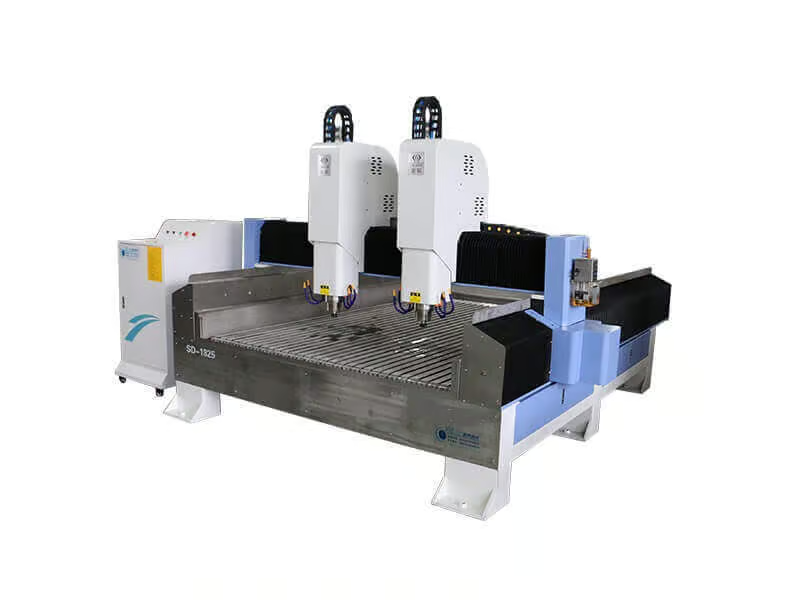 Stone Engraving Machines
 Thin Stone Veneer Saw Machine
 Horizontal Stone Slab Splitting Machine
 Stone Edge Polishing Profiling Machine
 Stone Auxiliary Equipment
In modern stone fabrication, water is just as critical as the diamond abrasives spinning on your machines. According to the Q1 2026 Global Industrial Water Cost Index, industrial water tariffs and wastewater discharge penalties have skyrocketed by an average of 35% over the past three years in major processing hubs like Italy, Brazil, and India.
Consider the harsh reality faced by a major granite exporter in Rajasthan, India, last year. Operating in an arid climate with severe municipal water rationing, their factory utilized two massive MOSCUT 24-head automatic polishing lines. Because they relied on traditional open-air concrete settling ponds, they were losing nearly 30% of their daily water volume to extreme evaporation and ground seepage. By mid-month, their strict water quota was exhausted, forcing a total factory shutdown. The solution? They installed a commercial-grade closed-loop filter press system. Practically overnight, their water recovery rate surged to an astonishing 95%. They entirely decoupled their production from local drought conditions. Today, an industrial water recycling system is not merely a tool for environmental compliance—it is the lifeline that keeps your polishing machines legally and financially operational.
The Math: The Absolute Thirst of an Automatic Polishing Line
Before you dig a concrete pit, you must understand exactly how much water your new machinery demands to survive.

440 Tons of Water Every Day
Let’s look at the MOSCUT DLM-2000-20C (a 20-head jumbo slab polishing line). To effectively cool the high-speed cast-iron spindles and flush away the thick abrasive slurry, this machine consumes approximately 28 cubic meters of water per hour (m³/h). If your factory runs two 8-hour shifts a day, a single line demands over 440 tons of water daily. Without an efficient recovery system, paying municipal rates for this volume of fresh water will instantly evaporate your slab profit margins.
The Hidden Danger of “Dirty Water” on Your Machine
Many older fabrication shops rely on a series of basic concrete settling tanks. However, the microscopic stone dust generated by high-speed polishing is incredibly buoyant and will not naturally settle to the bottom. Consequently, pumps end up circulating “dirty water” heavily laden with Total Suspended Solids (TSS) back into the machinery.
The impact of this is devastating. According to the United Nations Environment Programme (UNEP) guidelines on industrial wastewater management, high concentrations of abrasive particulates in recirculated industrial water cause catastrophic secondary wear on mechanical systems. In a stone factory, these suspended quartz particles act as a destructive abrasive paste. They rapidly clog the internal cooling channels of the polishing spindles, aggressively scour and destroy the expensive resin polishing pads, and prematurely chew through the pneumatic cylinder dust seals we discussed in our previous maintenance guide.
How a Closed-Loop Filter Press System Works
A true closed-loop system entirely eliminates the need for massive, inefficient concrete ponds through three highly engineered stages.
Coagulation & Flocculation
Wastewater from the polishing line is pumped into a towering conical silo. Here, a precise dose of environmentally safe, biodegradable polymer flocculant is injected. This chemical acts like a magnet, causing the microscopic, floating stone dust particles to rapidly clump together into heavy “flocs” that instantly sink to the bottom of the silo.
The High-Pressure Filter Press
The thickened mud at the bottom of the silo is aggressively pumped into the filter press machine. Heavy-duty hydraulic cylinders squeeze dozens of filter plates together under immense pressure. This physically forces the water out through industrial filter cloths, leaving behind completely dry, hard “mud cakes.”
Pure Water Return
The water squeezed from the mud—along with the clean water overflowing from the top of the silo—is crystal clear. It is collected in a clean water tank and continuously pumped back to the polishing line’s spindles. This achieves a >95% Zero-Liquid Discharge (ZLD) rate, protecting your machines and the environment.
Future-Proof Your Factory Against Regulations
Environmental agencies worldwide are cracking down on stone slurry dumping. A filter press is no longer an optional luxury; it is the cost of doing business in the 21st century.
Building a new facility? Don’t bottleneck your cooling supply.
An industrial polisher is only as reliable as the clean water that cools it. When configuring your production capacity, ensure you consult with our engineering team to size the perfect water recycling system for your layout.
Explore the Automatic Stone Polishing LineTop 10 FAQ: Stone Processing Water Management
1. Is the chemical flocculant expensive to use every day?
No. Flocculant is highly concentrated. Most mid-sized factories only use a few kilograms of the powder per month. The cost of the chemical is vastly cheaper than the municipal cost of buying thousands of tons of fresh water.
2. What do I do with the dry “mud cakes” produced by the filter press?
Because they are dry and solid, they are easy to transport. Depending on your local regulations, they can be safely disposed of in standard landfills, or frequently sold/donated to construction companies as clean fill dirt or raw material for brick manufacturing.
3. Can one water recycling system handle my gang saws AND my polishing line?
Yes, provided the silo volume and filter press capacity are sized correctly to handle the combined cubic meters per hour (m³/h) of both machines. However, some factories prefer separating them, as saw slurry contains metal grit, while polishing slurry contains resin.
4. Why does the recycled water in my factory smell like rotten eggs?
A foul sulfur smell is caused by anaerobic bacteria growing in stagnant water tanks. This usually happens over the weekend when the water isn’t moving. Installing a simple aeration bubbler in your clean water tank prevents bacteria from growing and eliminates the smell.
5. How much physical space does a silo and filter press require?
Modern vertical silos take up very little floor space (often less than 4×4 meters), utilizing vertical height (up to 10 meters) for gravity settling. The filter press itself requires an additional 3×2 meters depending on the plate count.
6. How often do the filter press cloths need to be cleaned or replaced?
Filter cloths should be power-washed regularly to prevent blinding (clogging). Depending on the abrasive nature of your stone (granite vs. marble), heavy-duty cloths typically last 6 to 12 months before requiring replacement.
7. What happens if the system freezes during the winter?
Ice will rupture the PVC plumbing and damage the water pumps. In freezing climates, the silo and pipes must be insulated, and factories often install submerged tank heaters to keep the water above freezing during overnight downtime.
8. Does using recycled water affect the color of white marble slabs?
If the water is poorly filtered, yes. Suspended dark granite dust can embed into the pores of light marble during polishing, dulling its appearance. A properly functioning filter press ensures the water is clear enough to polish pure white Thassos marble safely.
9. Does a filter press consume a lot of electricity?
Surprisingly, no. The primary power draw is the hydraulic pump, which only runs for a few minutes to clamp the plates shut and push the mud inside. The rest of the “squeezing” time relies on static hydraulic pressure, consuming very little energy.
10. What is the typical ROI (Return on Investment) for a closed-loop system?
When factoring in the massive savings on water bills, the elimination of municipal sludge disposal fines, and the significantly extended lifespan of your polishing abrasives, most commercial filter press systems pay for themselves within 8 to 14 months.