
 Stone Cutting Machines
 Stone Polishing Machines
 Bridge Saw Machines
 Stone Quarry Cutting Machines
 Stone Block Cutter Machine
 CNC Stone Wire Saw Machine
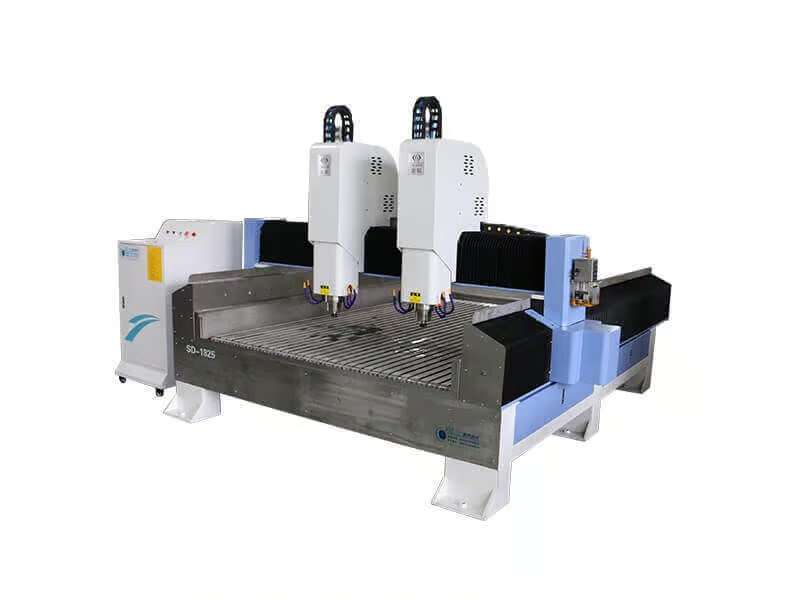 Stone Engraving Machines
 Thin Stone Veneer Saw Machine
 Horizontal Stone Slab Splitting Machine
 Stone Edge Polishing Profiling Machine
 Stone Auxiliary Equipment
The global manufacturing sector is currently navigating a period of significant structural change, driven by unprecedented wage inflation and a shrinking specialized labor pool. According to 2026 data released by the International Labour Organization (ILO), average industrial wages have surged by 18% over the past two years, making labor-intensive processes a primary threat to factory profitability. For stone fabricators, this trend has shifted the “Manual vs. Machine” debate from a matter of preference to a critical survival strategy. As companies analyze their Q1 2026 balance sheets, the transition toward semi-automated bridge structures has emerged as the most efficient way to maintain competitive pricing without sacrificing surface quality.
In Sydney, Australia, a mid-sized stone fabrication plant faced a typical industrial bottleneck: they had successfully secured several large commercial flooring contracts, but their output was limited by the slow, exhausting pace of manual hand polishing. The rising cost of overtime and a high rate of surface rejections were eating their margins alive. After performing a thorough financial audit, they decided to integrate a MosCut 3-head bridge polishing machine into their production line. Within months, the transformation was staggering. The plant managed to reduce its dedicated polishing labor force by two-thirds, reallocating those workers to installation teams, while doubling their total daily slab output. Most impressively, the facility achieved a full return on investment (ROI) in just five months, purely through labor savings and reduced material waste.
Quick Navigation
The Hidden Costs of Manual Stone Polishing
While the initial purchase price of a hand polisher is low, the cumulative hidden costs of manual labor act as a silent tax on every square meter of stone produced in your facility.
Operator Fatigue and Inconsistent Gloss Levels
Manual polishing is an incredibly grueling physical task. As an operator tires throughout an 8-hour shift, the downward pressure applied to the stone inevitably becomes inconsistent. This leads to visible “water ripples” and varying gloss levels across a single slab, often resulting in expensive re-work or client rejections.
The High Turnover Rate in Heavy Physical Labor
Finding and retaining skilled manual polishers is becoming nearly impossible in the modern economy. The physical strain leads to high employee turnover and frequent injury claims, both of which incur massive recruitment and training costs that are often overlooked in standard ROI calculations.
Calculating the Direct Labor Savings
The most immediate impact of upgrading to a bridge polishing machine is the radical optimization of your payroll efficiency and workforce allocation.
The 3-to-1 Operator Ratio
A single automated bridge polishing machine can typically perform the work of three skilled manual operators. Because the machine handles the rhythmic, heavy movement across the X and Y axes, one operator can easily manage multiple machines simultaneously, or spend their time preparing the next slab for processing.

Reallocating Staff to Higher-Value Tasks
By automating the repetitive grinding phases, you can move your most experienced staff away from the “dirty work” and into quality control, CNC operation, or on-site installation. This rebalancing allows your factory to generate more revenue without increasing your total headcount.
Increased Output and Revenue Generation
Speed is more than just a metric; it is the capacity to take on larger, high-value commercial projects that were previously out of reach for a manual shop.
Square Meters Per Hour: A Direct Comparison
A manual polisher might struggle to finish 15 square meters of dense granite in a shift. In contrast, a multi-head bridge polishing machine can consistently output 60 to 100 square meters in the same timeframe. This 4x to 6x increase in capacity allows you to clear backlogs and shorten lead times for demanding clients.
Eliminating the Production Bottleneck
Many factories find that their bridge saws cut slabs faster than their polishing team can finish them. This creates a “bottleneck” where semi-finished slabs pile up, tying up capital in inventory. A bridge polishing machine aligns your finishing speed with your cutting speed, ensuring a smooth, profitable flow of goods.
Abrasive Cost Reduction and Quality Control
Automation removes the human element from abrasive management, ensuring that every diamond pad is used to its maximum potential without being wasted or destroyed.
Controlled Pneumatic Pressure vs. Human Error
Bridge machines utilize precise pneumatic cylinders to apply constant, even pressure. Humans, by contrast, tend to lean too hard or too light. Excessive pressure destroys resin-bond pads prematurely, while insufficient pressure glazes the diamonds. Machines eliminate these errors, reducing your monthly abrasive spend by up to 25%.
Maximizing the Lifespan of Diamond Tools
Because the bridge movement is perfectly linear and the RPM is constant, the abrasive wear is perfectly uniform. This prevents “rounding” of the tool edges, allowing you to use every millimeter of the diamond segment before a replacement is required.
Head-to-Head Comparison: Manual vs. Bridge Polishing
To truly understand the value of a factory upgrade, we must analyze the operational metrics side-by-side. The data reveals exactly why semi-automated systems have become the definitive standard for growing fabrication plants.
| Operational Dimension | Manual Polishing Machine | MosCut Bridge Polishing Machine |
|---|---|---|
| Initial Equipment Cost | Very Low | Medium (High Cost-Performance) |
| Daily Production Output | 15 – 20 m² (Depends heavily on stamina) | 60 – 100+ m² (Consistent output) |
| Labor Costs & Dependency | High (Requires constant heavy physical labor) | Very Low (One operator manages multiple machines) |
| Surface Quality & Gloss | Inconsistent (Prone to human error and water ripples) | Flawless 95+ GU (Zero-vibration, consistent pneumatic pressure) |
| Abrasive Tooling Cost | High (Uneven pressure wears pads quickly) | Low (Perfect alignment maximizes diamond lifespan) |
| Large Slab Capability | Very difficult and exhausting for 3x2m slabs | Excellent (Designed specifically for oversized slabs) |
| Operator Skill Required | High (Relies on physical feel and experience) | Low (Smart PLC touch-screen handles the logic) |
| ROI Payback Period | Slow (Due to extreme limits on output volume) | Extremely Fast (Typically 5 to 8 months) |
When analyzing these multi-dimensional metrics, the strategic path forward is undeniable. While hand-operated tools have their place in localized repair work, they are mathematically incapable of sustaining the volume required by modern commercial contracts. Because it perfectly balances affordable capital investment with industrial-grade automated output, the bridge polisher stands as the premier, undisputed choice for mid-sized stone enterprises looking to aggressively scale their market share.
Upgrade Your Factory’s Profitability Today
Investing in automation is no longer a luxury; it is the fundamental foundation for any stone fabrication business looking to scale in 2026 and beyond.
Boost Your Output with the MosCut Bridge Polishing Machine
Eliminate labor bottlenecks and achieve a perfect mirror finish every time. Our heavy-duty bridge polishers offer a 5-month average ROI and industrial-grade reliability for any workshop size.
View Machine Pricing & SpecsTop 10 FAQ: Polishing Machine ROI
We have gathered the most common financial and operational questions from plant directors considering the switch from manual to bridge polishing.
1. How long does the average ROI take?
Based on our global 2025/2026 client data, factories running a single 8-hour shift typically see full ROI within 5 to 8 months through labor and abrasive savings.
2. Does the machine use more electricity than manual tools?
While the main motor is larger (11kw-15kw), the machine finishes slabs 4x faster. The electricity cost-per-square-meter is actually lower than manual polishing.
3. Is specialized training required for my current staff?
No. Most manual operators can learn to operate our PLC touch-screen interface within 2 to 3 days of on-site training.
4. Can a bridge machine handle exotic, fragile stones?
Yes. By adjusting the pneumatic pressure on the PLC, you can achieve a gentler touch for fragile marble than a manual operator ever could.
5. What are the typical monthly maintenance costs?
Excluding abrasives, maintenance is minimal. Regular lubrication and air filter cleaning cost less than $50 USD per month.
6. How does the machine affect my material rejection rate?
Automation typically reduces slab rejection rates by over 90% because it eliminates human inconsistencies and “ripple” marks.
7. Do I need a concrete foundation for installation?
Standard models can be installed on a 15cm reinforced concrete floor. For multi-head heavy models, we provide foundation drawings for cement worktables.
8. Can it polish 3-meter large slabs?
Absolutely. Our bridge polishers are specifically designed for 3200x2000mm slabs, which are very difficult to polish manually.
9. What is the lifespan of a MosCut bridge polishing machine?
With basic maintenance, the heavy-duty cast iron structure is designed to last 15-20 years in a high-production environment.
10. Is the machine compliant with international safety standards?
Yes. All our machines are built to CE and ISO 9001 standards, featuring emergency stops and water splash protection for operator safety.