
 Stone Cutting Machines
 Stone Polishing Machines
 Bridge Saw Machines
 Stone Quarry Cutting Machines
 Stone Block Cutter Machine
 CNC Stone Wire Saw Machine
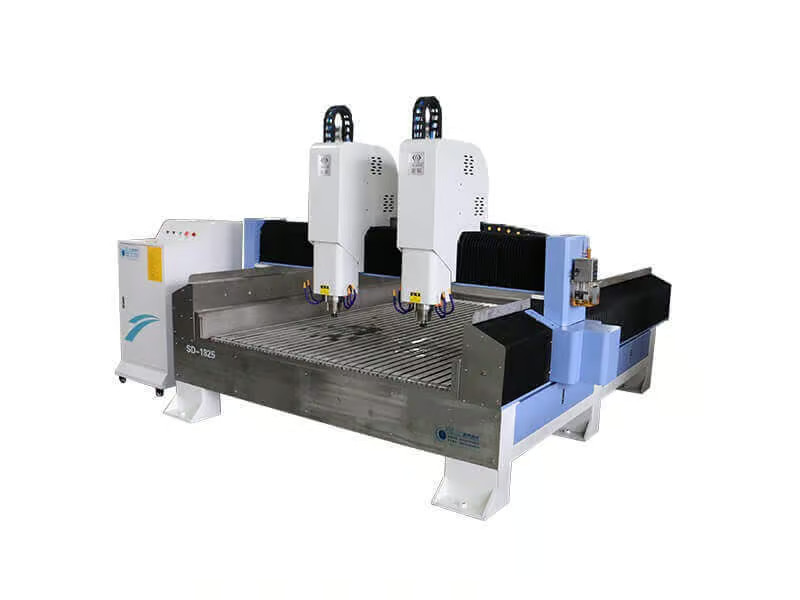 Stone Engraving Machines
 Thin Stone Veneer Saw Machine
 Horizontal Stone Slab Splitting Machine
 Stone Edge Polishing Profiling Machine
 Stone Auxiliary Equipment
In the realm of heavy industrial extraction, raw power without intelligent control is a recipe for catastrophic equipment failure. According to safety and motor protection standards established by the International Electrotechnical Commission (IEC), utilizing intelligent Variable Frequency Drives (AC Drives) in high-torque applications is mandatory to prevent mechanical overload, protect critical components, and ensure operator safety. In diamond wire sawing, the VFD is not a luxury; it is the definitive barrier between a profitable cut and a severed wire.
A prominent granite quarry operator in Rajasthan, India, provides a stark example. Relying on outdated wire saws equipped with manual tensioning winches, they were unable to react quickly to the extreme density variations of their stone. Consequently, they suffered an average of five snapped wires per month, incurring nearly $5,000 in consumable losses and severe downtime. After upgrading to MosCut machines featuring our proprietary Dual-VFD tensioning system, the machine began autonomously adjusting pullback speed based on real-time resistance. Wire snapping was completely eliminated, and overall consumable lifespan increased by an unprecedented 40%.
The Physics of Wire Snapping: Why Manual Tension Fails
Understanding the failure points of traditional extraction methods is the first step toward implementing intelligent electrical solutions.Mountain deposits are rarely uniform. As a diamond wire cuts deep into a granite face, it often encounters hidden veins of ultra-hard quartz or experiences sudden shifts in internal rock pressure. When using a traditional manual winch to pull the machine backward, the operator sets a fixed pullback speed.
When the wire hits a hard vein, the cutting resistance spikes instantaneously. Human reaction time is simply too slow to stop the manual winch from continuing to pull backwards. Within milliseconds, the tension on the wire exceeds its breaking strength (often over 2,000 kg of sheer force), snapping the steel core and turning the high-speed diamond beads into dangerous projectiles.

Sensory Nervous System: How a VFD ‘Reads’ the Mountain
A VFD does not just provide power; it acts as the sensory nervous system of the wire saw, feeling the resistance of the rock in real-time.A Variable Frequency Drive (VFD) controls the speed and torque of an AC motor by varying the input frequency and voltage. But its true magic in a quarry environment lies in its diagnostic capabilities.
The VFD continuously monitors the Ampere Draw (current load) of the main cutting motor hundreds of times per second. If the wire is cutting through soft stone, the motor spins easily, and the amp draw remains low and stable. The exact millisecond the wire hits a hard quartz pocket, the motor struggles, and the amp draw spikes dramatically. The VFD ‘feels’ this resistance before a human operator even hears a change in the machine’s pitch.

The MosCut Dual-Inverter Advantage: Closed-Loop Constant Tension
True automation requires communication. Our dual-inverter PLC architecture ensures the main cutting motor and the track movement motor work in perfect synchronization.MosCut machines do not rely on a single drive. We utilize a highly sophisticated Dual-Inverter PLC System to achieve true ‘Constant Tension’.
The Communication Loop: The Main VFD controls the large flywheel (wire speed). The Walking VFD controls the small motor that pulls the machine backward on its rails. When the Main VFD detects an amp spike (indicating a snag or extreme hardness), it instantly sends a signal through the PLC to the Walking VFD. The Walking VFD immediately stops pulling backwards, or even inches forward, instantly releasing the tension on the wire. Once the amp draw normalizes, the machine automatically resumes its backward travel. This closed-loop system entirely prevents wire snapping.

Calibrating VFD Parameters: Granite vs. Marble
Hardware is only as good as its software configuration. Tailoring your VFD parameters to your specific stone hardness maximizes both speed and wire longevity.Setting the correct baseline parameters on your VFD is crucial. A machine cutting soft travertine requires an entirely different tension profile than one extracting Class-1 black granite.
- For Granite Extraction: You must configure a highly sensitive traction limit. Because granite is highly abrasive, you want a high linear wire speed (24-26 m/s) but a very gentle pullback force. Pulling too hard will ‘glaze’ the diamond beads, rendering them useless.
- For Marble Extraction: Marble is softer and cuts freely. You can safely increase the linear speed (30-33 m/s) and allow the VFD a higher baseline traction limit. The machine can pull back more aggressively, maximizing your daily square-meter output without risking a wire snap.

Stop Losing Money to Snapped Wires
Upgrade your quarry with intelligent extraction technology. Discover the MosCut Quarry Wire Saw Machine equipped with our state-of-the-art Dual-VFD tensioning system.
View the VFD Quarry Wire Saw